MBA Admissions Interview AI: What Actually Helps in 2026
MBA admissions interview AI guide: how live alumni interviews differ from Kira Talent async video, what schools score, and where AI prep honestly helps.

TL;DR: MBA admissions interview AI prep works differently depending on the format. Live alumni or admissions-officer interviews reward the same mock-practice approach as any behavioral interview — a real-time AI copilot can help you rehearse pacing and structure. Kira Talent-style async video interviews are single-take, time-boxed, and make scripted answers stand out, so AI belongs in your prep beforehand, not during the recording. Either way, schools are scoring the same three things: leadership evidence, a coherent why-MBA/why-this-school narrative, and self-awareness.
Two emails land in your inbox the same week. One is from an alumni interviewer asking to schedule a video call for Thursday. The other is a Kira Talent link with a 48-hour countdown attached. Both say "interview." They are not the same event, and prepping for one like it's the other is the single most common mistake candidates make this cycle.
Business school admissions offices have quietly split into two interview formats, and almost no advice online treats them as genuinely different products. This guide does.
Two Very Different MBA Interviews
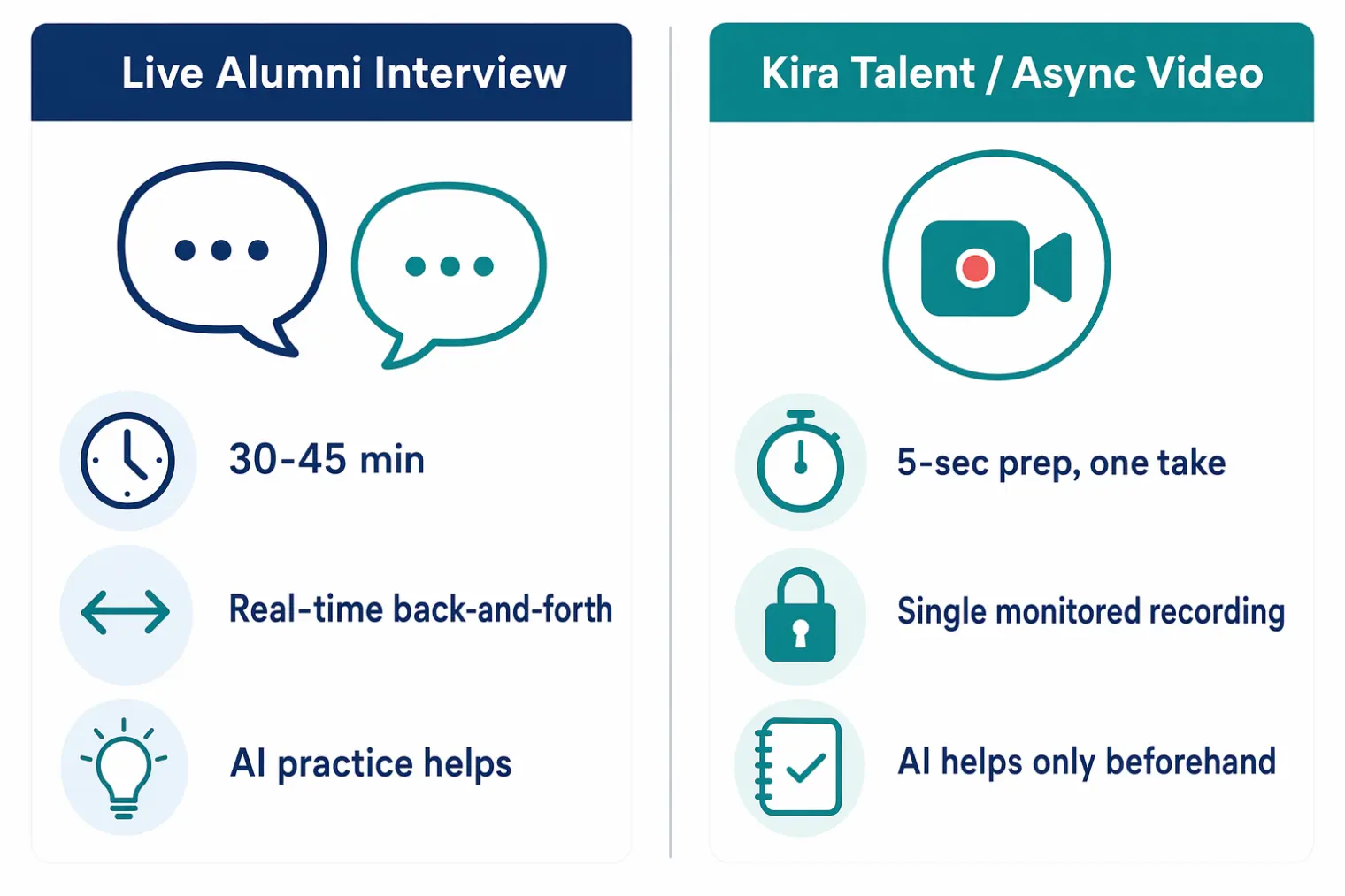
The live interview — with an alumni volunteer, a current student, or an admissions officer — is a real-time conversation, usually 30–45 minutes, video or in person. The interviewer has already read your file. They're not testing whether you can recite your resume; they're testing whether the person on the file matches the person in the room.
The async video interview — run through platforms like Kira Talent, used by INSEAD, Oxford Saïd, Yale SOM, Kellogg, and Cambridge Judge among others — is a different mechanism entirely. You get a link after your application deadline, a fixed window to complete it (INSEAD gives 48 hours; some US programs give up to a week), and per-question prep time as short as 5 seconds before the camera starts recording. One take. No pause, no redo, no live human reacting to what you just said.
Schools use the async format to compare how you communicate under time pressure with the polished written application. Because the response window is short and there is no live interviewer to clarify or redirect you, memorized scripts tend to sound obvious. That changes what "preparing well" means, and it's the part most MBA-interview content skips entirely in favor of generic question lists.
What Schools Are Actually Scoring
Strip away the format differences and both interview types are evaluating the same three things, which GMAC's own admissions guidance confirms is the intent behind the standard question set:
- Leadership evidence. Not a title — a specific moment where you made a call, took ownership, or moved a group forward. "I was on a team that..." doesn't land the same way "I decided to..." does.
- A coherent why-MBA / why-this-school narrative. Admissions committees can tell the difference between "an MBA would help my career" (generic, forgettable) and a specific gap this program's specific resources close for your specific next role.
- Self-awareness. Failure and weakness questions aren't there to catch you out — they're checking whether you can talk about a real gap without either downplaying it or turning it into a humble-brag.
The Closing Question That Sinks More Candidates Than Any Behavioral Prompt
"Do you have any questions for us?" shows up at the end of nearly every live MBA interview, and recruiter-facing guidance from firms like Michael Page consistently flags it as a moment candidates underprepare for — treating it as a formality instead of a genuine chance to demonstrate you've done your homework.
A generic "what's the culture like?" wastes the moment. A specific question tied to the program — a course, a club, a recent curriculum change, something the interviewer would actually know from experience — does two things at once: it signals real research, and it gives the interviewer something enjoyable to answer, which people remember.
Where AI Honestly Helps — and Where It Doesn't
Admissions consulting itself has already gone AI-native: Clear Admit launched a GPT-powered mock-interview simulator in early 2026 that takes your resume and target school, runs a spoken mock session, asks follow-up questions, and scores your answers against what that school's interviewers typically look for. That's a rehearsal tool, and a good one — but it's built for practice, not for the moment of the real interview.
That distinction matters because it maps cleanly onto the two formats above:
- For a live alumni or admissions-officer interview, a real-time AI copilot like AceRound can genuinely help the same way any mock-interview partner would — giving you something to structure your answer against in the moment, the way our guide to answering AI interview questions covers for job interviews generally. It won't invent your leadership story for you, and it won't help if you haven't done the story-bank work below.
- For Kira Talent, real-time assistance doesn't really fit the format the way it might for a live call — see our breakdown of how one-way, async video interviews actually work more broadly. It's a single take on the school's own timed recording, with prep windows measured in seconds rather than minutes. The honest use of AI here is entirely beforehand: rehearsing your answers to timed prompts until the structure is automatic, not leaning on a tool mid-recording.
Nobody else selling "AI for MBA interviews" draws this line clearly, and it's the difference between a tool that helps you prepare and a tool that oversells what it can do inside a recorded, single-take format.
A Practice Framework That Covers Both Formats
- Build a four-story bank. One leadership story, one failure, one conflict, one instance of contributing without formal authority — each with a specific number or outcome attached, not a theme. "Cut onboarding time by 30% by redesigning the handoff process" survives a follow-up question. "I'm good at process improvement" doesn't.
- Write a two-sentence why-MBA and a two-sentence why-this-school answer, per school. Generic versions get spotted instantly by interviewers who do this every cycle. Name a specific course, professor, club, or resource this program offers that a competing program doesn't.
- Time-box your practice to match your actual format. If you're prepping for Kira, rehearse against a countdown timer with near-zero prep time — the discomfort of the format is part of what you're training for. If you're prepping for a live call, run a full mock conversation, not just isolated answers.
- Prepare two or three specific questions to ask, tied to something concrete about the program, and save them for the close.
- Run at least two mock rounds before the real interview — one focused on your story bank holding up under a follow-up, one focused on pacing under the format's actual time constraints.
Common Mistakes That Sink Strong Candidates
- Treating "why this school" as optional. It's usually weighted as heavily as your leadership story, and a generic answer here undoes an otherwise strong interview.
- Over-rehearsing for Kira Talent. A visibly scripted answer stands out immediately in this format — aim for prepared, not memorized.
- Skipping the closing question. Walking in without at least two specific questions ready reads as under-researched, even if everything before it went well.
- Confusing "AI helped me practice" with "AI answered for me." The first builds real interview skill. The second falls apart the moment a follow-up question asks for a detail you can't produce yourself.
Frequently Asked Questions
How nervous should I be for an MBA interview?
Some nerves are normal and even useful — interviewers expect a candidate who cares about the outcome. What actually hurts you isn't nervousness itself, it's under-preparation: not having your leadership, failure, and why-MBA stories ready cold. Fix the prep gap and the nerves become manageable.
How do I prepare for my first MBA interview?
Build a story bank first — one leadership example, one failure, one conflict, one team-contribution story, each with a specific number or outcome attached. Then research the interview format (live alumni call, admissions-officer interview, or Kira Talent async video) since the prep is different for each. Run at least two full mock rounds before the real thing.
What is Kira Talent and how do I answer its questions?
Kira Talent is an asynchronous video interview platform several top MBA programs use post-application. You get a fixed window (often 48 hours to 7 days) to record answers to a set of prompts, usually with very short prep time (as little as 5 seconds) and a single take — no retakes, no live back-and-forth. Answer directly, keep it under the time limit, and don't try to sound scripted; graders are specifically looking for unrehearsed responses.
Will AI help me pass an MBA interview?
It depends which interview. For a live alumni or admissions-officer interview, practicing with a real-time AI copilot can help you think faster and structure answers under pressure — the same way any mock interview partner would, just available on demand. For a Kira Talent-style recorded submission, real-time AI assistance doesn't really apply: it's a single take on the school's own timed recording flow, so the honest use case is rehearsing beforehand, not getting help during the recording.
Is it cheating to use AI to prepare for an MBA interview?
Preparing with AI — running mock interviews, drilling your story bank, getting feedback on structure — is no different from working with an admissions coach or a friend who asks you tough questions. It becomes a problem only if you're generating live answers about experience you don't actually have, or using it during a school-controlled single-take recording where the school evaluates unscripted responses. Practice honestly, and the tool is no different from a rehearsal partner.
Do business schools ask different questions than a typical job interview?
The format overlaps — you'll still get behavioral questions like a specific leadership or conflict story — but MBA interviews weight three things job interviews usually don't: your specific reason for pursuing an MBA now, why this particular school over its close competitors, and a coherent post-MBA career narrative that the admissions committee can picture actually happening.
Author · Alex Chen. Career consultant and former tech recruiter. Spent 5 years on the hiring side before switching to help candidates instead. Writes about real interview dynamics, not textbook advice.
Related Articles
OpenAI's AI Interview Policy: Banned, Required, or Team-Dependent
OpenAI sells AI coding agents, then bans most candidates from using one. Here's the round-by-round policy, including the new agentic round that flips it.
Does Harver Detect Cheating? What Its Proctoring Actually Checks
Does Harver detect cheating on its pre-employment assessments? A candidate look at Harver's Proctoring add-on, what gets logged after a flag, and what happens next.

Micro1's Zara AI Interview: What It Actually Tests (And Why Timing Gets Flagged)
Micro1's AI interviewer Zara has run 300,000+ interviews for remote roles. Here's why it flags response latency as a cheating signal, and what that means for AI prep.