Difficult Customer Interview Answer Guide
How to answer 'how do you deal with a difficult customer' using STAR, with 5 worked example answers across retail, call center, healthcare, and more.

TL;DR: For the difficult customer interview question, pick one specific incident, use STAR (Situation, Task, Action, Result), and show what you did — not how the customer made you feel. Interviewers already assume you've dealt with someone difficult; they're scoring whether you stayed professional, solved the actual problem, and didn't just survive the interaction.
During the 2020–2022 period, researchers tracking call-center volume found that calls flagged as "difficult" or "escalated" more than doubled compared to pre-pandemic baselines, according to Harvard Business Review. Stress makes people worse customers, and hiring managers know it. That's exactly why almost every customer-facing role — and a surprising number of non-customer-facing ones — asks some version of "tell me about a time you dealt with a difficult customer."
Most candidates answer this the same three weak ways: they claim they "always stay calm and it works out" (too vague to evaluate), they turn it into a complaint about an unreasonable customer (bad look), or they freeze mid-story because they can't recall a clean example fast enough under pressure.
This guide gives you a framework, five fully worked example answers across different industries, and the mistakes that get this answer marked down.
Why Interviewers Ask This Question
Every version of this question — "tell me about an angry customer," "how do you handle a difficult customer," "give me an example of resolving a customer issue" — is testing the same three things:
Composure under pressure: Can you stay professional when someone is upset with you personally, even if the situation isn't your fault?
Problem-solving inside constraints: Did you actually fix something, or did you just de-escalate the emotion and hope it went away?
Judgment about escalation: Do you know when to hold a policy line, when to bend it, and when to loop in a manager — or do you either cave immediately or dig in regardless of the cost?
Interviewers are not looking for a customer you "won." Some of the best answers involve outcomes where the customer left unhappy but the situation was handled correctly and professionally.
The STAR Framework for This Question
The STAR method (Situation, Task, Action, Result) is the right skeleton, but for a difficult-customer story it needs one addition: naming the constraint you were working inside.
- Situation (1 sentence): Who was the customer, and what set them off?
- Constraint (1 sentence): What couldn't you do — refund policy, inventory, authority level, time pressure?
- Action (2–3 sentences): What you specifically said and did, in order.
- Result (1–2 sentences): The actual outcome, ideally with a number or a concrete change.
Without the constraint sentence, your story sounds like you just apologized until the person calmed down. With it, the interviewer sees you solving a problem that had real limits — which is what the job actually involves.
Target length: 60–90 seconds spoken. Longer than that and you're narrating, not answering.
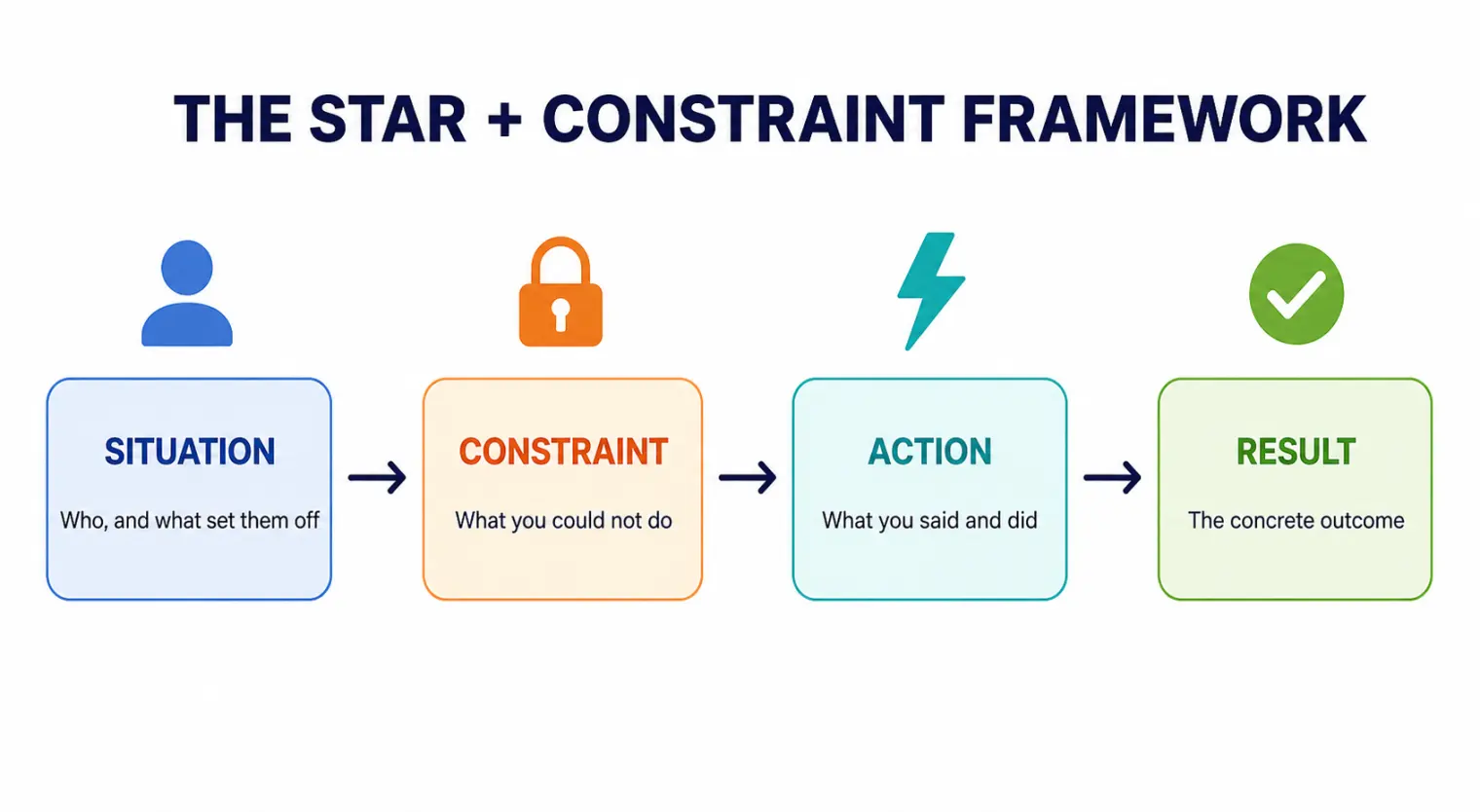
The hardest part isn't knowing the framework — it's recalling a clean example under pressure, live. AceRound AI listens during your actual interview and quietly structures a Situation → Constraint → Action → Result outline the moment a question like this lands, so you're never stuck staring at the ceiling trying to remember which story to use. It's a safety net for the freeze moment, not a script to read off.
5 Worked Example Answers by Industry
Generic advice tells you to "use STAR and stay calm." That's true but useless when you're trying to write your own answer from scratch. Here are five industry-specific examples you can adapt.
1. Retail
Constraint: No manager override authority, strict return policy, other customers waiting.
Sample answer: "A customer wanted to return a dress worn once, past our 30-day window, without a receipt. She was raising her voice and other shoppers were watching. I couldn't override the policy myself, but I could offer store credit at the current price instead of a refund — that was within my authority. I explained the option calmly, without repeating 'policy' more than once, and framed it as the best thing I could actually do for her. She took the store credit. My manager later used that exact offer as the standard response for that scenario."
2. Call Center / Phone Support
Constraint: No visibility into the root cause yet, customer already escalated twice before reaching you.
Sample answer: "A customer called in furious because their internet had been down for the third time that month and two previous reps had closed the ticket without a fix. I didn't defend the previous reps or make promises about the root cause. I said: 'I can see this has happened three times — that's not okay, and I'm going to stay on this call until we know what's actually wrong.' I ran diagnostics live with them on the phone, found a faulty modem lease, and processed a replacement with expedited shipping and a service credit. Call resolution rate on repeat-issue tickets for my queue improved after I started using that same 'I'm staying on this until we know' opening."
3. Healthcare (Patient-Facing)
Constraint: Clinical information you legally couldn't share, family member demanding answers on someone else's behalf.
Sample answer: "A patient's adult son called demanding test results over the phone, upset that no one had called him back. I couldn't share protected health information without consent on file, and saying that directly made him angrier. I acknowledged the wait was unacceptable regardless of the privacy issue, confirmed what I could do — flag the case as urgent for callback and check whether consent paperwork was on file — and called him back within the hour once I'd confirmed it was. He was still frustrated about the delay, but he wasn't angry at me by the end of the call, and we changed our callback SLA for flagged-urgent cases afterward."
4. Hospitality
Constraint: Fully booked property, customer wants something structurally unavailable (room type, late checkout, refund on a non-refundable rate).
Sample answer: "A guest arrived expecting a suite upgrade a booking site had promised but that we had no record of and no availability for. I didn't argue about whose error it was. I confirmed what we did have — a comparable room on a higher floor — and offered a complimentary breakfast and late checkout to close the gap in value. He accepted, and left a review afterward that specifically mentioned the recovery, not the original mistake."
5. Tech Support / SaaS
Constraint: A real product bug, not user error, with no fix ETA yet, customer threatening to churn.
Sample answer: "An enterprise customer reported a data-export bug right before their board reporting deadline and said they'd cancel if it wasn't fixed by end of day. I confirmed it was a real bug — not user error — within 20 minutes, which mattered because it meant I could be direct about scope instead of guessing. I couldn't promise a same-day fix since it needed an engineering ticket, so I gave them a manual export workaround for the immediate deadline and set a specific follow-up time for the actual fix status, instead of a vague 'we're looking into it.' They kept the workaround until the fix shipped four days later and renewed that quarter."
The Four Customer Archetypes Interviewers Expect You to Recognize
Most difficult-customer situations fall into one of four patterns. Naming the pattern in your head before you answer helps you pick the right story:
The Angry/Emotional Customer: Something genuinely went wrong and they're venting. Your job is to acknowledge the emotion without escalating it, then move to action.
The Unrealistic-Expectations Customer: They want something outside policy or physically impossible. Your job is to hold the line without making it personal, and offer the closest real alternative.
The Technical/Complex Customer: The issue itself is hard, not the person. Your job is patience and structured diagnosis, not just soft skills.
The Silent/Withholding Customer: They're clearly unhappy but won't say why. Your job is to draw out the actual problem before you can solve anything.
If your example doesn't clearly fit one of these, the interviewer may have trouble following your story — pick an example where the pattern is obvious in the first sentence.
Customer mistreatment is also a recognized occupational stressor, not just an annoyance — a peer-reviewed study on work-family stress found it spills over into employees' home lives when left unmanaged, which is part of why employers weight this question so heavily. If the role you're interviewing for is customer-facing full time, it's worth pairing this prep with a customer service interview guide that covers the rest of the role-specific question set.
Mistakes That Get This Answer Marked Down
Making the customer the villain: "They were being completely unreasonable" without acknowledging any legitimate frustration reads as low empathy, even when the customer really was being unreasonable.
No constraint, no tension: If your story is just "I apologized and they calmed down," there's nothing for the interviewer to evaluate. Add what you couldn't do and how you worked around it.
Vague resolution: "It worked out fine" tells the interviewer nothing. Use a number, a specific outcome, or a policy change that resulted from it.
Claiming you've never had a difficult customer: Every hiring manager in a customer-facing role has heard this and doesn't believe it. It signals either dishonesty or zero real experience.
Over-apologizing in the retelling: If you're still narrating the story with visible discomfort or over-explaining why you weren't at fault, it can read as unresolved rather than handled.
Frequently Asked Questions
When asked at a job interview how I would deal with a difficult customer, what is the best answer to give?
Pick one real, specific incident — not a hypothetical — and walk through what you actually did using Situation, Constraint, Action, Result. Specificity beats philosophy; "I stay calm and listen" is a value statement, not an answer.
How do you answer "tell me about a time when you had to deal with a difficult customer" if you're entry-level with no customer service jobs?
Use a parallel example: a classmate, roommate, or volunteer situation where someone was upset with you and you had to resolve it under some kind of constraint. Frame it explicitly — "I haven't worked a customer-facing role yet, but I had a comparable situation..." — then apply the same structure.
What if the customer demanded to speak to a manager who wasn't available?
Say exactly that in your answer if it's part of the real story: what you offered as the next-best option, and whether you set a specific callback time. Interviewers want to see you handle the gap, not avoid mentioning it.
Give me an example of a time you resolved a difficult customer issue — should the outcome always be positive?
No. A resolution where the customer still left dissatisfied but the situation was handled fairly and professionally is a legitimate, sometimes stronger, answer than a suspiciously perfect one.
How long should my answer be?
60–90 seconds spoken. If you're going past two minutes, you're including detail the interviewer doesn't need — cut to the constraint, the action, and the result.
Is it okay to say I was wrong or that my company's policy was the actual problem?
Yes, and it often lands better than a story where you're blameless. "I later realized I should have flagged the delay proactively instead of waiting for them to call back" shows self-awareness without undermining the rest of the story.
Author · Alex Chen. Career consultant and former tech recruiter. Spent 5 years on the hiring side before switching to help candidates instead. Writes about real interview dynamics, not textbook advice.
Related Articles
Airbnb Software Engineer Interview: The Core Values Round, Explained
Airbnb's four core values are public, but the interview round built on them isn't documented. Here's what's official, what candidates report, and how to prepare.
Cisco and Intuit Fresher Interview Process in India: Official vs Reported
Cisco's own Code with Cisco page, a third-party guide and one Intuit SDE-1 account differ on rounds and timing. What each says, and how to prep.
Meesho SDE-1 Interview Process for Freshers: Three 2025 Accounts Compared
Meesho SDE-1 campus accounts from 2025 disagree on test length, round order and design format. Here is what each reported and how to prep for any of them.