Datadog Interview Process (2026): What's Allowed With AI, Round by Round
Datadog publishes its AI rules for candidates. Here's what they allow, what they ban, the reported loop, and how to prep for the project deep dive.
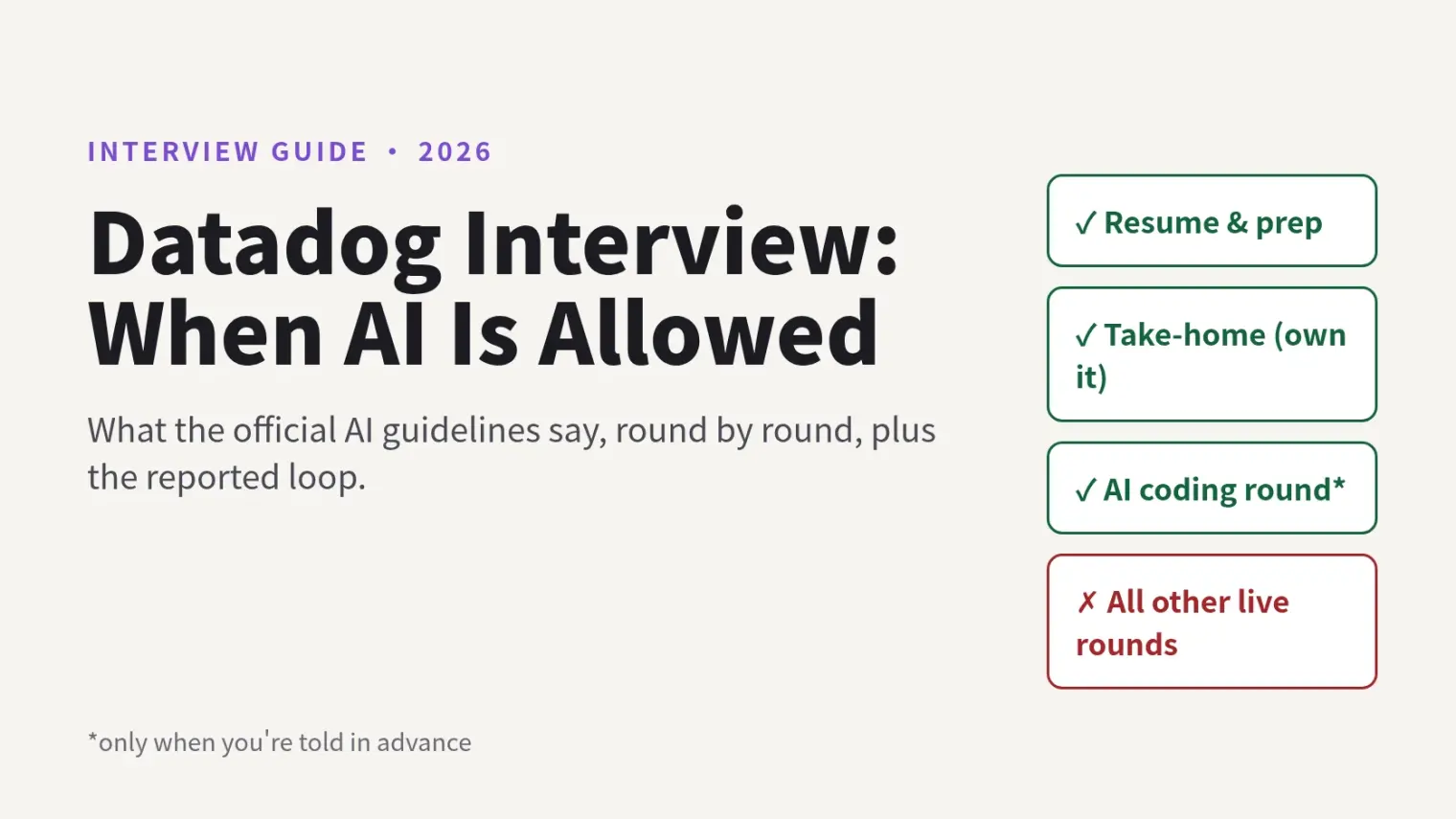
TL;DR: Datadog is one of the few companies that has written down its AI rules for candidates, and they're specific. AI is fine for your resume and research. It's allowed on a take-home as long as the conclusions are yours and you can defend them live. It's expected only in AI-assisted coding interviews you're told about in advance. Everywhere else, live, it's off, and misuse or undisclosed use "may lead to disqualification."
Source note: the rules and stage list below come from Datadog's own careers pages (AI guidelines last updated May 13, 2026). Round contents, question topics and timing come from third-party guides and candidate reviews, so they're labeled reported.
Most "does company X allow AI" answers are guesses stitched from Blind threads. Datadog's isn't, because the company wrote it down. That makes this one of the easier policies to plan around, and one of the easier ones to get wrong if you assume "AI-friendly company" means "AI-friendly interview."
What Datadog's AI Guidelines Actually Say
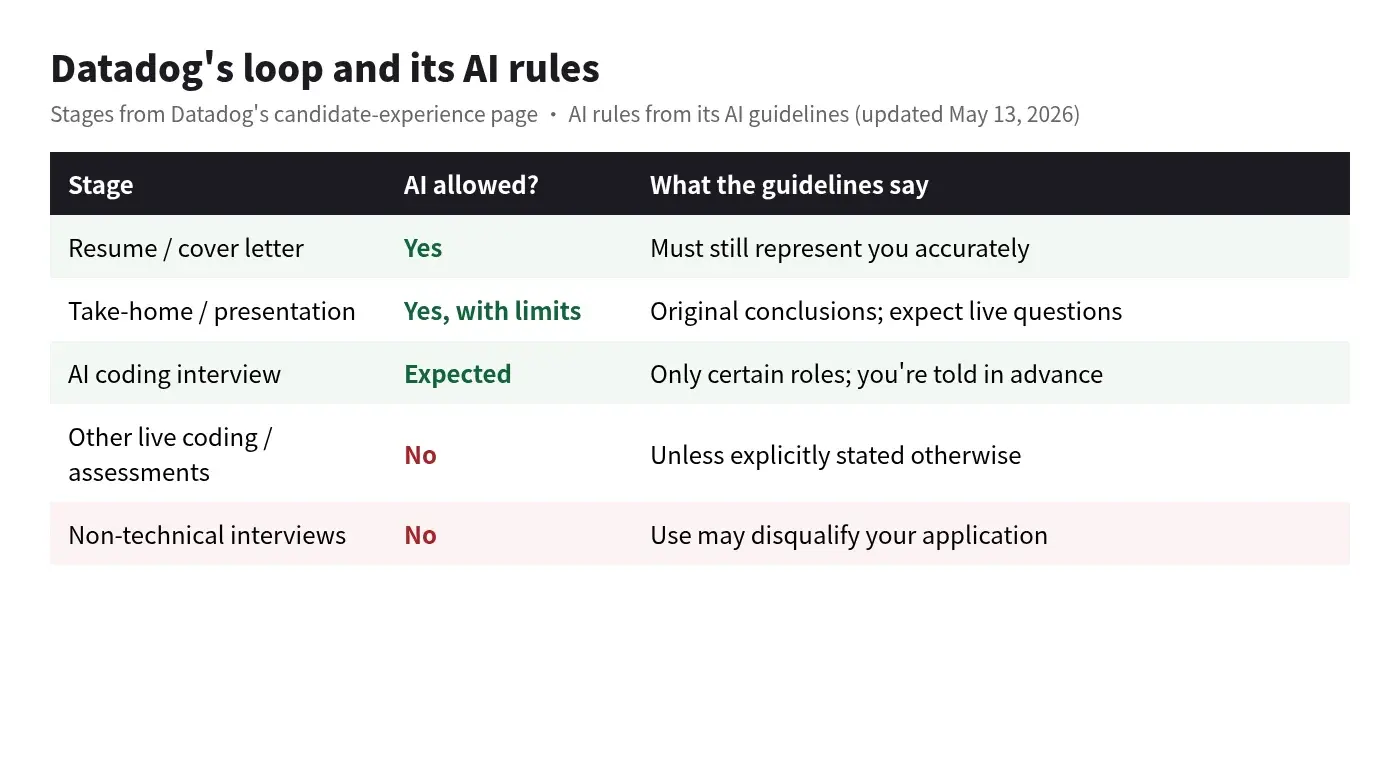
The guidelines split the process into places you may use AI and places you may not. Paraphrasing, with the key phrases quoted:
Where it's allowed
- Application materials. Using AI to build a resume or cover letter is acceptable, but the materials must "represent your qualifications and skills accurately." If Datadog determines they've been misrepresented, you may be disqualified.
- Take-home assignments and presentations. Datadog says it's "interested in what you create, not what you copy." You can research however you like, but the submission should reflect your own conclusions, and you "should expect to answer questions live based on your work."
- AI coding interviews. For certain roles, Datadog runs AI-assisted coding interviews where you're "explicitly allowed (and expected)" to use AI. The goal is to see how well you use it to reason and make engineering decisions, and you should be ready to explain how and why you used it. The examples chart names Claude as an example of the kind of tool. You'll be told in advance.
Where it's not
- All other live coding and technical assessments, "unless explicitly stated otherwise."
- Non-technical interviews (role knowledge, people management, cross-functional partnership). Being found using AI-based tools there "may result in your application being disqualified."
The practical rule is the one the guidelines end on: unless you've been told in advance that an interview assesses AI skills, don't use AI tools once it has begun or at any point during the live interview.
The Loop: Official Stages Plus Reported Contents
Datadog's candidate-experience page lists the stages, and says the process differs by role, team and department:
- Initial screen, usually a phone or Zoom call with the recruiter and/or hiring manager.
- Face-to-face interview, which may be multiple rounds or panels with the recruiter, hiring manager or team members.
- Take-home project, for some roles. Your recruiter explains the scope.
- Executive interview, for some roles, as a final step.
- Selection, where the interviewing team compares notes, then an offer from your recruiter.
The page also says interviews are mostly on Zoom, and that one step is expected to happen in person. Elsewhere it says candidates can come onsite at any point after the face-to-face phase, so ask your recruiter what that means for your loop.
What happens inside those rounds is where the official material stops. TechPrep's 2026 guide, which draws on candidate reports, describes this for software engineers:
- A recruiter screen of about 30 minutes.
- A technical phone screen of about an hour in CoderPad, often starting with a short resume discussion.
- An onsite of roughly four to five rounds: two pair-programming coding rounds, a system design round (reportedly using Excalidraw), a project deep dive, a debugging or production-simulation round, and a behavioral or hiring manager conversation.
- Three to six weeks end to end.
Treat that as one source's picture. A review on Glassdoor's Paris listing described a process of only two interview rounds for an earlier cycle, and others describe five or six. Your recruiter's schedule beats any guide.
What Candidates Report Being Asked
Again, reported rather than confirmed, but consistent across guides:
- Coding wrapped in real engineering contexts, not pure puzzles: sliding windows for metric aggregation, tree traversal over service dependency graphs, LRU cache, insert/delete/getRandom in O(1). Follow-ups are where the difficulty lives: make it thread-safe, handle data that doesn't fit in memory, survive 100x the throughput.
- System design close to what Datadog sells: metrics ingestion at very high volume, time-series storage, log processing, distributed alerting. Expect to defend trade-offs like SQL vs. NoSQL at each layer.
- Low-level design such as a rate limiter, a log storage system with time-range queries, or a thread-safe buffered writer.
- Debugging / production simulation: you're handed a broken service or odd metrics and logs, and asked to diagnose and mitigate.
- Behavioral weighted toward ownership and production incidents. What did you do when something you owned broke?
Why the Guidelines Change How You Should Prepare
Two things follow from the rules above.
The take-home is an oral exam in disguise. Datadog tells you in writing that you'll be questioned live on whatever you submit. If AI drafted a section you can't explain, that's the failure mode, regardless of how good the section reads. The workable approach is to use AI to research and structure, then write the recommendations yourself and rehearse defending each one to someone who'll keep asking why.
An AI coding round, if you get one, tests judgment more than speed. The stated goal is how you "leverage AI to solve problems, reason through solutions, and make engineering decisions." That matches what's been reported for other AI-allowed rounds. We cover that workflow in our write-ups on Ramp's AI-assisted coding round, LinkedIn's AI-enabled coding interview and DoorDash's AI-assisted working session. Plan before you prompt, read the output like a diff you didn't write, and narrate why you accepted or rejected it.
For everything else, the policy is clear, and this guide won't help you work around it. If you'd rather not gamble your candidacy on a disclosure issue, put the effort where it's allowed: preparation. Datadog explicitly says using AI to research the company and its products is fine, with one caution worth keeping: don't make it your only source, because the tools can be wrong about the company.
How to Prepare
- Week 1: Practical coding. Sliding windows, trees, LRU, rate limiter. After each solution, add the follow-up yourself: thread safety, memory limit, 100x load. Write your own test cases, since the CoderPad rounds reportedly expect that.
- Week 2: Observability-flavored system design. Design a metrics ingestion pipeline and an alerting system out loud, timed, with someone interrupting.
- Week 3: Project deep dive and incident stories. Pick a project where you can say, without notes, what alternatives you rejected, what broke under load and what you'd change. Prepare two production-incident stories where you owned the outcome.
- Throughout: Ask your recruiter which rounds, if any, are AI-assisted, and whether there's a take-home. Datadog says it will tell you in advance, so asking is a normal logistics question.
Speaking out loud is the skill most people under-train. A mock interview session is a reasonable place to rehearse the narrated, interrupted format for the design rounds and the project walk-through. Do the CoderPad rounds timed and unassisted, as the guidelines intend.
FAQ
Does Datadog allow AI in interviews?
In some places. The guidelines (updated May 13, 2026) allow it for your resume, company research and take-home support, and expect it in AI-assisted coding interviews you're told about in advance. Other live coding, technical assessments and non-technical interviews are off limits.
What happens if you use AI when you shouldn't?
Datadog says misuse, or failing to disclose use, may lead to disqualification. For non-technical interviews, using AI-based tools may result in your application being disqualified.
How do I know if I'm in a Datadog AI coding interview?
You'll be explicitly told in advance. If you haven't been, the guidelines say don't use AI tools once the interview has begun.
How many rounds is the Datadog software engineer interview?
Officially: an initial screen, a face-to-face stage of one or more rounds, an optional take-home, an optional executive interview, then selection. Third-party guides describe a one-hour CoderPad screen and a four-to-five-round virtual onsite over three to six weeks. It varies by team and level.
What is the Datadog project deep dive?
Reportedly, a round where you walk an interviewer through a complex past project and defend your architecture and technology decisions. Not officially described, so confirm with your recruiter.
Author · Alex Chen. Career consultant and former tech recruiter. Spent 5 years on the hiring side before switching to help candidates instead. Writes about real interview dynamics, not textbook advice.
Related Articles
Figma Software Engineer Interview Process (2026): What's Reported
Figma publishes no interview rubric. Here's the loop candidates report, the product-flavored coding and design rounds, and what's known about an AI round.
Oracle and PayPal Fresher Interview Process in India: What Candidates Reported, Year by Year
Oracle India's test moved from aptitude plus core CS to HackerRank with a REST API task. PayPal's cut-offs and platform also differ. Posts compared.
Airbnb Software Engineer Interview: The Core Values Round, Explained
Airbnb's four core values are public, but the interview round built on them isn't documented. Here's what's official, what candidates report, and how to prepare.