Data Analyst Interview AI: What to Do When the Hard Question Lands Live
SQL, behavioral, case study, and new AI-usage questions all in one pipeline. Here's how real-time AI copilots help data analyst candidates when preparation alone isn't enough.

TL;DR: A data analyst interview in 2026 tests SQL fluency, statistical reasoning, stakeholder communication, and behavioral judgment — often in the same 45-minute conversation. Most candidates over-prepare question lists and under-prepare for the live moment when their mind goes blank. Real-time AI interview copilots like AceRound give answer guidance during the actual session, not just practice questions you've already rehearsed.
The Job Market Is Strong. The Interview Is Harder.
Data analyst demand grew 33.5% in projected employment from 2024–2034, according to the U.S. Bureau of Labor Statistics — roughly 23,400 new US openings per year. Global demand runs steeper. But the interview hasn't gotten easier to match: companies now screen for SQL fluency, A/B testing literacy, business communication under pressure, and your ability to work with and validate AI-generated outputs.
Four distinct test categories. Each with a different failure mode. Most prep guides cover one or two.
A 2026 job-posting analysis by 365 Data Science found SQL in 50% of all data analyst postings, "stakeholder communication skills" in 59%, and Python in roughly 40%. The role requires both technical depth and the ability to explain what you found to someone who doesn't code.
That combination is what makes data analyst interviews uniquely difficult to prepare for.
What Data Analyst Interviews Actually Test in 2026
The University of Pennsylvania Career Services guide maps the typical hiring pipeline at mid-to-large companies:
- Recruiter screen — motivation, role fit, salary alignment
- Technical round — SQL, Python or Excel, data manipulation
- Statistics and experimentation round — A/B testing, confidence intervals, causality vs. correlation
- Case study or presentation round — translate a data problem into a business recommendation
- Behavioral round — past work, how you handled failure, stakeholder conflict
At smaller companies, rounds 2–4 collapse into one session. At FAANG and large financial firms, each gets its own slot. What doesn't change: you'll face technical questions and behavioral questions in the same interview pipeline, often on the same day.
The standard playbook — memorize 50 SQL questions, rehearse STAR answers, read a case study guide — leaves a gap. It covers each round separately. It doesn't prepare you for the moment when a behavioral question follows immediately after a complex SQL problem you got wrong.
What SQL Skills Are Tested in a Data Analyst Interview in 2026?
The honest answer: more than you think, less than you fear.
Most data analyst interviews don't test SQL engineering (indexing strategies, query optimizer internals). They test whether you can write clean, correct queries against realistic business tables and reason about the output.
What comes up consistently:
- Aggregations — GROUP BY, HAVING, counting distinct users vs. distinct events
- Joins — inner, left outer, and self-joins against real business schemas (orders + customers + products)
- Window functions — RANK(), ROW_NUMBER(), LAG() for consecutive-week activity, user rankings, and time-series comparisons
- CTEs — breaking a multi-step problem into readable named steps instead of nested subqueries
- NULL handling — COALESCE, IS NULL, and why averages behave unexpectedly with missing data
The harder SQL questions aren't syntactically complex. They're logically complex:
- "Write a query to identify customers who purchased in January but not in February"
- "Find users who were active in any two consecutive weeks"
- "Calculate the 7-day rolling average of daily signups"
These test your ability to decompose a business question into SQL logic — not memorization.
Where AI copilots help here: Under live-interview pressure, you can reach for the wrong function or overcomplicate a simple join. A real-time copilot can surface the core pattern — window function vs. subquery, LEFT vs. INNER, deduplicate before or after the join — so you reason out loud confidently rather than freeze.
Behavioral Interview for Data Analysts: The "Messy Dataset" Framing
The behavioral questions data analysts face aren't generic. They're work-specific:
- "Describe a time you worked with a messy dataset"
- "Explain a situation where your findings contradicted business assumptions"
- "Walk me through how you communicated a complex finding to a non-technical audience"
- "Tell me about a time your analysis influenced a significant decision"
These questions check three things simultaneously: technical instincts, business judgment, and storytelling under pressure.
The structure that works: business question the data was supposed to answer → what made this hard technically → what you specifically did → what changed because of your analysis.
Don't start with "We had a dataset where...". Start with why the business cared about the data at all.
What most candidates get wrong: they over-index on technical actions ("I wrote a deduplication script using...") and under-explain business impact ("the forecast improved and we avoided a ¥40M overstock in Q4"). Interviewers care about both. Lead with the problem, include the method briefly, close with a concrete outcome in business terms.
Will I Be Asked About AI in a Data Analyst Interview?
Yes — and more often than most prep guides acknowledge in 2026.
Common forms:
- "How do you validate AI-generated outputs in your analysis workflow?"
- "What's your approach when a model recommendation contradicts what the raw data shows?"
- "Tell me about a time you caught an error in an automated analysis."
These aren't trick questions. They're checking whether you treat AI as a source-of-truth or as a tool you verify. The right answer in almost every case: you treat it as the latter. You check outputs against sanity benchmarks, you understand the model's training scope, and you maintain a human judgment layer for high-stakes decisions.
If you don't have a real example yet, the honest answer beats a fabricated one: describe your approach in principle, acknowledge you haven't yet worked in an environment where this was a live issue, and explain how you'd handle it. Senior interviewers can usually tell the difference.
How to Communicate Technical Concepts to a Non-Technical Audience
This question shows up in case study rounds and behavioral rounds. It's also where technically strong candidates lose interviews they should win.
Three techniques that hold up in live interviews:
1. Lead with the business implication, not the method. Instead of "I ran a t-test at 95% confidence and got p < 0.05," say "We were 95% confident the UI change actually improved conversion, not just noise — confident enough to roll out."
2. Use one concrete number. Abstract explanations ("the metrics improved significantly") are forgettable. A single specific number ("we reduced false positives by 40%, which saved the team about 6 hours per week in manual review") anchors the story.
3. Anticipate the next question before it's asked. After stating your finding, briefly address the obvious follow-up risk: "The main caveat is this only holds if traffic mix stays similar to Q3 — if the campaign targets a different audience segment, we'd want to re-validate." This signals business awareness, not just technical execution.
In a live interview, this is harder than it sounds. You're tracking your answer, reading the interviewer's reaction, and managing nerves simultaneously. Real-time AI copilots can surface a reminder to land on the business implication when you drift into pure technical description.
How AceRound AI Works During a Data Analyst Interview
Every competing interview-prep tool ends at preparation. They give you questions to practice before the interview. None of them are present when the actual conversation starts.
AceRound AI works during the live interview — on Zoom, Google Meet, Microsoft Teams, or any video platform. You run it in the background on your desktop (Mac or Windows). When a question comes in, it surfaces a response scaffold in real time:
- SQL question → core pattern and recommended approach
- Behavioral question → STAR structure with data-analyst-specific framing
- Statistics question → key concept and how to explain it to a non-technical listener
- Case study → structuring the recommendation in business terms
For non-native English speakers specifically: data analyst roles are globally distributed, but interviews often happen in English regardless of location. Fluency in SQL doesn't translate automatically into fluency in describing your reasoning under pressure in a second language. AceRound gives you the structure before you speak, so your working memory goes to the content rather than searching for the right phrase.
Data Analyst Interview AI: Common Questions Answered
What SQL skills are tested in a data analyst interview in 2026? Aggregations, joins (inner, left, self), window functions (RANK, LAG, PARTITION BY), CTEs, and NULL handling. The hard questions are logically complex — decomposing a business problem into multi-step SQL — not syntactically exotic. Most interviewers want clean, readable queries against realistic schemas.
Will I be asked about AI in a data analyst interview? Increasingly yes, especially at companies using ML or LLMs in their data pipelines. Prepare one concrete example of validating or catching errors in automated outputs, or a clear principle-based answer if you don't have one yet.
How can I communicate technical concepts to a non-technical audience? Lead with the business implication, not the statistical method. Anchor the finding in one concrete number. Briefly address the obvious follow-up risk before the interviewer asks it. This pattern signals business awareness and confident communication simultaneously.
Describe a time you worked with a messy dataset. Lead with the business question the data was supposed to answer — not the technical problem you found. Interviewers care about both your technical actions and the business outcome. Close with a concrete result: what decision changed, what cost was avoided, what metric moved.
Explain a situation where your findings contradicted business assumptions. This is a judgment and communication question. Show you raised the finding clearly (not hedged), validated it before presenting, and gave the stakeholder a path forward rather than just a problem. How you handled the conversation matters as much as the technical work.
How do you handle tight deadlines or pressure in a data role? Prioritize what analysis actually moves the decision at hand. Communicate scope trade-offs early — not after delivery. Document your assumptions in real time so the analysis can be revisited without starting from scratch.
Author · Alex Chen. Career consultant and former tech recruiter. Spent 5 years on the hiring side before switching to help candidates instead. Writes about real interview dynamics, not textbook advice.
Related Articles
OpenAI's AI Interview Policy: Banned, Required, or Team-Dependent
OpenAI sells AI coding agents, then bans most candidates from using one. Here's the round-by-round policy, including the new agentic round that flips it.
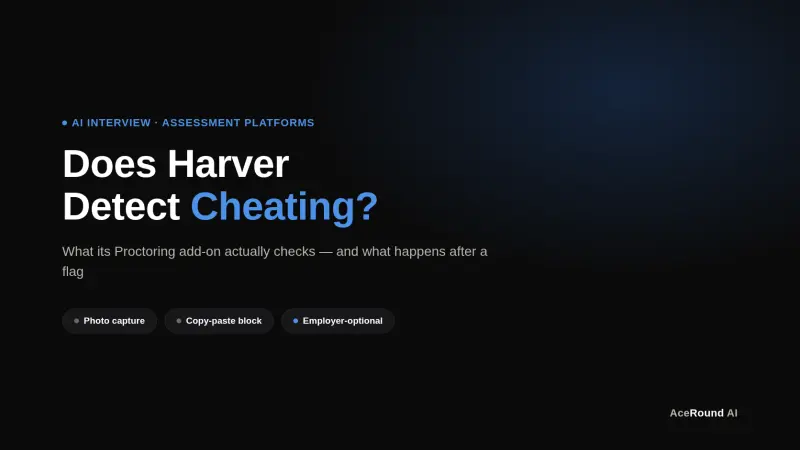
Does Harver Detect Cheating? What Its Proctoring Actually Checks
Does Harver detect cheating on its pre-employment assessments? A candidate look at Harver's Proctoring add-on, what gets logged after a flag, and what happens next.

Micro1's Zara AI Interview: What It Actually Tests (And Why Timing Gets Flagged)
Micro1's AI interviewer Zara has run 300,000+ interviews for remote roles. Here's why it flags response latency as a cheating signal, and what that means for AI prep.