Curveball Interview Questions: A Framework for Answering Them
Curveball interview questions are surging in 2026 because AI made scripted STAR answers easy to spot. Here's the framework and 12 real examples.

TL;DR: Curveball interview questions — "design a car for a deaf person," "what animal would you be," brainteasers with no clean answer — are having a real 2026 moment, and the honest reason is that AI made scripted STAR answers too easy to fake convincingly. There's no line to memorize here. Use a four-step move instead: pause, clarify if genuinely needed, reason out loud, land on something specific. The examples below show exactly how that plays out against 12 real questions candidates have actually been asked.
Lyft CEO David Risher's go-to interview question for product hires isn't about your resume. It's: "Design a car for a deaf person." No warm-up, no context you can prep for, no way to know it's coming. According to a January 2026 Fortune piece rounding up how CEOs are adjusting their hiring bar for a flooded, AI-assisted applicant pool, he's not alone — IBM, Twilio, and Denny's leadership all described leaning harder on questions candidates can't have rehearsed.
That's the part most "curveball interview questions" listicles skip. They'll hand you fifty weird prompts and a "just stay calm" tip, but nobody explains why this category is resurging right now, in 2026 specifically, or gives you a repeatable way to think through one live. This guide does both — the honest mechanism behind the trend, a four-step framework, and worked answers against 12 real questions people have actually been asked.
What Are Curveball Interview Questions?
Curveball questions are surprise, off-script prompts with no clean, memorizable answer: "If you were shrunk to the size of a pencil and put in a blender, how would you get out?" "Why are manhole covers round?" "Is Die Hard a Christmas movie?" They're a different animal from the other two question types you've probably already prepped for:
- Behavioral questions ("Tell me about a time you missed a deadline") ask about something real that already happened — you're retrieving a memory and narrating it.
- Situational questions ("What would you do if a teammate missed a deadline?") ask about a plausible hypothetical grounded in the actual job — you're reasoning through a scenario you could realistically face.
- Curveball questions ask about something absurd, abstract, or deliberately unrelated to the role — you're reasoning through something with no realistic precedent at all, and often no single correct answer.
That last property is the point. You can rehearse a behavioral answer word-for-word. You can prep a situational framework in advance. A genuine curveball resists both, which is exactly why it's becoming more common at the moment scripted prep got easier than ever to produce.
Why Curveball Questions Are Making a Comeback in 2026
Here's the mechanism, stated plainly instead of hand-waved: AI tools made it trivially easy to generate a polished, structurally correct answer to almost any standard interview question. Interviewers noticed. The Interview Guys reported in 2026 that 88% of hiring managers say they can now spot an AI-prepared answer — and, more importantly, that asking candidates directly about their AI usage tends to produce equally rehearsed, superficial responses. Direct questions get direct-question answers. Indirect, unscriptable ones don't.
Curveball questions are one of the few formats that still forces unscripted reasoning, because there's nothing to have pre-written. Fortune's coverage of CEOs adjusting to a flooded, AI-assisted Gen Z applicant pool makes the same point from the hiring side — Risher's car-design question, and a reported "do you think we're in an AI bubble?" prompt from another exec in the same piece, aren't there to trip you up for sport. They're there because the standard questions stopped reliably separating candidates once AI made every answer sound equally polished.
Worth being upfront about: this doesn't mean AI interview help has become useless — it means the kind of help that's useful has shifted. A memorized answer to "design a car for a deaf person" isn't a thing that exists. What's still fair game is help structuring your live reasoning into something coherent, the same way a debate coach helps you think faster without ever writing your actual arguments for you.
The Framework: Pause, Clarify, Reason Aloud, Land
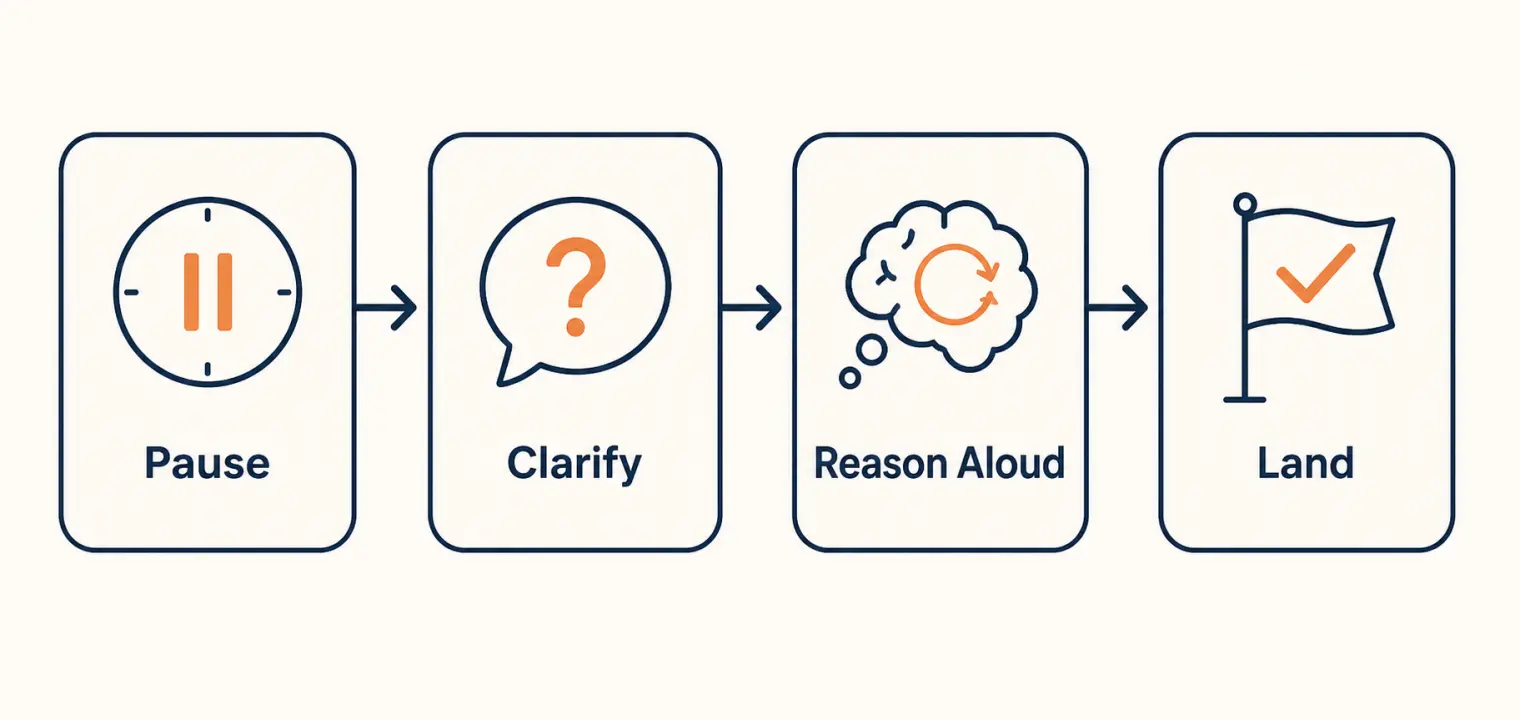
Four moves, in order, work for almost any curveball:
- Pause for two or three seconds. It feels like an eternity to you. It reads as "thoughtful" to the interviewer. Blurting the first image that pops into your head is the single most common way these go wrong.
- Ask one clarifying question — only if the prompt is genuinely ambiguous. "When you say 'design a car,' are we talking about a physical redesign, or the in-cabin experience?" buys you thinking time and shows you gather requirements before acting. More than one clarifying question starts to read as stalling.
- Reason out loud, in a visible sequence. Say your approach before you dive into the answer itself: "I'd start from the specific problem — a deaf driver can't rely on sound cues — then work outward." The narration is what's being scored, not just the destination.
- Land on something specific. Trailing off with "...so, yeah, something like that" undoes the first three steps. Commit to a concrete answer, even a partial one, and stop.
None of this requires the "right" answer, because for a true curveball there usually isn't one. It requires a visible, structured process — which is the exact thing a memorized line can't fake.
Structuring live reasoning is a different skill from having a script, and it's genuinely harder to practice alone — there's no answer key to check yourself against. AceRound listens during the interview and can nudge you back toward "pause, then narrate a sequence" if you start rambling or freeze, but it can't hand you a pre-written answer to "what animal would you be" — that answer doesn't exist to be handed over. What it helps with is staying structured once you're already mid-thought on something you didn't and couldn't have rehearsed.
12 Real Curveball Questions and How to Approach Each
"Design a car for a deaf person." (Lyft CEO David Risher, reported by Fortune) Clarify scope first (physical redesign vs. in-cabin experience), then reason from the actual constraint — no reliable audio cues — toward visual/haptic alternatives (dashboard vibration for sirens, visual blind-spot alerts). The interviewer is scoring how you isolate the real constraint, not automotive expertise.
"Do you think we're in an AI bubble?" (reported exec question, Fortune, 2026) There's no safe non-answer here. Pick a side, give one concrete reason, and acknowledge the strongest counterpoint in a sentence — that's a stronger answer than hedging into "it depends."
"How would you sell ice to an eskimo?" / "Sell me this pen." Reframe the absurd premise into a real use case out loud ("ice for events, not warmth — cocktail presentation, ice sculptures") before pitching. Skipping straight to a generic pitch script is the most common failure here.
"Design a spice rack for someone who's blind." Same move as the car question: name the actual constraint (no visual labeling), then reason toward texture, braille, or audio-cue solutions.
"How many golf balls fit in a school bus?" (classic estimation brainteaser) Estimate out loud in visible steps — bus volume, golf ball volume, a packing-efficiency discount — rather than guessing a number. The math being slightly off matters far less than showing a decomposable method.
"If you were shrunk to the size of a pencil and put in a blender, how would you get out?" (reported Goldman Sachs question) Absurdist premises reward playing it straight: reason about the blender's actual mechanics (is it on, are the blades reachable, what's the exit path) rather than deflecting with a joke and nothing else.
"Why are manhole covers round?" (classic tech-brainteaser era question) The expected reasoning path: round covers can't fall through their own round opening at any angle, unlike a square one turned diagonally. Walk the logic, don't just recite the fact if you happen to know it.
"What kind of animal would you be, and why?" The most commonly reported curveball across roundups. Pick a trait relevant to the role (a trait that reads as adaptable, methodical, collaborative) and justify it in one sentence — this is closer to a personality check than a puzzle.
"You're in a hot air balloon losing altitude with strangers aboard — how do you convince the group it shouldn't be you thrown out?" An ethics-and-pressure hybrid. State your reasoning criteria explicitly (who has dependents, who has a skill needed to land safely) rather than just arguing for yourself — showing you'd apply a consistent rule matters more than winning the argument.
"Is Die Hard a Christmas movie?" Low-stakes culture-fit curveball. Pick a side, give a real reason, keep it short and a little fun — over-analyzing a light question reads as missing the tone of the room.
"What's the color of money?" A trick-simplicity question: resist overthinking and give the literal, confident answer — some curveballs test whether you can spot when a question genuinely is that simple.
"Rate yourself 1–10 on how weird you are." (reported Capital One question) Commit to a specific number and a specific, work-relevant reason for it ("a 7 — I ask a lot of 'why' questions other people have stopped asking"). A vague non-answer here reads as evasive, not modest.
Are These Questions Even Fair?
Worth raising honestly, because most "how to answer" guides skip it entirely: there's no solid research evidence that abstract brainteasers predict job performance. Psychology Today has pointed out that Google itself dropped its infamous brainteaser interview rounds after internal data showed no meaningful correlation between nailing them and succeeding on the job.
That doesn't make them pointless to prep for — companies still use them, whatever the research says — but it's a useful reframe. Interviewers who still lean on curveballs are generally not grading you against a hidden correct answer. They're watching whether you can build a coherent thought out loud, under mild pressure, without a script. Treat it as a reasoning demo, not a trivia test, and a "wrong" answer delivered with visible, structured logic will usually outscore a "right" answer blurted with none.
Common Mistakes That Sink Curveball Answers
- Answering instantly. The rushed first-instinct response is almost always the weakest one you'll give in the entire interview.
- Deflecting with a joke and stopping there. Humor is fine as an opener; it can't be the whole answer.
- Treating it like a trivia question with a "correct" fact to recall. Most curveballs aren't testing knowledge — reasoning from the wrong starting fact, shown clearly, beats silence.
- Apologizing for not knowing. "Sorry, I'm not sure" with nothing after it wastes the one thing being scored: your process.
- Overexplaining past the point of a decision. Once you've landed on an answer, stop — trailing into five more caveats undoes the confidence you just built.
FAQ
What are curveball interview questions? Surprise, unconventional, or lateral-thinking prompts — "design a car for a deaf person," "what animal would you be," brainteasers like "why are manhole covers round" — that have no memorized right answer and no real-world precedent to narrate from. They're built to test how you think in the moment, not what you've rehearsed.
How do you answer curveball interview questions? Pause for two or three seconds instead of blurting the first thing that comes to mind, ask one clarifying question if the prompt is genuinely ambiguous, narrate your reasoning out loud instead of jumping straight to an answer, and land on a specific conclusion rather than trailing off. The reasoning you show matters more than the conclusion you reach.
Why do interviewers ask weird questions? Increasingly, because polished, generic answers to standard behavioral questions have gotten cheap and easy to produce with AI. A curveball can't be pre-written the same way a "tell me about a time" answer can, so it's one of the few remaining ways to see unscripted, real-time thinking.
What is the most common curveball interview question? "What kind of animal would you be, and why?" shows up across more roundups and candidate reports than any other single curveball. Close behind are sales-pitch curveballs ("sell me this pen," "how would you sell ice to an eskimo") and classic estimation brainteasers ("how many golf balls fit in a school bus").
Are brainteaser interview questions still used in 2026? Less than a decade ago, and Google famously killed its own brainteaser rounds after finding zero correlation with job performance. But they haven't disappeared — some interviewers, particularly at smaller companies or in creative/consulting-adjacent roles, still use them, now often alongside the newer "catch AI-rehearsed answers" motivation rather than the old "test raw IQ" one.
Is it fair for companies to ask curveball interview questions with no right answer? There's a real debate here, and it's fair to raise it: research hasn't established that abstract brainteasers predict job performance, which is exactly why Google dropped them. If you land one, treat it as a reasoning demo rather than a trivia test — that's what most interviewers who still use them say they're actually scoring.
Curveballs aren't the only unscripted format on the rise. If you're also facing hypothetical "what would you do if" prompts, our situational interview questions guide covers the job-grounded version of live reasoning, and our behavioral interview questions guide covers the classic, memory-based STAR format these are increasingly asked alongside.
Author · Alex Chen. Career consultant and former tech recruiter. Spent 5 years on the hiring side before switching to help candidates instead. Writes about real interview dynamics, not textbook advice.
Related Articles
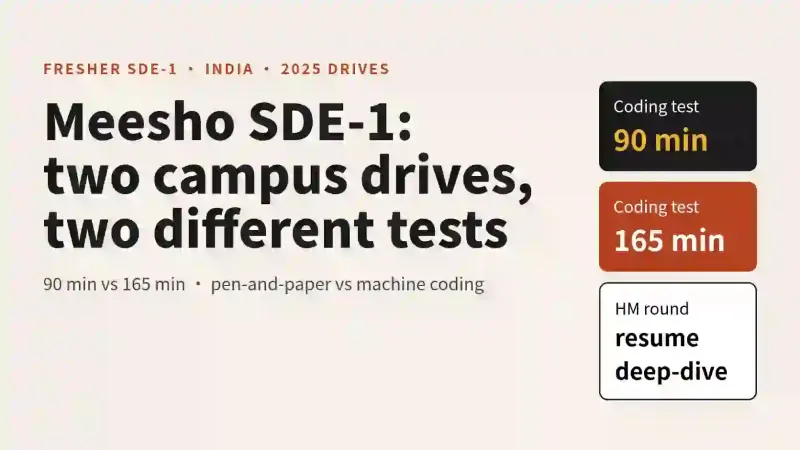
Meesho SDE-1 Interview Process for Freshers: Three 2025 Accounts Compared
Meesho SDE-1 campus accounts from 2025 disagree on test length, round order and design format. Here is what each reported and how to prep for any of them.
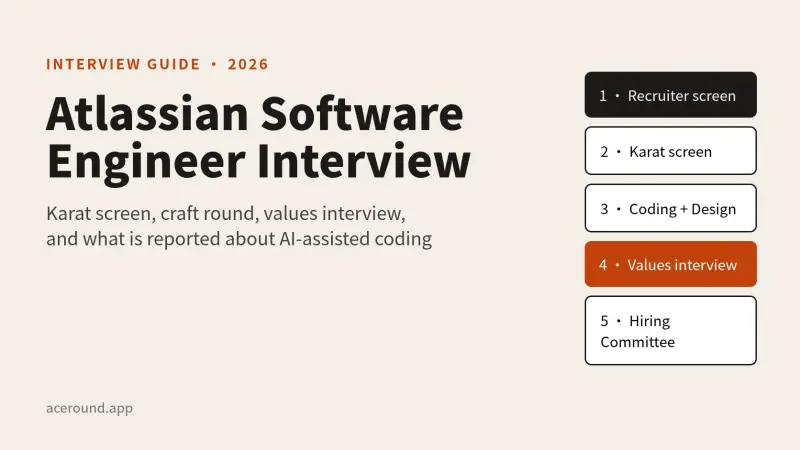
Atlassian Software Engineer Interview: Karat Screen, Craft Round and the Values Interview
How Atlassian's engineering loop works, from the Karat screen to the values round, what is official and what candidates report, including the AI-assisted rounds.
LinkedIn's AI-Enabled Coding Interview: What Candidates Report and How to Prepare
LinkedIn reportedly swaps one coding round for a CoderPad session with an AI panel. Here is the reported format, what gets scored, and what is unconfirmed.