Business Analyst Interview AI: How to Nail BA Questions in 2026
A practical guide to using AI for business analyst interview prep — covering BA behavioral questions, case studies, requirements gathering, and the new AI fluency category.

TL;DR: Business analyst interview AI preparation now covers two parallel tracks — answering the new AI fluency questions interviewers are adding in 2026, and using AI tools to practice the hardest BA scenarios (stakeholder conflict, requirements elicitation, case studies) before you sit down. This guide covers both.
A business analyst at a mid-size SaaS company told me she spent 40 hours preparing for her dream job interview. She memorized 50 behavioral questions, reviewed her SQL skills, and prepped three solid STAR stories. She still blanked when the interviewer asked: "Walk me through how you'd validate a machine learning recommendation for product prioritization."
That question wasn't in any prep guide. But it's exactly the type of question BA interviewers are adding as AI becomes embedded in the analyst's daily toolkit.
Here's what's changed: IIBA data shows 66% of hiring leaders won't consider candidates who lack AI skills, and 75% of analysts already use AI in their work. That means business analyst interviews in 2026 have a new category that almost no prep content covers — and that's where most candidates get tripped up.
This guide covers both problems: what AI-related questions you'll face, and how to use AI tools to practice the scenarios that have always been hardest.
What Business Analyst Interviews Actually Test in 2026
Business analyst interview questions have always spanned a wide range. Interviewers want to see that you can translate messy business problems into structured requirements, manage difficult stakeholders, and think analytically without losing sight of outcomes.
But the question set has expanded. Most interviewers now include at least one of these AI-adjacent questions:
- "How have you used AI tools in your analysis work?"
- "What's your approach to validating AI-generated insights before presenting to stakeholders?"
- "How would you document requirements for a feature powered by a generative AI model?"
- "Walk me through a situation where an AI recommendation turned out to be wrong — how did you catch it?"
If you haven't prepared for this category, these questions will feel like they came from a different job description. They didn't. They're now standard in mid-to-senior BA roles.
The 7 Business Analyst Interview Question Categories
Most BA interviews draw from these buckets. The first six are traditional; the seventh is new.
1. Requirements Elicitation and Documentation
You'll be asked how you gather, document, and validate requirements from stakeholders who often don't know exactly what they want. Classic questions include process walkthroughs and examples of BRD or user story work.
2. Stakeholder Management
This is where most candidates struggle. Interviewers probe specifically for how you handle disagreement, competing priorities, and stakeholders who miss meetings or ignore your recommendations.
3. Process Analysis and Improvement
Expect questions about how you've mapped current-state vs. future-state workflows, identified bottlenecks, or reduced process waste. Gap analysis and root cause analysis frameworks come up here.
4. Data Analysis and SQL
Not every BA role requires heavy SQL, but you should be comfortable explaining how you've used data to support a decision. Some roles will give you a case study with a dataset and expect you to walk through your analysis logic.
5. Agile and Scrum Methodology
If the role is in a product org, you'll almost certainly get questions about sprint planning, backlog refinement, and how you've worked with engineering teams. Know the difference between epics, user stories, and acceptance criteria.
6. Business Analysis Case Study Interview
Case study rounds are increasingly common, especially at consultancies and larger tech firms. You'll be given a scenario — a process inefficiency, a stakeholder conflict, a make-or-buy decision — and asked to reason through it aloud. There's no single right answer; interviewers are watching your structure and communication.
7. AI Fluency (New in 2026)
This is the category that trips up unprepared candidates. Questions in this bucket assess whether you understand where AI fits into analysis workflows and where it doesn't. You don't need to be a data scientist. You do need to demonstrate judgment about when AI output should be trusted, challenged, or flagged.
Business Analyst Technical Skills Interview Prep
The technical depth expected varies significantly by role. Entry-level roles often focus on Excel and PowerPoint. Senior roles may expect proficiency in SQL, Power BI, or Tableau, plus comfort with modern AI tools.
What interviewers actually test on technical skills:
- SQL: Can you write a basic JOIN or GROUP BY without help? Can you explain what an index does?
- Data visualization: Can you pick the right chart type for the insight you're communicating?
- Documentation tools: Confluence, Jira, Miro — know the workflow
- AI tools in analysis work: ChatGPT for drafting requirements, Copilot for summarizing stakeholder interviews, AI for data cleaning
The AI tools component is no longer optional. If you haven't used any AI tools in your analysis work, spend a few hours before your interview running requirements documents through ChatGPT and seeing what comes out. At minimum, you'll have something concrete to say.
One useful framing: the best BAs use AI to reduce time on low-value tasks (summarizing meeting notes, generating initial user story drafts) so they can spend more time on the judgment-intensive work that AI can't replace (stakeholder alignment, trade-off decisions, edge case identification).
Business Requirements Gathering Interview: What Interviewers Want to Hear
Requirements gathering is where many BA candidates give vague, generic answers. Interviewers have heard "I held workshops and gathered feedback from stakeholders" hundreds of times. Here's what makes an answer stand out:
Be specific about your elicitation technique and why you chose it. Interviews, workshops, observation, prototyping, surveys — each has a use case. Telling an interviewer you chose to observe users directly because stakeholder interviews were producing aspirational answers rather than real behavior demonstrates actual analytical judgment.
Name the artifact. User story, BRD, use case diagram, process flow — interviewers respect candidates who can name exactly what they produced and explain who consumed it downstream.
Include one failure or conflict. A requirements gathering story where everything went smoothly reads as either inexperienced or rehearsed. Mention a stakeholder who kept changing scope, or a requirement that turned out to be technically impossible to implement — and what you did.
If you want to practice this, AI interview tools can simulate a stakeholder interview with you. Ask an AI to play the role of a business owner who's vague about what they actually want — then practice your elicitation approach. It's a low-stakes way to stress-test your questions before doing it live.
Try AceRound AI — it lets you run mock BA interview scenarios, including stakeholder roleplay, with real-time feedback on how clearly you're communicating requirements. aceround.app
How to Prepare for BA Behavioral Interviews with AI
Business analyst behavioral interview questions follow the same STAR structure as any other role, but the stories need to be BA-specific — focused on analysis, requirements, stakeholder dynamics, or process decisions.
The six questions below came from real candidates via Glassdoor. Practice these before anything else:
- "Tell me about a time when you used analysis to make a business-critical decision. Walk me through the analysis and outcome."
- "Tell me a time when you had to influence clients to follow a different course of action."
- "How do you handle difficult stakeholders?"
- "Tell me about a time when you had to deal with conflict."
- "What do you do if nobody shows up to your meeting?"
- "What was a difficult problem you were tasked with in a previous role and how did you handle it?"
The challenge with these questions isn't knowing what to say — it's knowing when to stop. BA behavioral answers tend to run long because the context is complex. A useful rule: if your answer exceeds three minutes, you've over-explained. AI mock interview tools will tell you this; human practice partners usually won't.
For the STAR method framework, the business analyst version emphasizes Situation and Result more than most roles. Interviewers want to understand the business context and what actually changed — not just what you did.
Business Analysis Case Study Interview Prep
Case studies are the hardest part of a BA interview to prepare for because there's no script. The interviewer is watching how you think, not just what you know.
The structure that works:
- Clarify before you analyze. Ask two or three scoping questions before diving in. This signals structured thinking and stops you from solving the wrong problem.
- State your framework out loud. "I'm going to look at this through the lens of current-state vs. future-state, and then identify the key stakeholders affected." Even if you adjust mid-analysis, starting with a framework shows discipline.
- Make a recommendation. Many candidates talk through the analysis but don't land anywhere. Interviewers want to see you make a call under uncertainty.
- Anticipate pushback. After your recommendation, briefly mention what could go wrong and how you'd address it.
For case study practice, AI tools can generate scenarios and push back on your reasoning in ways that generic prep guides can't. McKinsey has built an internal AI tool specifically so associates can practice case interviews — the same logic applies to BA case study prep. For behavioral interview fundamentals that apply across roles, see our behavioral interview questions guide.
FAQ
How do you handle difficult stakeholders?
Name the specific conflict dynamic first — competing priorities, a stakeholder who's disengaged, or someone who changes requirements after sign-off. Then walk through what you did to understand their underlying concern, not just their stated position. Show that you separated the person from the problem.
Tell me about a time when you used analysis to make a business-critical decision.
Lead with the business outcome, then work backwards to the analysis. Interviewers forget methodology quickly but remember stakes. "This decision affected $2M in product roadmap investment" is a better opening than "I gathered data from three sources."
Tell me a time when you had to influence clients to follow a different course of action.
The risk here is sounding like you steamrolled someone. Anchor the story in evidence — what data, what user research, what financial model — not personal authority. If you changed their mind with data, say so specifically.
What do you do if nobody shows up to your meeting?
This is a judgment question about how you handle blocked processes. A strong answer includes: following up asynchronously with context and clear stakes, identifying which person's absence is the actual blocker, and proposing an alternative that respects their constraints. Showing you've thought about why people don't show up (too vague, too frequent, wrong timing) scores better than just escalating.
What AI skills should I highlight in a BA interview?
Focus on judgment, not tools. Specific experience using AI to accelerate low-value tasks (summarization, drafting, data cleaning) is worth mentioning — but pair it with an example of where you caught AI output that was wrong or biased. That combination shows you're a practitioner, not just a name-dropper.
How do I prepare for business analyst case study questions?
Practice with a scenario partner or an AI tool that can throw unexpected variables at you. Run through at least three different case types (process improvement, make-vs-buy, stakeholder conflict) before your interview. Timing yourself is critical — most candidates go too long. For a structured catalog of BA interview questions by type, DataCamp's BA interview guide is one of the most comprehensive free resources available.
Author · Alex Chen. Career consultant and former tech recruiter. Spent 5 years on the hiring side before switching to help candidates instead. Writes about real interview dynamics, not textbook advice.
Related Articles
OpenAI's AI Interview Policy: Banned, Required, or Team-Dependent
OpenAI sells AI coding agents, then bans most candidates from using one. Here's the round-by-round policy, including the new agentic round that flips it.
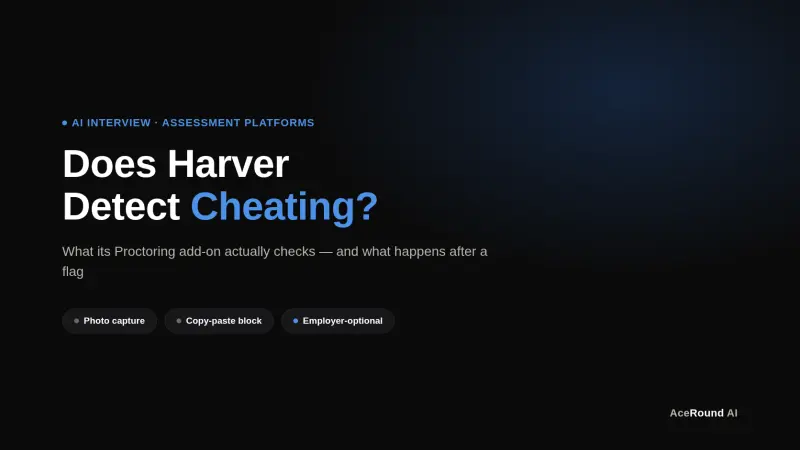
Does Harver Detect Cheating? What Its Proctoring Actually Checks
Does Harver detect cheating on its pre-employment assessments? A candidate look at Harver's Proctoring add-on, what gets logged after a flag, and what happens next.

Micro1's Zara AI Interview: What It Actually Tests (And Why Timing Gets Flagged)
Micro1's AI interviewer Zara has run 300,000+ interviews for remote roles. Here's why it flags response latency as a cheating signal, and what that means for AI prep.