What Is Googleyness? A Practical Guide to Google's Behavioral Interview Round
Googleyness is one of Google's four hiring criteria. Learn what Googleyness actually means, the 8 traits evaluated, real questions from candidates, and how to structure standout answers.

Google's behavioral interview GOOGLEYNESS round is a 30–45 minute session assessing one thing: would your future teammates want to work with you for years? Googleyness is one of Google's four hiring dimensions—alongside General Cognitive Ability, Leadership, and Role-related Knowledge. It's assessed through behavioral stories, not personality tests. The traits Google looks for are learnable. This guide covers the definition, the 8 traits, real questions from actual candidates, and how to structure answers that land.
In October 2024, a candidate posted on LeetCode: "I recently appeared for the Googleyness round and my interviewer was not very helpful, he was not giving any reaction on my answers. So I don't know how it went really."
That comment got hundreds of upvotes because it captures exactly what makes this round disorienting. Unlike a coding interview—where you either pass the test cases or you don't—a behavioral round feels like performing into silence, especially when the interviewer holds a poker face throughout.
Here's the useful flip side: the outcome is highly preparation-dependent. Googleyness is the least "innate" of Google's four hiring dimensions. You can get substantially better at it. The candidates who struggle most are those who treat it as a personality test—something you either have or don't. It isn't.
What Google Actually Means by Googleyness
The term appears in Google's official hiring materials. Laszlo Bock, former SVP of People Operations, defined it in Work Rules! as:
"A certain dose of intellectual humility, a strong measure of conscientiousness, comfort with ambiguity, and evidence that you've taken some courageous or interesting paths in your life."
Google's official hiring guide frames it as a combination of culture fit and culture add. The distinction matters: Google doesn't want cultural conformity. They want people who work effectively within a collaborative environment and bring something distinctive. This shift from "fit" to "add" is meaningful for candidates from non-Western backgrounds—your different perspective is potentially an asset, not a liability.
The four dimensions Google evaluates in all interviews:
- General Cognitive Ability — how you solve novel problems
- Leadership — how you influence and navigate without formal authority
- Role-related Knowledge — technical or domain skills for the job
- Googleyness — this article
Googleyness is often evaluated in a dedicated "G&L" (Googleyness and Leadership) round, but experienced interviewers pick up Googleyness signals throughout the entire loop. How you respond when a technical question stumps you, whether you credit teammates, how you handle ambiguous requirements—all of it feeds the Googleyness assessment.
The 8 Googleyness Traits — and What Google Is Actually Looking For
Google's Ten Things We Know to Be True corporate philosophy, the PM interview prep pack, and Bock's Work Rules! converge on eight traits. Here's what each actually means in practice.
1. Intellectual Humility
Not "I admit when I'm wrong." More precisely: "My initial approach was X, I received new data, and I updated my view." Google values intellectual honesty. Stories where you defend a position long after evidence contradicts it are red flags.
2. Conscientiousness
You do what you say. You notice problems that fall outside your formal responsibility and address them. Your work is careful—not slow, careful.
3. Comfort with Ambiguity
Most real problems at Google don't come with a spec. Your stories should show you navigating incomplete information and making reasonable progress rather than waiting for clarity that never arrives.
4. Doing the Right Thing
Integrity under pressure. Not vague claims about being ethical—specific moments where you chose the harder right path over the easier wrong one. Disagreeing with your manager, flagging a problem that reflected poorly on you, reporting something uncomfortable.
5. Care for Users and the World
Empathy for who you're building for. This matters more in product-facing roles, but even purely technical roles benefit from stories where you considered downstream impact beyond task completion.
6. Enjoying Fun and Collaboration
Not "I'm a team player" (everyone says this). Stories that show genuine curiosity about colleagues' work, humor in difficult situations, and actual enjoyment of the collaborative process—not just tolerance of it.
7. Being Direct and Action-Oriented
Google rewards people who say what they think even when it's inconvenient, and who move toward action rather than prolonged deliberation. Your stories should show a bias toward decisive action.
8. Boldness in the Face of Risk
Specific times you advocated for an unpopular idea, took a non-obvious career path, or ran an experiment with a genuine chance of failing. This is the "interesting path" Bock references. It's the hardest trait to fake, so most candidates skip it—which makes a strong boldness story distinctive.
The most under-prepared trait: boldness. Candidates default to safe success stories. Google finds bold stories with real tension more credible and more memorable.
The Most Common Googleyness Interview Questions
These questions were compiled from Glassdoor, LeetCode Discuss, Teamblind, and Reddit. Organized by the trait they primarily probe.
Intellectual Humility / Learning:
- "Tell me about a time you changed your mind about something important."
- "Describe a situation where you were wrong and how you handled it."
- "Tell me about a time you received feedback you initially disagreed with."
Comfort with Ambiguity:
- "Describe a project where the goals were unclear. How did you proceed?"
- "Tell me about a time you had to make a decision without all the information you wanted."
Integrity / Doing the Right Thing:
- "Tell me about a time you disagreed with your manager. What did you do?"
- "Describe a situation where you had to make a difficult ethical choice."
Boldness / Interesting Paths:
- "Tell me about a risk you took that didn't work out. What did you learn?"
- "Describe a time you advocated for something unpopular."
- "What's the most unconventional thing you've done in your career?"
Collaboration / Care for Others:
- "Tell me about a time you mentored or helped someone at work."
- "Describe a conflict with a colleague and how it was resolved."
- "How do you work with people whose communication style is very different from yours?"
Notice what's absent: questions about your greatest strength, your five-year plan, or why you want to work at Google. Those belong to a different category. Googleyness questions are almost always behavioral (past-tense situations), not hypothetical.
How to Structure Your Googleyness Answers
The standard STAR framework works well. For Googleyness, add one element: L for Learning. The Learning component transforms a competency answer into a Googleyness answer.
STAR-L structure:
- S — Situation: Context, briefly. One to two sentences.
- T — Task: What needed to happen and why it was hard or ambiguous.
- A — Action: What you specifically did. Use "I" not "we." Google interviewers are trained to probe until they find what you personally contributed. If you preempt this with "I" throughout, you signal self-awareness.
- R — Result: Concrete outcome. Numbers where possible. "The team shipped 2 weeks early" beats "the project was successful."
- L — Learning: What changed in how you think or work as a result. One sentence of genuine reflection.
What separates a great answer from a good one:
A good answer uses STAR and has a clear result. A great answer has a Learning moment that reveals something real about how you think. "This taught me that early alignment meetings feel slow but actually compress total cycle time" is a real L. "I learned the importance of communication" is not.
One specific technique: Lead with the result, then unfold the story. "The project shipped 2 weeks ahead of schedule and reduced support tickets by 30%. Here's what happened..." Google interviewers value directness. Burying the outcome at the end of a 3-minute story buries the signal.
The Non-Native Speaker's Challenge — and Where AI Helps
No prep guide talks about this directly, but it's a real problem affecting a large portion of Google candidates worldwide.
Googleyness requires you to tell emotionally coherent stories in real time, in English, to a silent evaluator. For native speakers, this is hard. For candidates whose first language is Japanese, Korean, or Mandarin, there are three compounded friction points.
1. First-person ownership culture. Many East Asian professional cultures use collective framing by default. "We built this system" feels natural. Google interviewers are explicitly trained to drill down: "What specifically did you contribute?" If you're not used to claiming individual ownership in stories, you'll sound evasive even when you're not.
2. Storytelling structure. Western behavioral storytelling has a specific shape: brief setup, tension, resolution. Many candidates from other cultures front-load with extensive background before reaching the action. By the time you get to what you actually did, you've lost the interviewer. Lead with the conflict or decision, not the history.
3. Real-time language production under pressure. Writing a behavioral story in your second language is one thing. Delivering it fluently with correct tense, natural pacing, and appropriate emotional register—while also managing interview anxiety—is a different skill. The story exists in your head; it's real-time English delivery that breaks down.
This is precisely what AceRound AI is built for. During practice sessions (and optionally during live interviews), it processes questions in real time and surfaces STAR-L framing cues and phrasing suggestions. It doesn't write your story—it helps you retrieve and structure what you already know, in the moment you need it.
For non-native English speakers preparing for Google, real-time AI practice is arguably the most effective preparation available. Static prep guides help you build stories offline. Real-time tools train the in-context retrieval that breaks down under pressure. You need both, but the second is harder to get through traditional prep. For a broader overview of AI interview coaching tools, see our AI interview coach guide.
5 Common Googleyness Mistakes
1. Using "we" throughout. Every "we" is an implicit question mark. An interviewer will follow up: "What was your specific role?" Consciously shift to "I" during preparation. The team gets credit in the Result section; the Action section is yours.
2. Choosing only success stories. Candidates default to narratives where they were obviously right and everything worked out. These stories are easy to tell and boring to hear. Stories with genuine tension—where you made a hard call that could have failed, or where you were wrong and updated—are far more memorable and more aligned with what Googleyness actually probes.
3. Skipping the Learning element. Ending at "and the project shipped successfully" makes the answer transactional. A single sentence of genuine insight—what you now do differently—transforms the interviewer's impression from "capable" to "self-aware and growing."
4. Story-question mismatch. Many candidates prepare three stories and force them onto every question. "Tell me about a time you changed your mind" should not be answered with your greatest achievement story. Organize your story bank by trait cluster, not by chronology.
5. Performing Googleyness. Using Google buzzwords ("culture add," "10x," "Googleyness") sounds rehearsed. Interviewers see hundreds of candidates who've read the same prep material. Authentic specificity—a real story with real details and real uncertainty—always beats polished mimicry.
FAQ
What exactly does Googleyness mean? I have an onsite coming up.
Googleyness is Google's shorthand for "would your future teammates want to work with you." Formally it includes intellectual humility, conscientiousness, comfort with ambiguity, and evidence of interesting or courageous paths. Think of it as culture fit + culture add + integrity, assessed through behavioral stories rather than gut feel.
My interviewer gave no reaction. How do I know if I did well?
This is standard Google behavioral interviewer style. They're trained to avoid giving encouraging or discouraging signals. If the interviewer asks a follow-up probe after your story—"What was your specific contribution?" or "What would you do differently?"—that's engagement, not criticism. Silence between answers usually means they're writing notes. Don't adjust your answers mid-session based on perceived emotional signals from the interviewer.
Is Googleyness just code for hiring young people?
No. The core traits—intellectual humility, comfort with ambiguity, taking interesting paths—have no age component. "Interesting paths" applies at any career stage. Trying to project youth or tech-hipness is counterproductive. Senior candidates who've changed their minds on important technical or organizational decisions have richer material for Googleyness stories than new grads.
How does Googleyness assessment differ by role?
The eight traits are evaluated across all roles, but emphasis shifts. For PMs, user empathy and directness are heavily weighted. For engineers, comfort with technical ambiguity and learning from failure get more focus. For UX roles, care for users matters more. Most candidates over-prepare boldness regardless of role—it's worth calibrating your story bank to role-specific emphasis.
Should I use AI tools to prepare for the Googleyness round?
Yes, particularly for behavioral story delivery practice. An AI coach can flag overuse of "we," identify missing Learning elements, and simulate the poker-faced interviewer dynamic. The most valuable use is real-time practice—not reading prep material but actually delivering stories aloud while receiving structured feedback. This builds the in-context retrieval skill that counts under interview pressure. See how this compares to Amazon's Leadership Principles preparation, which follows a similar but more structured behavioral framework.
Author · Alex Chen. Career consultant and former tech recruiter. Spent 5 years on the hiring side before switching to help candidates instead. Writes about real interview dynamics, not textbook advice.
Related Articles

The Amazon Bar Raiser Interview: What They Actually Do (2026 Guide)
Amazon's Bar Raiser interview explained: what the role actually is, how the veto really works, how Amazon selects Bar Raisers, and how to prepare for one.
Predictive Index Test: How to Actually Prepare for the PI Cognitive and Behavioral Assessment
The Predictive Index test is really two assessments. Here's what the 12-minute Cognitive test and the untimed Behavioral checklist actually measure, score, and allow.
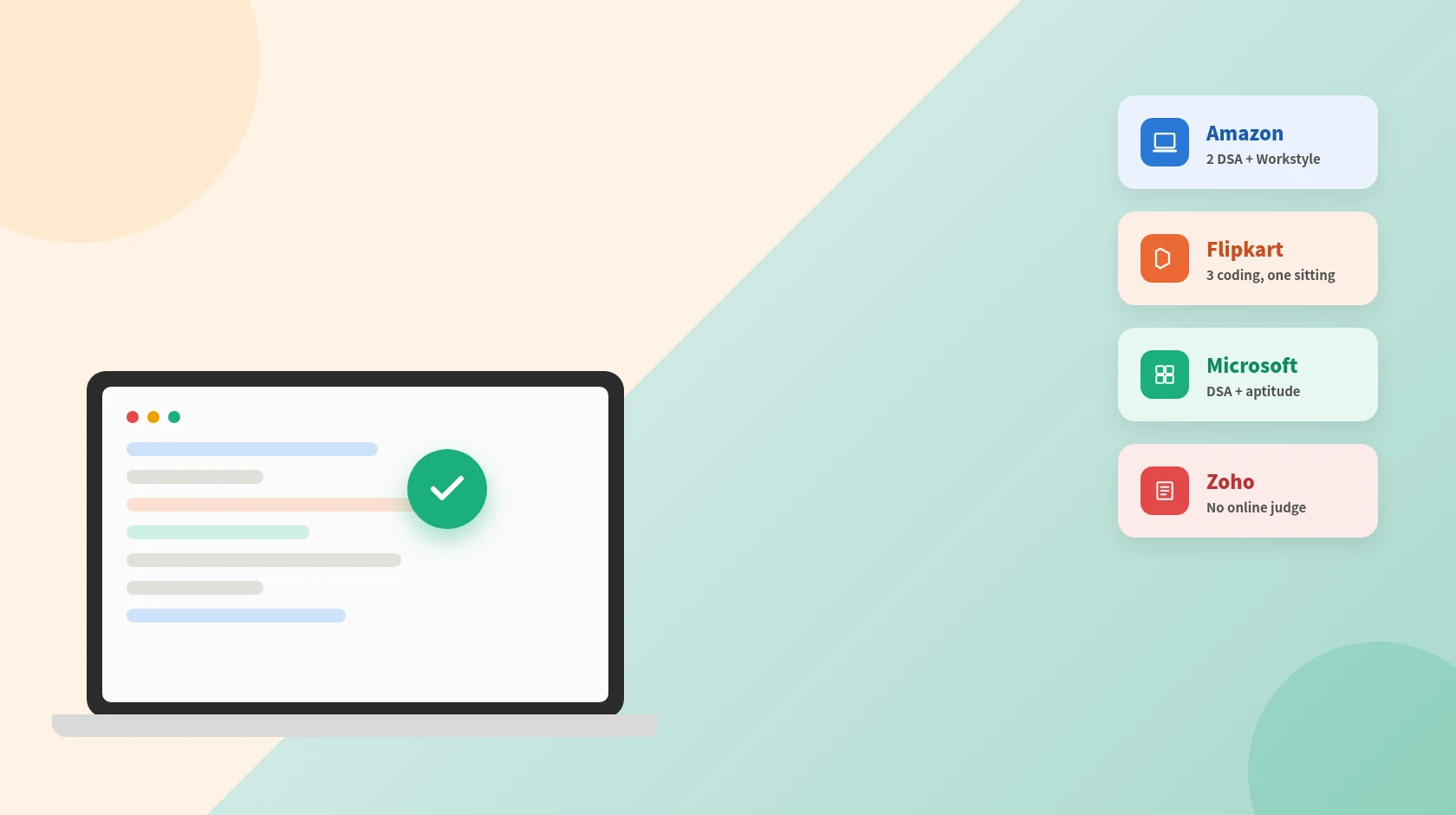
Off-Campus OA Prep for Product-Based Companies: Amazon, Flipkart, Microsoft, and Zoho Compared
Amazon, Flipkart, Microsoft, and Zoho run off-campus OA very differently. Here's what each one actually tests, and how to prepare for the one you'll face.