Engineering Manager Interview AI: Prep for the Round Question Lists Don't Cover
Engineering manager interview prep goes beyond a question list — the four-round loop, first-time EM vs manager-of-managers stories, and real-time AI help when a scenario catches you cold.
TL;DR: Engineering manager interviews don't reward memorizing a question list — they test how you handle scenarios with no clean answer: coaching an underperformer, mediating conflict between reports, pushing back on an estimate, delivering bad news. An engineering manager interview AI copilot like AceRound gives real-time structure the moment a panel hits you with a people-management scenario you never rehearsed — it can't invent a management track record you don't have, but it can help you say the judgment you do have clearly, under pressure.
A senior engineer interviewing for her first EM role got this in a final-round loop: "One of your reports has been missing deadlines for two months. Walk me through what you do this week." No ramp-up question, no warning it was coming next. She'd rehearsed "tell me about a time you led a project." She had nothing prepared for "walk me through what you do this week" — a question that wants a plan, not a story.
That gap is the whole problem with how most people prepare for engineering manager interviews. They study a list of 40 questions and memorize answers to each one, then freeze the moment a panel phrases the same underlying scenario slightly differently. On r/ExperiencedDevs, one candidate put it bluntly: "These are hard to prep for because 1. It's not as concrete as technical and 2. No one really knows how to interview managers so they're also just grabbing at straws."
Why Engineering Manager Interviews Don't Work Like a Question List
Every top-ranking "EM interview questions" guide does the same thing: a categorized list — leadership, people management, project management, culture fit — with a few sentences of advice under each. That's useful for recognizing a question when it shows up. It does nothing for the moment the panel changes the framing, stacks two scenarios into one question, or asks a follow-up you didn't script an answer for.
The reason EM interviews feel this unpredictable is that there's no standardized rubric the way there is for coding rounds. Will Larson, who has built manager-hiring loops at Stripe and Uber-scale companies, argues that interviewing senior engineering leaders should evaluate demonstrated skill against real scenarios rather than described skill against a checklist — but most companies still default to the checklist because it's easier to run. Camille Fournier, author of The Manager's Path, makes a related point in a conversation with LeadDev: managers "can bullshit you more easily than an engineering candidate," which is exactly why interviewers keep pushing for specifics instead of philosophy.
The Four Rounds of a Real EM Interview Loop
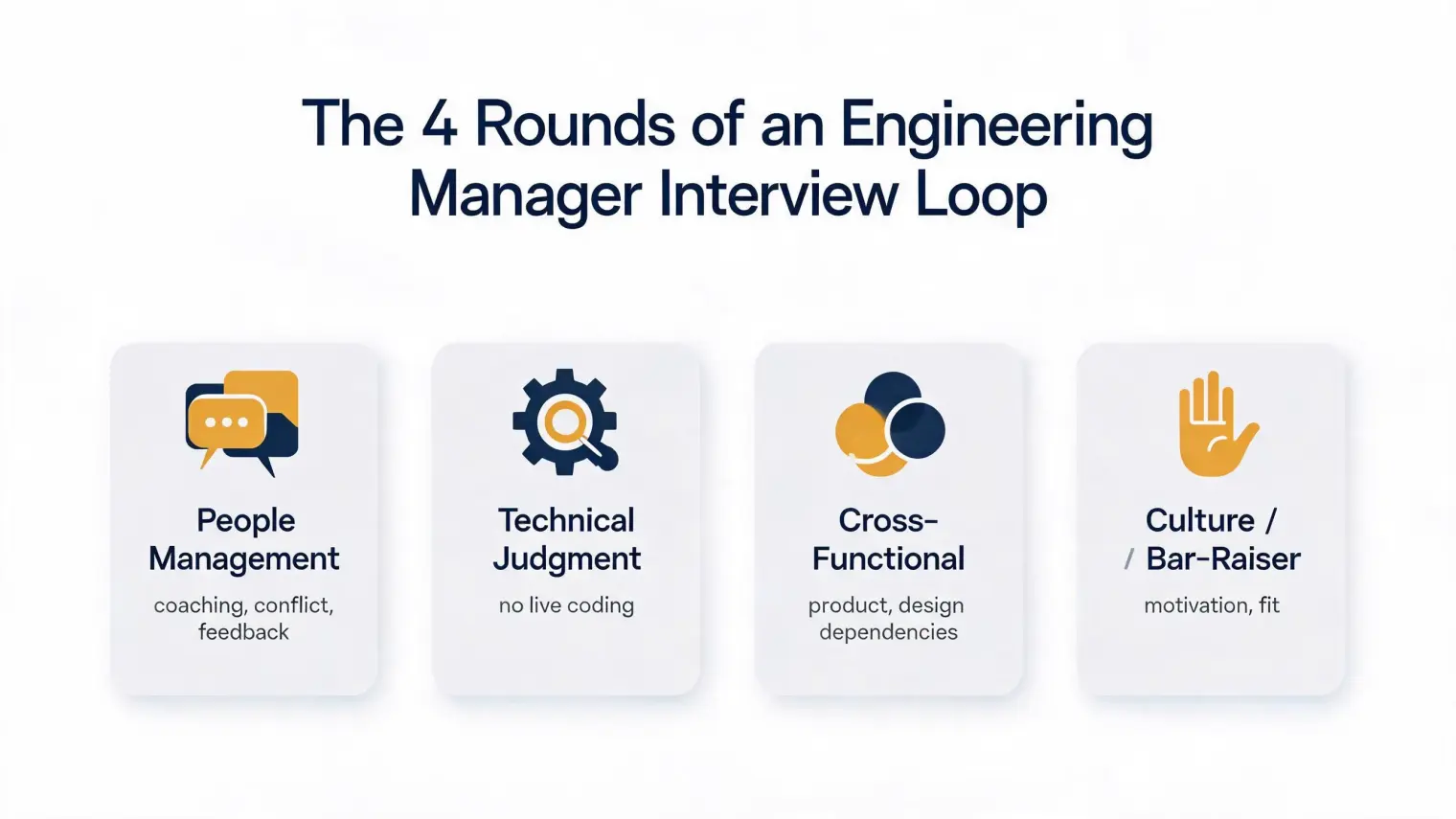
Based on interview reports across IGotAnOffer, Exponent, and hiring-manager threads on Reddit, a typical onsite loop for an engineering manager role runs through four distinct rounds, each testing something different:
- Behavioral / people-management round(s) — conflict between reports, coaching an underperformer, career development conversations. Some loops split this into two separate rounds: one for handling high performers, one for handling struggling ones.
- Technical judgment round — not live coding. This checks whether you can push back on an engineer's estimate, reason about a system design tradeoff, or spot risk in an architecture decision without writing code yourself. A hiring manager describing this round on Reddit put it plainly: "These candidates tend to have been ICs 7-12 years ago and I certainly wouldn't expect them to leetcode."
- Cross-functional / stakeholder round — prioritization conflicts with product or design, handling a leadership-mandated initiative your team disagrees with, managing dependencies you don't control.
- Culture-fit or bar-raiser round — motivation for management, "why this company," and sometimes a broader philosophy question about how you think about growing people.
Most candidates prepare heavily for round one and treat the other three as afterthoughts. That's backwards if the technical-judgment round is where a former-IC candidate is expected to prove they haven't gone rusty on judgment even if they've gone rusty on syntax.
First-Time EM vs. Manager-of-Managers: You Need Different Stories
A first-time EM interview is trying to answer one question: can this person actually do the job? That means proving you can run a 1:1, give direct feedback, and resolve a conflict between two individual contributors — the fundamentals.
A manager-of-managers interview assumes you've already cleared that bar and tests something different: organizational judgment. Can you develop other managers rather than just develop engineers? Can you resolve conflict between teams, not just between people? Can you make a tradeoff on a roadmap you no longer touch line-by-line? Reusing your "I coached one engineer through a rough patch" story in a manager-of-managers loop signals you haven't made the jump — panels are listening for scope, not just competence.
If you're coming from an IC background and want more on how the story-bank habit transfers, our guide on describing a time you led a team covers the STAR structure this format leans on before you add the manager-specific layer.
People-Management Scenarios You Need a Real Story For
These are the questions candidates most often have no answer for, based on real interview reports — not because they lack judgment, but because they've never had to narrate the judgment out loud:
- "Tell me about coaching an underperformer." Strong structure: name the specific gap (not "they weren't performing well" — what, exactly, was missing), the written expectations you set, the cadence of feedback you gave, and the outcome — ideally with a measurable business result, whether the person improved or exited.
- "Describe a conflict between two of your reports." Strong structure: neutral fact-finding first, hearing both sides separately before forming a view, a mediated resolution, and a follow-up check that it actually stuck. Panels watch for whether you take a side too fast.
- "How do you push back on a senior engineer's estimate?" Strong structure: ask clarifying technical questions to surface the estimate's hidden assumptions rather than overruling with authority, then describe a real technical follow-up that changed or confirmed the number.
- "Tell me about delivering bad news — a layoff, a cancelled project, a PIP." Strong structure: how you prepared the message beforehand, delivering it directly without burying the point, acknowledging the impact honestly, and the concrete next steps or support you offered.
If you've genuinely never run a formal PIP or a termination, say so directly and answer with the closest real analog — coaching someone off a project, or a hard performance conversation that didn't end in termination. A specific analog beats a vague hypothetical every time.
The Technical Judgment Round: What Replaces LeetCode
If you're prepping like you're still interviewing as an IC, you're prepping for the wrong round. The technical portion of an EM loop is judgment under ambiguity, not implementation under a timer. Expect questions like "an engineer tells you a feature will take three weeks — how do you evaluate that?" or "walk me through how you'd think about a service that's becoming a bottleneck." The goal isn't to prove you can still write the code; it's to prove you still understand the tradeoffs well enough to ask the right follow-up question. Candidates coming from a specific technical background — see our guide on cloud architect interviews for how tradeoff-explanation questions get structured — can reuse that same "explain the tradeoff to a non-expert" muscle here.
When the Panel Asks Something You've Never Rehearsed
Here's the honest limit of any prep, including AI-assisted prep: nothing can hand you a management track record you don't have. If you've never coached someone through underperformance, no tool changes that.
What AceRound's real-time interview copilot can do is narrower and more specific — the moment a panel throws an unrehearsed scenario at you mid-loop, it surfaces a structure on screen: name the stakeholder, name the tradeoff, sequence it Situation → Action → Result. That's the gap most candidates actually fall into — not a lack of judgment, but freezing on how to organize the judgment they already have into a coherent answer in real time. Before the actual loop, running through EM-specific scenario rounds with AceRound's AI mock interview feature — the people-management round, the technical-judgment round, the cross-functional round — builds the story bank so fewer questions land as a total surprise in the first place.
FAQ
What are the most common engineering manager interview questions?
Coaching an underperformer, mediating conflict between two reports, pushing back on a senior engineer's estimate, delivering bad news, and a motivation question about why you want to manage instead of stay hands-on. Expect at least one question with no clean answer.
Is there still a technical round in engineering manager interviews?
Usually, but it's not LeetCode — it's a technical judgment round that checks whether you can push back on an estimate or reason about a tradeoff without writing code live.
How is a manager-of-managers interview different from a first-time EM interview?
A first-time EM interview confirms you can do the job at all. A manager-of-managers interview assumes that and tests organizational judgment instead — developing other managers, resolving cross-team conflict, and making tradeoffs on a roadmap you no longer touch directly.
What if I've never actually fired someone or run a PIP?
Say so directly, then answer with the closest real analog. Interviewers use the firing question as a proxy for how you handle hard conversations in general.
Can an AI interview copilot actually help in an engineering manager interview?
It can hand you a structure the instant a panel asks something you never rehearsed. It can't fabricate a management track record you don't have — the copilot closes the gap between having judgment and saying it clearly under pressure.
What's the biggest mistake candidates make in EM interviews?
Preparing only the "nice" stories and having nothing ready for the uncomfortable ones. Panels ask about underperformance and conflict specifically because those moments reveal whether someone can actually manage.
Author · Alex Chen. Career consultant and former tech recruiter. Spent 5 years on the hiring side before switching to help candidates instead. Writes about real interview dynamics, not textbook advice.
Related Articles
OpenAI's AI Interview Policy: Banned, Required, or Team-Dependent
OpenAI sells AI coding agents, then bans most candidates from using one. Here's the round-by-round policy, including the new agentic round that flips it.
Does Harver Detect Cheating? What Its Proctoring Actually Checks
Does Harver detect cheating on its pre-employment assessments? A candidate look at Harver's Proctoring add-on, what gets logged after a flag, and what happens next.

Micro1's Zara AI Interview: What It Actually Tests (And Why Timing Gets Flagged)
Micro1's AI interviewer Zara has run 300,000+ interviews for remote roles. Here's why it flags response latency as a cheating signal, and what that means for AI prep.