Embedded Systems Interview AI: Company-Specific Prep for DJI, MediaTek, and TSMC
Why embedded systems interviews feel impossible and how AI interview tools close the feedback gap with company-specific prep for firmware, RTOS, and hardware-software engineering roles.
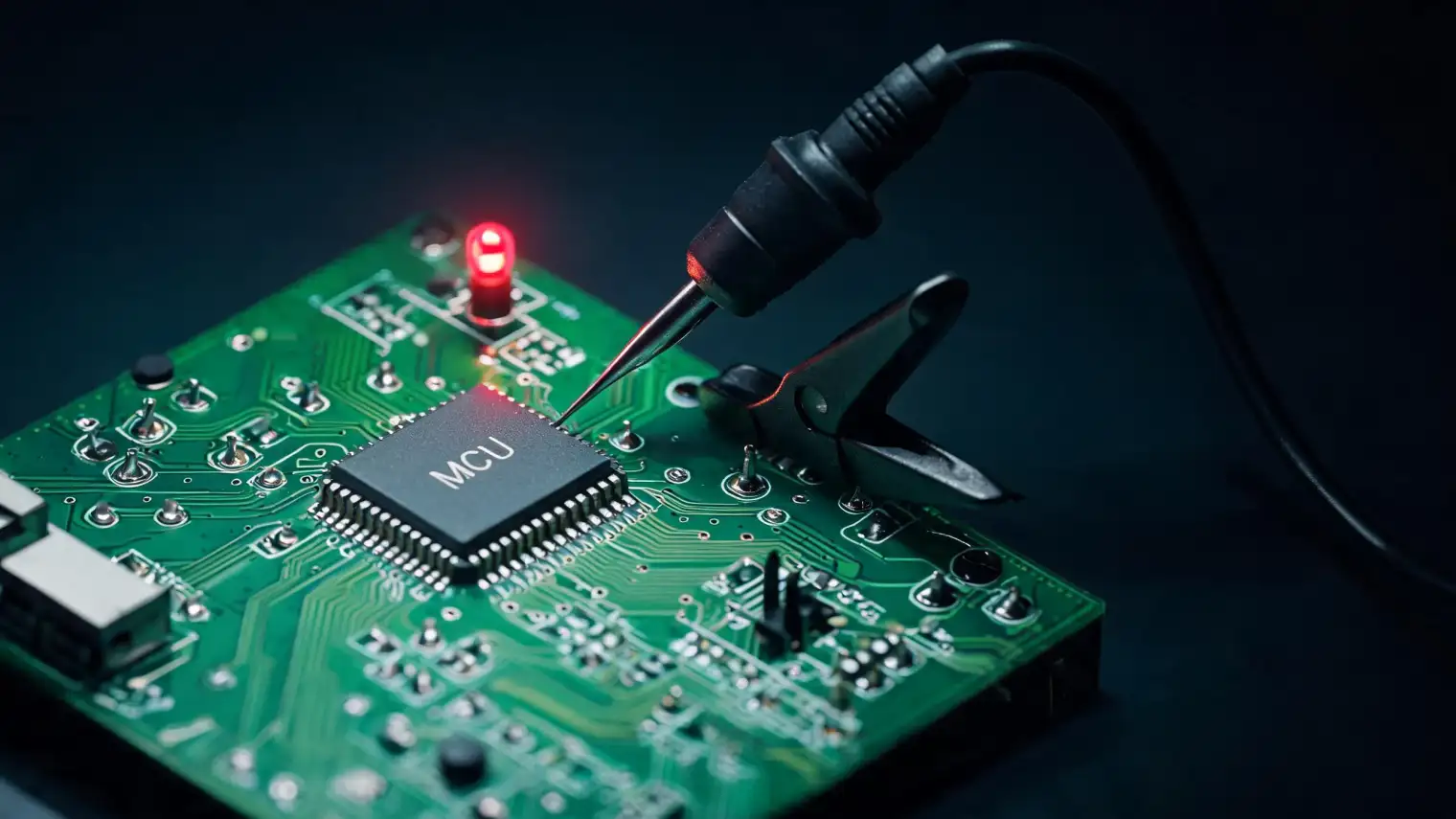
TL;DR: Embedded systems interview AI tools close the feedback vacuum that keeps even experienced firmware engineers stuck. Most guides recycle the same 30 RTOS questions — but companies like DJI, Huawei, MediaTek, and TSMC probe firmware security, edge AI, and company-specific hardware stacks that generic prep doesn't cover. An AI interview copilot lets you rehearse these company-specific patterns and get instant feedback, instead of waiting weeks for a rejection email that says nothing useful.
There's a thread on TeamBlind from a firmware engineer who made it through 35 interviews at Apple, Meta, Google, Amazon, and Nvidia — without a single offer. They wrote: "Every interview is the same, some arcane embedded systems interview question that I have never encountered before. I solved the problem in under 40 mins. If that's not good enough then makes me wonder how these other supercandidates are getting through."
This is the embedded systems interview experience that nobody writes about. You know C. You understand memory-mapped I/O. You've debugged real-time systems under pressure. But the interviews feel arbitrary, the feedback is nonexistent, and each rejection just restarts the same loop.
The problem isn't your skills. It's that embedded systems interviews are evaluated against very different bars depending on the company, the team, and even the individual interviewer — and the prep resources available don't reflect this reality.
Why Embedded Systems Interview Questions Are Different
Most software engineering interviews converge around a common format: LeetCode-style algorithm problems, a system design session, and behavioral questions. Embedded systems interviews are far less standardized.
Depending on the company, you might face:
- Hand-coded memory allocators (no STL allowed)
- Real-time scheduling proofs on paper
- Oscilloscope readings from a live circuit (on-site interviews at hardware companies)
- Linker script analysis
- Interrupt latency calculations under specific hardware constraints
- Firmware security architecture for IoT devices
The difficulty isn't that these questions are harder than algorithm puzzles. It's that the domain is narrower. A candidate who aces LeetCode mediums in Python can study their way to a Google offer with consistent preparation. A firmware engineer candidate can't generalize from a FreeRTOS scheduling question at one company to a Yocto BSP debugging scenario at another.
And the feedback loop is nearly nonexistent. Software engineering interviews at big tech often come with recruiter debriefs or even written notes. Embedded systems roles — especially at hardware companies in East Asia — routinely send a one-line rejection with nothing actionable inside.
What DJI, Huawei, MediaTek, and TSMC Actually Ask
The most useful preparation isn't reading generic embedded interview guides. It's building a model of what specific companies care about.
DJI (Shenzhen) is known for RTOS internals and real-time programming depth. A verified 2022 intern interview record posted on CSDN shows their questions centering on: "What is the difference between RTOS and Linux? If you were to write an RTOS, what features would you implement and what data structures would you use?" Beyond RTOS, DJI probes C pointer manipulation, mutex/semaphore design, and interrupt handling on their custom flight controller hardware. Candidates who've studied generic Linux device driver material often get caught out here — DJI cares about bare-metal behavior, not kernel-land abstractions.
Huawei runs notoriously deep technical screens. Expect Linux kernel internals, device driver development, network protocol stack questions, and increasingly — AI acceleration on edge devices. Their bar for memory management is high: candidates report questions about buddy allocator implementation, slab caching, and cache coherence across heterogeneous SoC cores.
MediaTek (Hsinchu, Taiwan) has 93+ verified interview questions catalogued by prior candidates. The pattern: data structures and algorithms (similar to FAANG), followed by deep OS concepts, CPU pipeline behavior, and compiler/linker internals. Unlike some embedded companies, MediaTek also expects strong DSP fundamentals given their chipset work. Their semiconductor context means "hardware-software interface" questions go deeper than typical — knowing how a cache miss affects your ISR latency matters.
TSMC (Taiwan) skews more toward hardware-software co-design and semiconductor-specific scenarios. Candidates report questions about process technology impacts on firmware, and algorithmic coding paired with hardware architecture. Given TSMC's role in advanced node manufacturing, some roles touch on reliability engineering and defect analysis at the firmware layer.
Denso / Renesas (Japan) prioritize automotive safety standards. Expect AUTOSAR (Automotive Open System Architecture) familiarity, functional safety concepts from ISO 26262, and BSP development for automotive-grade microcontrollers. Renesas hires heavily for embedded middleware engineers who can sit between hardware abstraction layers and application code. The interview pace is more methodical than Silicon Valley-style rapid-fire questions.
Firmware Engineer Interview Prep: Three Skills Most Guides Skip
If you've read the top-5 Google results for "embedded systems interview questions," you've already seen the standard syllabus: memory-mapped I/O, volatile keyword, mutex vs. semaphore, I2C vs. SPI. These questions do come up. But three skill areas show up in real hiring processes that almost no prep guide covers.
1. Firmware security. According to 2025 hiring data from embedded engineering recruiters, firmware security is now a "standard requirement" for mid-to-senior firmware roles — especially in automotive, medical devices, and connected IoT products. Expect questions on: secure boot implementation, encrypted OTA update architecture, hardware root-of-trust (TPM chips, ARM TrustZone), and side-channel attack mitigations in cryptographic implementations. If you're interviewing at companies building connected consumer devices (DJI drones, automotive ECUs, industrial IoT), skipping firmware security prep is a real gap.
2. CI/CD for embedded. The assumption that embedded development is slow, manual, and hardware-dependent is outdated. Most professional embedded teams run automated build pipelines with Yocto or Buildroot, hardware-in-the-loop (HIL) testing, static analysis tools (PC-lint, Polyspace), and MISRA compliance checks in CI. Interviewers at mature embedded teams will ask how you've approached automated testing for code running on bare metal, and what your experience is with cross-compilation toolchains in pipeline environments. For additional context on CI/CD skills in technical interviews, see our guide on DevOps engineer interview prep.
3. Edge AI and TinyML. Edge AI TinyML interview questions are appearing at a growing number of embedded roles — particularly those involving sensor fusion, computer vision on microcontrollers, or AI-enhanced motor control. Companies building autonomous drones, smart cameras, and industrial robot controllers now expect firmware engineers to understand model quantization, neural network inference on microcontrollers (TensorFlow Lite, CMSIS-NN), and the memory/power constraints that make TinyML different from cloud AI. This is where embedded engineers can command 25–40% salary premiums over peers with equivalent RTOS experience.
If you're preparing for a firmware engineer interview at any of the companies named above, these three areas represent the actual differentiation in hiring — not whether you know what a semaphore is.
Finding the Feedback You're Not Getting
This is where AI interview tools actually help in a domain like embedded systems.
The core problem isn't lack of knowledge — it's lack of feedback. When you practice LeetCode, the judge tells you immediately whether your algorithm is correct. When you study behavioral questions with an AI mock interviewer, it points out where your STAR structure broke down. But embedded systems interview preparation has historically been: read a list of questions, write answers in your head, move on, hope for the best.
AceRound AI gives real-time suggestions during technical mock sessions. You can frame a question like "explain your approach to designing a RTOS task scheduler with a priority inheritance mutex" — and get immediate feedback on whether your explanation hits the depth an interviewer would expect, what you're missing, and how to sharpen the answer.
It won't replace hands-on hardware experience. No AI tool will. But it solves the feedback vacuum problem that's unique to embedded systems prep: you finally know whether you're explaining interrupt service routines at the right level of abstraction before you're doing it in front of an interviewer at MediaTek.
For a broader comparison of AI tools for technical roles, our best AI for technical interview guide covers how to use these tools without over-relying on them.
RTOS Interview Questions: What Interviewers Actually Want
RTOS knowledge is tested at almost every embedded systems interview, but what interviewers actually want varies more than the question list suggests.
At entry/mid-level: understanding of tasks, queues, semaphores, and the difference between preemptive and cooperative scheduling. The classic question — "what's the difference between a mutex and a semaphore?" — is table stakes. If you can't explain priority inversion and how priority inheritance addresses it, you're not ready for a mid-level embedded role at a hardware-focused company.
At senior level: the questions shift to design. DJI's RTOS-vs-Linux question is a design question disguised as a knowledge check. They want to know if you understand why you'd choose bare-metal RTOS over embedded Linux for a given constraint set — determinism vs. richness, footprint vs. capability, boot time vs. feature set. The right answer isn't "RTOS is for microcontrollers" — it's a nuanced trade-off based on real-time deadline requirements, memory budget, peripheral complexity, and team capability.
Specifically for companies building autonomous systems (DJI drones, automotive ADAS), expect questions about worst-case execution time (WCET) analysis and deadline monotonic scheduling. If you can prove to an interviewer that your task design won't miss hard deadlines even in the worst-case interrupt scenario, you stand out.
Microcontroller Interview Tips for Automotive and Semiconductor Hiring
Microcontroller interview tips that apply generically — "know your registers, understand interrupts" — are accurate but don't reflect domain-specific expectations.
For automotive hiring (Denso, Bosch, ITAS, Continental, NXP), the microcontroller context includes:
- AUTOSAR Classic Platform architecture and how it maps to specific MCU families (Infineon AURIX, Renesas RH850, NXP S32K)
- ISO 26262 ASIL classification and how it affects firmware development practices (diagnostic coverage, watchdog design, memory partitioning)
- CAN/LIN/FlexRay protocol implementation experience
For semiconductor/consumer electronics hiring (MediaTek, Realtek, Novatek in Taiwan; Renesas, Rohm, MegaChips in Japan):
- SoC-level understanding — how firmware manages DVFS (dynamic voltage-frequency scaling), power domains, and clock tree configuration
- Memory subsystem: DRAM training, cache hierarchy, and prefetcher behavior as it affects real-time firmware performance
- Register-level peripheral control for UART, I2C, SPI, I2S, and camera interfaces
The practical advice: tailor your preparation to the MCU families that appear in each company's job description. A candidate who mentions Infineon AURIX-specific experience in a Bosch automotive interview signals real domain fit, while a generic "I've worked with ARM Cortex-M" answer sounds like everyone else.
How Edge AI Is Changing Embedded Interviews
Edge AI TinyML interview questions have become a real component of embedded hiring at companies deploying AI at the sensor level.
What changed: five years ago, neural networks ran in data centers. Today, keyword spotting models run on ARM Cortex-M4 cores with 256KB of SRAM. Object detection pipelines run on camera SoCs with 2MB of flash. Embedded engineers who understand how to deploy and optimize these models are genuinely scarce, and companies are testing for this in interviews.
Specific topics that come up in edge AI embedded interviews:
- Post-training quantization (INT8/INT4) and its impact on model accuracy vs. memory/latency
- CMSIS-NN vs. TensorFlow Lite Micro vs. ONNX Runtime for embedded deployment
- Operator fusion and memory reuse strategies for inference on memory-constrained MCUs
- NPU (neural processing unit) integration in modern SoCs — how to schedule inference alongside real-time sensor processing
If you're applying to companies building smart cameras, robotics controllers, or edge inference accelerators, a 30-minute exploration of TinyML deployment is no longer optional. It's the difference between an offer and a polite rejection from a recruiter who's seen 200 candidates who all know UART.
FAQ
What do embedded systems interviewers actually expect that most guides don't mention?
Firmware security, CI/CD familiarity, and edge AI basics. Every guide covers RTOS and memory management. Almost none cover secure boot architecture, Yocto-based CI pipelines, or TinyML deployment constraints — and these are increasingly tested at companies like DJI, Huawei, and MediaTek for mid-to-senior roles.
What is the difference between RTOS and Linux, and why do companies like DJI ask this in interviews?
RTOS provides deterministic real-time behavior with microsecond-level deadline guarantees and minimal footprint (often <100KB). Embedded Linux provides richer features (filesystem, networking, dynamic loading) but without hard real-time guarantees by default. DJI asks this because their flight controllers have hard real-time constraints (motor control loops at 1–4kHz) that can't tolerate OS scheduling jitter, while their companion computers need Linux for camera processing. A good answer articulates why you'd choose each, not just what they are.
How are embedded systems interviews different at Japanese companies versus Taiwanese semiconductor companies?
Japanese companies (Denso, Renesas, Sony, Panasonic) emphasize automotive safety standards (AUTOSAR, ISO 26262), BSP development, and process methodology. Taiwanese semiconductor companies (MediaTek, TSMC, Realtek) tend to probe deeper into hardware architecture, CPU microarchitecture, and compiler/linker internals — essentially treating firmware engineers as expected to understand the chip itself. Both markets have far less English-language prep material than FAANG companies, so AI tools with company-specific knowledge are genuinely useful here.
How are embedded software engineer interviews different from firmware engineer interviews?
The terms overlap significantly, but in practice: embedded software engineers at larger companies often work above the hardware abstraction layer — Linux userspace, middleware, application software running on embedded Linux. Firmware engineers typically work at or below the HAL — bare-metal code, bootloaders, device drivers, and BSP code. Firmware interviews go deeper on hardware-level concepts (register programming, interrupt latency, real-time scheduling), while embedded software interviews may be closer to standard software engineering interviews with embedded-specific context.
Does firmware security actually come up in embedded systems interviews?
Yes, increasingly. According to 2025 hiring data, firmware security is now a standard requirement for mid-to-senior embedded roles, particularly in IoT, automotive, and medical device companies. Expect questions on secure boot chains, hardware root-of-trust, encrypted OTA updates, and at security-focused companies, side-channel analysis awareness.
I solved the problem in under 40 minutes, but still got rejected. What did I miss?
Solving the problem is necessary but not sufficient. Embedded systems interviewers evaluate whether your solution would work in their actual production context — not just whether the algorithm is correct. Communication style, ability to reason about edge cases under constraints (power budget, memory limits, hard deadlines), and domain knowledge about their specific stack all factor in. Using an AI interview copilot to practice explaining your solutions — not just arriving at them — often surfaces the gap faster than solving more problems alone.
Author · Alex Chen. Career consultant and former tech recruiter. Spent 5 years on the hiring side before switching to help candidates instead. Writes about real interview dynamics, not textbook advice.
Related Articles
OpenAI's AI Interview Policy: Banned, Required, or Team-Dependent
OpenAI sells AI coding agents, then bans most candidates from using one. Here's the round-by-round policy, including the new agentic round that flips it.
Does Harver Detect Cheating? What Its Proctoring Actually Checks
Does Harver detect cheating on its pre-employment assessments? A candidate look at Harver's Proctoring add-on, what gets logged after a flag, and what happens next.
Micro1's Zara AI Interview: What It Actually Tests (And Why Timing Gets Flagged)
Micro1's AI interviewer Zara has run 300,000+ interviews for remote roles. Here's why it flags response latency as a cheating signal, and what that means for AI prep.