How to Use AI to Ace Your Graphic Designer Interview in 2026
Graphic designer interview AI tips: articulate your portfolio, handle design critiques, and answer the AI workflow question that appears in 32% of job listings.
TL;DR: Graphic designer interviews trip up even strong candidates because interviewers care more about business impact than aesthetics. An AI interview copilot gives you real-time prompts to frame portfolio decisions as business outcomes, handle live design critiques, and confidently answer the "how do you use AI in your workflow?" question that now appears in 32% of design job listings.
You're four minutes into walking the interviewer through your best rebrand project. You've covered the color palette rationale, the typography choices, the three rounds of revisions. Then they ask: "What was the business impact?"
You know the campaign increased brand recognition. You know sales went up. But in the moment, your brain reaches for the aesthetic language you're trained in — and the ROI framing just isn't there.
That's the gap most graphic designer interview prep ignores. This article covers how AI closes it.
What Graphic Design Interviewers Actually Want (Not What Most Candidates Prepare For)
Here's the disconnect: designers prepare for creative questions. Interviewers evaluate commercial judgment.
A 2026 Robert Half survey found that 69% of marketing and creative leaders say AI is reshaping the skills they need on their teams — and "ability to connect design to business outcomes" tops that list. The candidate who can say "this rebrand reduced customer support ticket volume by 18% because the new iconography was more intuitive" beats the one who talks about Pantone choices every time.
Three things interviewers screen for, in rough priority order:
1. Can you explain your design process, not just your output? They want to see how you think, not just what you made. The question "walk me through your process" is actually "show me how you'd behave on my team when facing ambiguity."
2. Can you handle stakeholder pushback without collapsing? "How do you handle it when a client completely rejects your concept?" is not a creativity test. It's a resilience and communication test. They've seen too many designers who either cave immediately or dig in defensively.
3. Are you AI-literate in the way that matters for this role? Not "do you use Midjourney" — but "can you articulate where AI fits in your workflow, where it doesn't, and what that means for your creative autonomy?" This question now appears in 32% of design job listings, up from 3% in 2023.
The "How Do You Use AI in Your Workflow?" Question
This is the question that's separating 2026 graphic design candidates. Most people either undersell ("I use it sometimes for inspiration") or oversell ("I use AI for everything") — and both answers miss the mark.
What interviewers want is nuance. Here's a framework that works:
The three-layer answer:
- Where AI accelerates: ideation speed, asset variation generation, removing repetitive tasks (background removal, resizing)
- Where you stay human: concept direction, brand voice interpretation, final aesthetic judgment
- Where AI changes the client conversation: being upfront about AI use, managing expectations, client education
Using an AI interview copilot like AceRound while practicing lets you drill this answer until it comes out naturally, and surfaces the specific language that lands for your background.
Practical tip: Before your interview, write down three specific projects where AI changed your workflow. Not "I used Firefly to generate concepts" — but "in this campaign, Firefly cut ideation from 3 days to half a day, which let us run a second round of stakeholder feedback we wouldn't have had time for." Specificity is the signal.
Design Portfolio Interview: How to Walk Through Work Without Freezing
The portfolio walkthrough is the central piece of every graphic design interview — and also where most candidates lose it.
The mistake: narrating what happened ("I created a new logo, then did a brand guide, then...") instead of telling a story with stakes ("The client had rebranded twice in four years and kept losing recognition. The brief was to create something stable enough to last a decade without feeling conservative.").
A structure that works for any portfolio piece:
- Context (20 seconds): What was the business situation? What did the client actually need vs. what they said they needed?
- Constraint (15 seconds): What made this hard? Time, budget, opposing stakeholders, brand baggage?
- Your decision (40 seconds): What did you choose to do and why? What did you consciously not do?
- Result (20 seconds): What happened? Quantify if you can, qualify if you can't.
Where AI helps here: AceRound listens to the interviewer's prompt and surfaces real-time suggestions when you're stuck on the impact framing. If an interviewer asks "what made you choose that direction?" and your mind blanks, a quick glance surfaces the business context you'd prepared but can't access under pressure. For the broader picture of what a real-time AI copilot does in a live interview, this guide to AI interview tools breaks down how the assist actually works in video calls.
Creative Interview Questions for Designers: The Curveballs
These are the questions candidates prepare least for and suffer most in:
"Redesign [our homepage/logo/packaging] on the spot." This isn't asking you to be perfect in 5 minutes. It's asking you to think out loud. The answer that wins: "Before I sketch anything, I want to understand who this needs to work for and where it lives. Can you tell me...?" Asking a clarifying question before touching the problem is the senior move.
"Show me a piece of work you're not satisfied with." They're watching for self-awareness and learning orientation. A good answer picks something real (not falsely humble), explains what you'd do differently with what you know now, and shows that failure taught you something transferable. Picking a piece that was "compromised by client demands" signals blame — pick something where the failure was at least partly yours.
"How do you push back on a brief that you think is creatively wrong?" This is an influence skills interview. The answer involves listening first, asking about the brief's underlying goal (not the surface request), offering two or three alternative directions that still honor the goal, and building buy-in with rationale — not just saying "trust me." If you're also preparing behavioral questions for this round, the behavioral interview questions AI guide has transferable frameworks.
"We're moving from in-house design to more AI-generated assets. How do you feel about that?" A values probe. They want to know if you're reactive or thoughtful. The strong answer shows you've actually thought about where human creative judgment adds irreplaceable value vs. where scale and automation win.
Graphic Design Skills Interview: Technical and Art Direction Questions
Technical skills questions for graphic designers tend to cluster around three areas:
Software proficiency "What's your Figma-to-final workflow?" is really asking whether you think in systems or just tools. Show you understand the relationship between design tools and production reality (print vs. digital specs, handoff quality, version control).
Type and color judgment "Why did you choose this typeface?" should never be answered with "it felt right." The answer is always rooted in the audience, the medium, and the brand personality — even if your gut got there first.
Art direction interview questions for senior roles If you're going for an art director or senior designer position, expect questions about briefing junior designers, giving feedback on others' work, and managing creative direction across a campaign. The answer interviewers value: show that you can separate "this isn't to my taste" from "this doesn't serve the brief."
Visual Design Interview Tips for Specific Formats
Phone screens You can't show your portfolio but the interviewer will ask about it anyway. Prepare two or three "verbal portfolio pieces" — projects you can describe so vividly that the interviewer can picture them. Focus on the problem, the decision, and the result. Don't say "I'll show you in the portfolio review" — treat the phone screen as a standalone.
Video interviews Your setup is part of your design presentation. A visibly thoughtful background (or clean virtual background), good lighting, and no visual noise signals that you think about presentation. Small, real, but true.
Freelancer-to-in-house transition This is a genuine interview challenge. In-house teams worry that freelancers can't collaborate, can't accept direction they disagree with, and won't work within brand systems they didn't create. Address this directly: "What I've valued about moving to freelance is the range — and what I want in-house is the depth. I want to know a brand well enough to push it forward, not just execute requests."
FAQ
What are the most common graphic designer interview questions? The consistently hardest ones aren't the technical questions — they're "walk me through your process," "tell me about a project that failed," "how do you handle client feedback you disagree with," and now "how do you incorporate AI tools in your work." Most candidates under-prepare for all four.
How do I explain my design decisions when I can't remember the project details? This is more common than interviewers think. The honest move: "I don't remember the exact decision point, but my general approach in situations like that is..." Then describe your principle. You lose some specificity, gain authenticity. Don't fabricate details — interviewers who've done the role can usually tell.
Do I need to show personal projects if my professional portfolio is thin? Yes. Personal projects show intrinsic motivation. They also show your actual aesthetic sensibility without client constraints. A well-chosen personal project with a strong rationale often lands better than a portfolio piece where you're explaining away client compromises.
Is using AI during a graphic design interview cheating? Using AI to prepare — practice answers, get feedback on your portfolio walk-through framing, simulate tough questions — is the same as using any other preparation method. Using AI in real-time during an actual interview is a separate question that depends on the company's norms. AceRound is designed to work in real-time video interviews as a discrete sidebar assistant, not as something the interviewer sees.
How should I handle the "show us something you'd change about our brand" question? Prepare this before the interview — always. Pick one thing that's genuinely improvable but not a core brand element (suggesting they redo their logo when it's a heritage asset is risky). Frame it as a question before a statement: "I noticed the brand uses three different sans-serifs across your web presence — was that intentional or evolved over time?" lets the interviewer tell you whether it's intentional before you go further.
What if I don't use AI tools in my current workflow and they ask about it? Honesty is better than a fabricated answer. But context matters: "I haven't integrated AI heavily yet, primarily because [my current work requires X type of judgment / my clients have specific AI-use policies]. I've been experimenting with [specific tool] for [specific task] and here's what I've found." Shows awareness and a learning orientation, even without deep current use.
Author · Alex Chen. Career consultant and former tech recruiter. Spent 5 years on the hiring side before switching to help candidates instead. Writes about real interview dynamics, not textbook advice.
Related Articles
OpenAI's AI Interview Policy: Banned, Required, or Team-Dependent
OpenAI sells AI coding agents, then bans most candidates from using one. Here's the round-by-round policy, including the new agentic round that flips it.
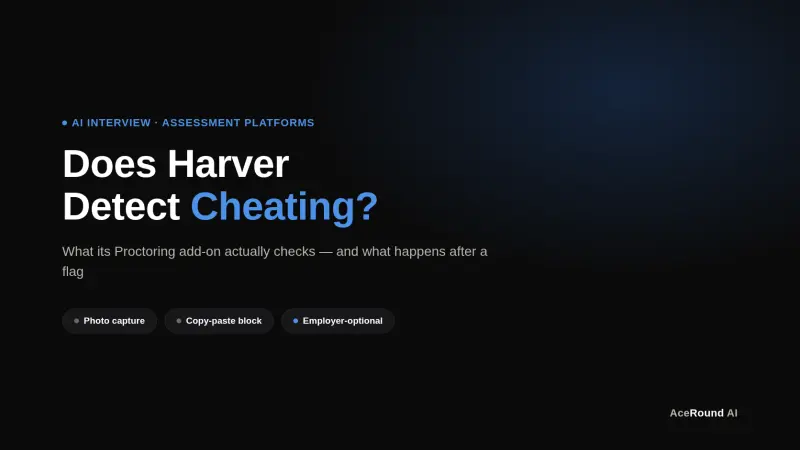
Does Harver Detect Cheating? What Its Proctoring Actually Checks
Does Harver detect cheating on its pre-employment assessments? A candidate look at Harver's Proctoring add-on, what gets logged after a flag, and what happens next.

Micro1's Zara AI Interview: What It Actually Tests (And Why Timing Gets Flagged)
Micro1's AI interviewer Zara has run 300,000+ interviews for remote roles. Here's why it flags response latency as a cheating signal, and what that means for AI prep.