Apriora AI Interview Tips: What Alex Actually Listens For
Apriora AI interview tips based on what the autonomous interviewer Alex actually scores — follow-up logic, cheat-detection triggers, and how to prepare honestly.
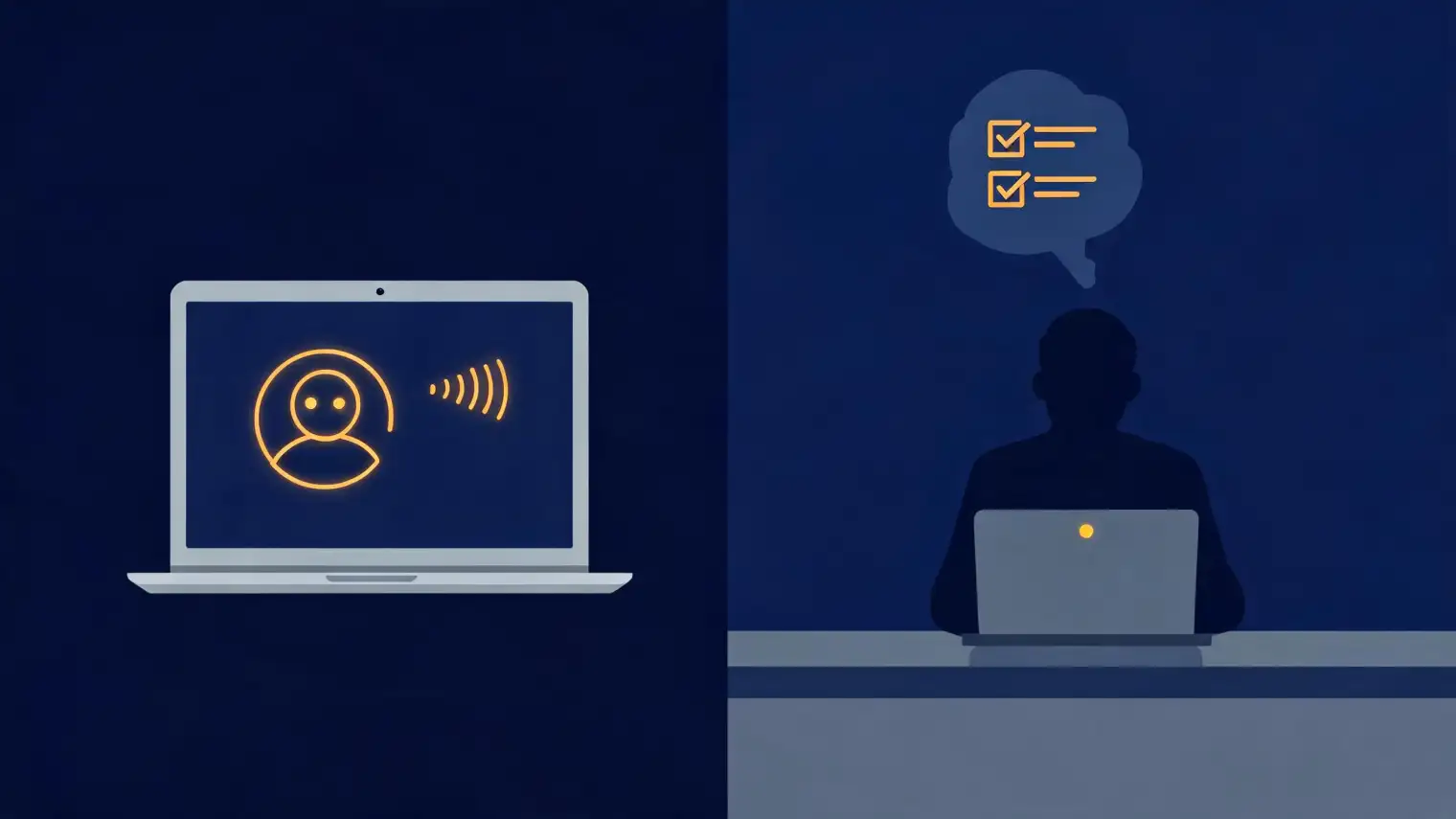
TL;DR: Apriora AI interview tips come down to one thing — Alex isn't grading a script, it's grading whether your specifics hold up under a follow-up. The AI runs 20–30 minute video interviews, asks adaptive follow-ups based on what you just said, flags tab-switching and background voices as "cheat" signals, and typically gates a single human round afterward. Prepare with real numbers ready, expect to be pushed on vague answers, and don't worry about the fast pace — it's the system, not you.
You click the link. A woman named Alex says hello, asks you to introduce yourself, and for the next 20-something minutes there's no human on the other end of the call. She listens, she nods (sort of), and when your answer is vague, she asks a follow-up you didn't prepare for.
That's Apriora — the AI interviewing platform built by a company most candidates have never heard of until they're staring at its camera. Backed by Y Combinator and covered by Forbes and CNBC, Apriora now runs roughly 1,000 interviews a day for employers who want a first-round screen without scheduling a human. If you're reading this because you have one scheduled, here's what's actually happening on the other side of the screen.
What Apriora Actually Is (and Why Alex Talks So Fast)
Apriora is not a recorded, one-way video interview like HireVue's async format. It's a live, conversational AI interviewer — the system asks a question, listens to your full answer, and generates a follow-up in real time based on what you said. That's a meaningfully different piece of software than a static question list, and it's why the experience feels different from other AI screens.
The most common candidate complaint isn't about the questions — it's about the pace. Candidates describe the AI speaking noticeably faster than a human interviewer would, moving briskly from question to follow-up to next question with little of the pause a nervous candidate might expect. That's a product characteristic, not a signal about how you're doing. Don't read speed as pressure; the AI talks at the same clip whether your last answer was strong or weak.
How the Apriora AI Interviewer Scores You
Apriora's adaptive follow-up logic is the part most prep advice misses entirely, because most of it is written for employers, not candidates. Based on how the system behaves in practice, here's what it's actually weighing:
Specificity over polish. A rehearsed, generic answer ("I'm a strong communicator who works well under pressure") doesn't hold up, because Alex's next question is usually a probe for a concrete example. Vague answers trigger vague follow-ups that expose the gap.
Whether your follow-up matches your first answer. This is the mechanic candidates don't expect. If you claim you "led the migration," expect a follow-up asking who else was on the team, what your specific decisions were, or what broke. Consistency between your headline claim and the follow-up detail matters more than the headline itself.
Speaking, not typing. Apriora requires spoken answers rather than text input for most question types. Some candidates have flagged this as a disadvantage for those who think better in writing — worth knowing going in so it doesn't catch you off guard mid-interview.
Behavioral signals it's built to flag. The system monitors for tab-switching, other voices in the room, and prolonged silence, tagging these as potential integrity flags for the employer to review. This isn't a stealth "gotcha" — it's disclosed monitoring, similar to what HireVue and HackerRank already do.
The Real Structure: What Happens After You Click Join
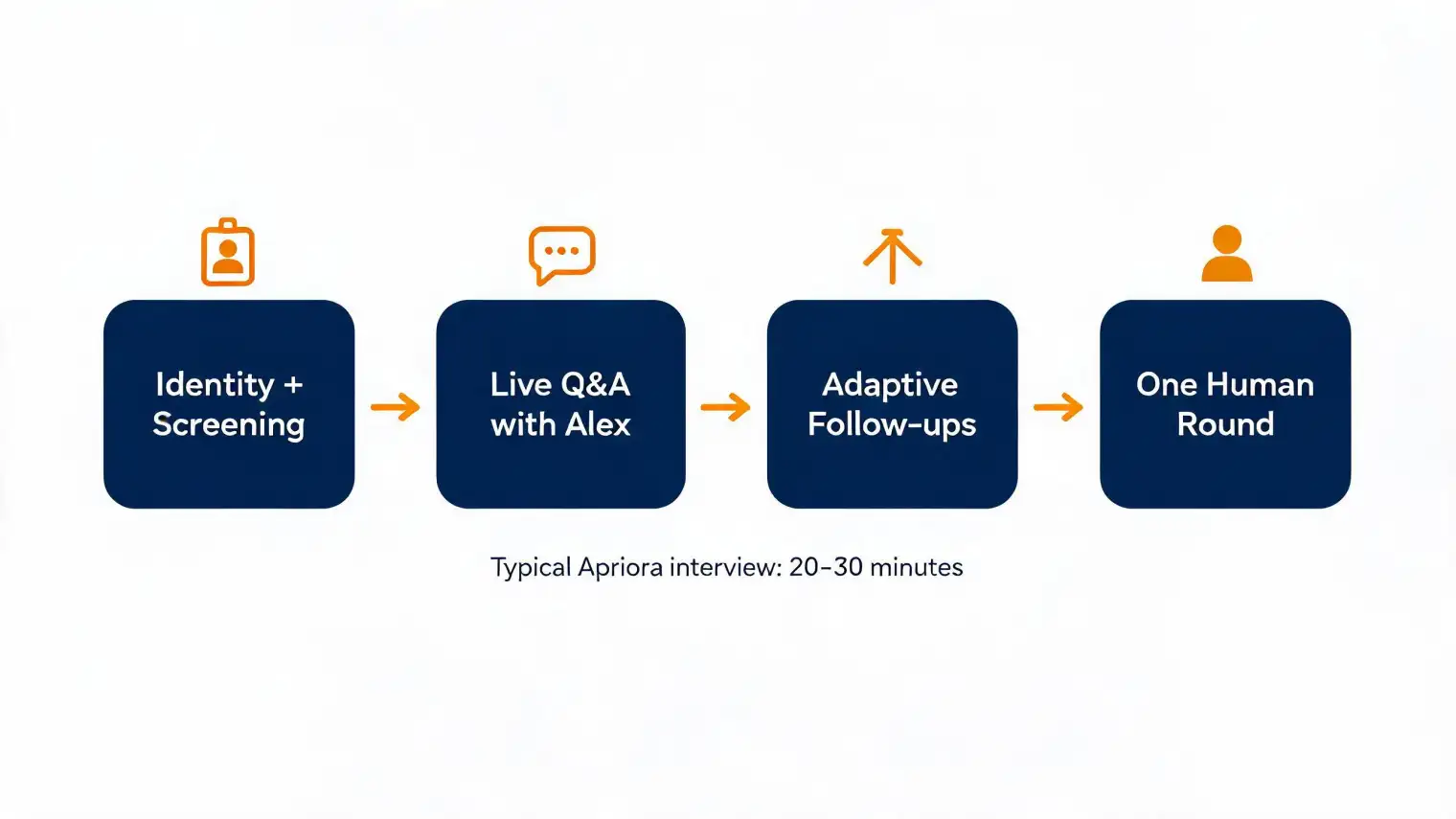
Most Apriora deployments follow a simple shape: identity/basic screening questions, a block of role-relevant behavioral or technical questions with live follow-ups, and then a close. The whole thing typically runs 20–30 minutes. For most employers using Apriora, this AI round is the first filter — candidates who pass usually move to one human-conducted round, not several. That's a meaningfully shorter pipeline than a traditional 4-5 round process, which is part of why employers adopted it in the first place.
Know that going in: this is not the final decision-maker in most pipelines, it's the gate. Treat it with the seriousness of a real interview, not a formality to click through.
Does Apriora Record You? What Happens to Your Data
Yes — video, audio, and in most implementations your screen are captured for the duration of the interview, and your responses are reviewed against the employer's rubric afterward. What candidates should actually be concerned about is disclosure, not surveillance: a 2026 Greenhouse candidate survey found 70% of candidates were never clearly told upfront that AI would be evaluating them, and Fortune reported nearly 4 in 10 candidates have walked away from a hiring process specifically because it required an AI interview.
If Apriora's data handling matters to you, ask the recruiter directly whether your interview footage is retained, for how long, and whether it's used beyond your own candidacy — legitimate employers using the platform should be able to answer this without hesitation.
How to Actually Prepare for an Apriora Interview
This isn't about tricking the system — Apriora's follow-up logic is specifically designed to catch answers that don't hold up, so trying to bluff past it usually backfires within one follow-up question. Prepare instead like this:
- Have 3-4 real stories ready with numbers attached. Not themes — specific projects, specific outcomes. "Reduced onboarding time by 40% by rebuilding the checklist flow" survives a follow-up. "I'm good at process improvement" doesn't.
- Rehearse out loud, not on paper. Since you're speaking, not typing, practice saying your answers, not just thinking them. The gap between a well-written answer and a well-spoken one is real.
- Expect to be pushed, and don't panic when it happens. A follow-up question is normal, expected behavior — not a sign you failed. Treat it as a chance to add the detail you left out the first time.
- Fix your environment before you start. Quiet room, one voice, no second monitor with notes open. Screen and audio monitoring exist; don't give the system something ambiguous to flag.
- Don't overthink the pace. The AI's speed is fixed regardless of how you're doing — it is not a signal, and reacting to it will only distract you from the actual answer.
When You're Interviewing With No Human on the Other End
The hardest part of an AI-conducted interview isn't the questions — it's that there's no human face giving you feedback cues while you talk, so you can't tell mid-answer whether you're rambling or landing the point. That's a real, specific problem, and it's part of what AceRound AI was built to help with: surfacing structure prompts in real time while you're speaking, so you have something to anchor to besides silence on the other end of the call. It won't write your answers for you, and it won't fool Apriora's follow-up logic — the goal is helping you stay organized under a format that gives you zero nonverbal feedback, not gaming a system built specifically to catch exactly that.
If you're facing more than one autonomous AI interviewer this cycle, our guide to Mercor AI interview tips covers a different but related platform, and how to pass an AI interview covers the category more broadly.
FAQ
How long is an Apriora AI interview? Most run 20–30 minutes, depending on the number of questions and how many follow-ups the system asks based on your answers.
Is Apriora just creating more steps to rejection? It can feel that way, but for most employers using it, Apriora replaces early-stage human screening calls rather than adding an extra round — if you pass, you typically move to one human-conducted interview, not several more AI rounds.
Why does the Apriora AI talk so fast? It's a product characteristic of the conversational engine, not a reaction to your answers. Candidates consistently note the brisk pace regardless of how the interview is going — don't read it as pressure or feedback.
Does Apriora AI record my video and screen? Yes, in most implementations. Video, audio, and often screen activity are captured and reviewed against the employer's rubric. If retention and data use matter to you, ask the recruiter directly before the interview.
Will I know if I'm being evaluated by AI instead of a person? You should be told, but a 2026 candidate survey found 70% of respondents said they weren't clearly informed upfront. If it isn't stated in your invite, it's reasonable to ask the recruiter directly.
Do I have to speak my answers, or can I type them? Apriora is built around spoken responses for most question types, unlike some AI screens that accept typed answers. Practice speaking your prepared stories out loud, not just reading them.
Author · Alex Chen. Career consultant and former tech recruiter. Spent 5 years on the hiring side before switching to help candidates instead. Writes about real interview dynamics, not textbook advice.
Related Articles
OpenAI's AI Interview Policy: Banned, Required, or Team-Dependent
OpenAI sells AI coding agents, then bans most candidates from using one. Here's the round-by-round policy, including the new agentic round that flips it.
Does Harver Detect Cheating? What Its Proctoring Actually Checks
Does Harver detect cheating on its pre-employment assessments? A candidate look at Harver's Proctoring add-on, what gets logged after a flag, and what happens next.
Micro1's Zara AI Interview: What It Actually Tests (And Why Timing Gets Flagged)
Micro1's AI interviewer Zara has run 300,000+ interviews for remote roles. Here's why it flags response latency as a cheating signal, and what that means for AI prep.