One-Way AI Video Interview Tips: What the AI Is Actually Scoring
One-way AI video interview tips: how transcript-based scoring actually works and how to structure your answers so it helps, not hurts, your score.

TL;DR: One-way AI video interviews score your transcript against a competency rubric, not your facial expressions — HireVue confirmed this shift publicly in 2021. The lighting and eye-contact tips everywhere online won't hurt you, but they also won't fix a rambling, unstructured answer, which is what actually tanks a one-way AI video interview score.
You get an email: "Complete your video interview within 5 days." You click the link, sit down alone in front of your laptop, and a countdown timer starts. No interviewer, no reaction, no follow-up question — just you, a camera, and a blinking red dot. Somewhere on the other end, software is going to grade what you just said.
That setup — a one-way video interview, also called an async or pre-recorded video interview — has become the default first screen at a huge number of companies, and almost every guide to it repeats the same five tips: quiet room, good lighting, look at the lens not the screen, don't sound scripted. Those tips aren't wrong. They're also not what actually moves your score, because almost none of them explain what the AI on the other end is actually measuring.
What Actually Happens in a One-Way AI Video Interview
The mechanics are the same across most platforms — HireVue, Spark Hire, Jobma, Willo, Modern Hire: you get a link, a set of preset questions appear one at a time, you record a response to each (sometimes with a short prep timer before recording starts), and you submit the whole set before a deadline. Some platforms give you one take per question; others let you re-record within limits before locking in a final answer.
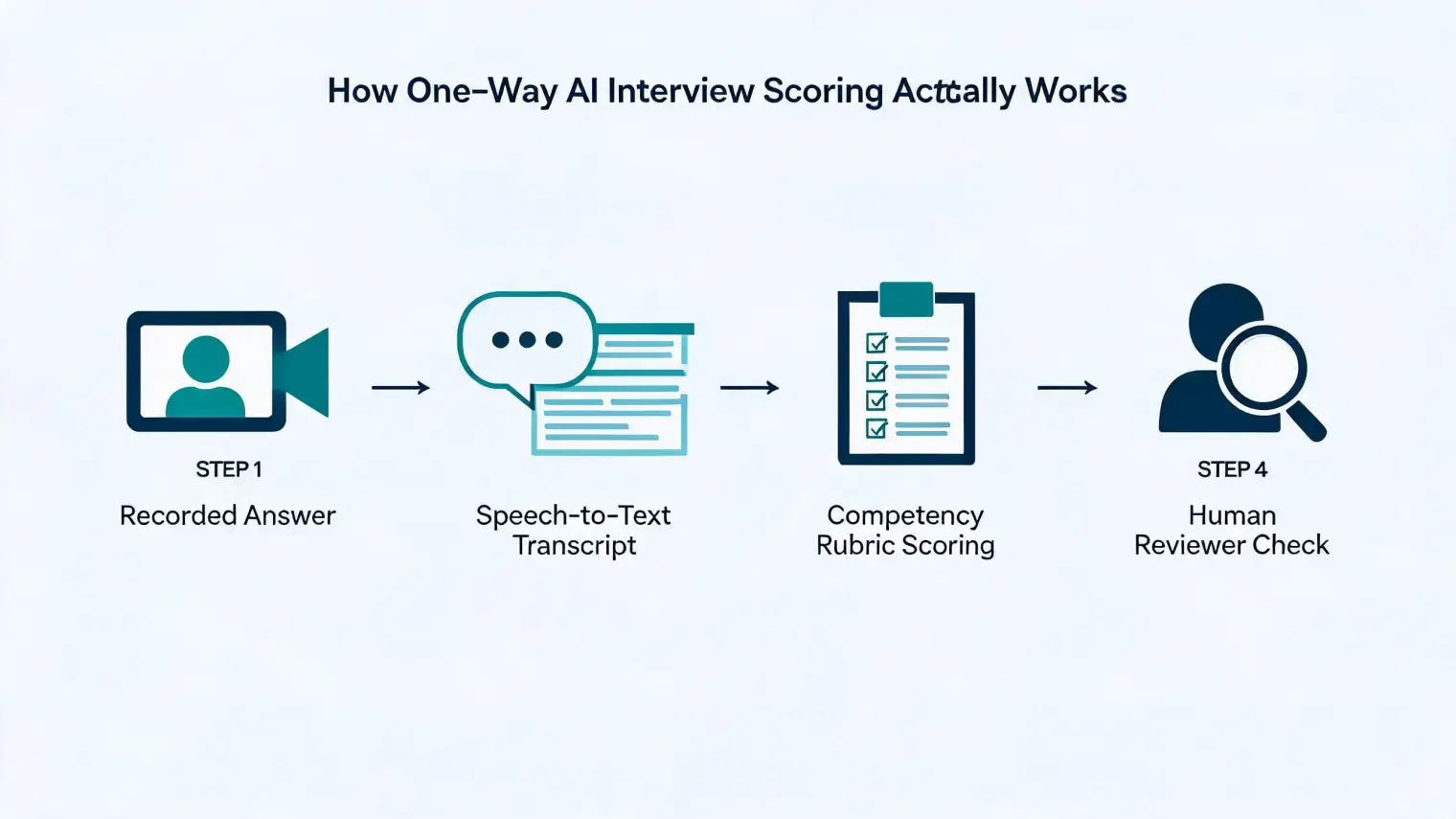
What happens after you hit submit is where most advice stops explaining and just reassures you. Your video is transcribed via speech-to-text, and that transcript — not your face — is what a scoring model checks against a rubric built from the job description. A recruiter or hiring manager typically reviews the top-scoring recordings afterward, which means the AI is functioning as a filter, not a judge with final say.
What the AI Is Actually Scoring (Not What You Think)
Here's the part most one-way interview guides skip entirely: in 2021, Fortune reported that HireVue dropped facial-expression analysis from its algorithm following an external bias audit. Other vendors in the space moved in a similar direction. That single change reshaped what actually matters in a one-way interview: the scoring is now built primarily on your transcript, checked against a competency rubric tied to the job posting.
Practically, that means:
- Filler words and rambling cost you more than nervousness does. A transcript full of "um," "like," and restarted sentences reads as unstructured even if you looked perfectly calm on camera.
- Missing the actual competency costs you the most. If the rubric is scoring "stakeholder management," a technically strong answer that never mentions stakeholders, conflicting priorities, or influence still scores low — the model isn't inferring intent, it's matching language to a rubric.
- Time limits interact with scoring. An answer that gets cut off mid-sentence by a hard time cap can be transcribed as incomplete, which reads as a weaker response than a shorter, complete one.
None of this means "game the keywords" — a transcript stuffed with buzzwords and no substance reads as hollow to a human reviewer even if it superficially matches a rubric. It means structure and specificity matter more here than in a live interview, because there's no interviewer to notice you were actually making a good point despite a clumsy delivery.
How to Structure Answers So the Transcript Scores Well
Two moves make the biggest difference, and neither is about faking anything:
1. Use STAR, but say the structure out loud. In a live interview, a skilled interviewer can follow a loosely structured story and mentally sort it into Situation-Task-Action-Result. A transcript-scoring model can't do that inference as reliably — it's pattern-matching language, not reading intent. Signpost your own structure explicitly: "The situation was... My task was... Here's what I did... The result was..." It sounds slightly more formal than natural conversation, and that's fine here — clarity outscores casualness in a transcript.
2. Mirror the job description's actual language. If the posting says "cross-functional collaboration" and "data-driven decisions," use those exact phrases when they're true of your experience — the same logic as tailoring a resume to pass an ATS keyword scan, applied to a spoken answer. This isn't about stuffing buzzwords into an unrelated story; it's about not making the model guess that your "worked closely with other teams" example was actually cross-functional collaboration.
Keep each answer to roughly 60-90 seconds. That's long enough for a full STAR structure, short enough that you don't bury your point in the back half of a two-minute ramble that a hard time cap might cut off anyway.
The "Is Anyone Actually Watching?" Anxiety Is Real — Here's the Honest Answer
Search around and you'll find real candidates describing one-way interviews as feeling like "a monologue in front of a blank screen," uncertain whether their answers are ever reviewed by an actual person or just scored and filed. Some candidates have reportedly abandoned recordings mid-way over exactly that uncertainty.
The honest answer: assume a human eventually watches it. Platforms and employers vary in exactly how the AI score gates human review, and most won't disclose their specific process — but in nearly every real-world deployment, the AI functions as a triage step that surfaces top recordings for a recruiter, not a fully autonomous hiring decision. Recording an answer you'd be comfortable with a real person watching — not just a rubric — is the safer assumption either way.
One-Way vs. Live AI-Assisted Interviews: What's Actually Different
It's worth being precise about a distinction that gets blurred a lot: a one-way interview and a live, AI-assisted interview are not the same format, and prep for one doesn't fully transfer to the other.
In a one-way interview, you're alone with a fixed question list, no live back-and-forth, and a transcript that gets scored after the fact. In a live interview — even one where you're using a real-time AI copilot like AceRound for support — the interviewer can push back, ask a follow-up you didn't script, or take the conversation somewhere your prepared STAR story doesn't quite fit. A live copilot has to adapt in the moment to whatever direction the actual conversation takes; it can't fall back on a fixed question bank the way a one-way platform's rubric can.
That's the honest limit worth naming: no tool, live or async, can fabricate interview substance you don't have. What real-time AI help is actually good for in a live round is structure under pressure — the same STAR-signposting habit that helps a one-way transcript score well, surfaced instantly when a live interviewer catches you off guard. If you're preparing for both formats, our guide on AI phone screen interview tips covers the voice-only live variant, and real-time AI interview help breaks down how live-assist actually works during an active conversation.
Common One-Way Interview Platforms and What to Expect
A few platforms show up constantly in one-way interview invites, and their mechanics differ slightly:
- HireVue — the largest player; publicly describes its evaluation approach as competency-based since dropping facial-analysis scoring in 2021. See our breakdown of what HireVue actually records if you're also worried about screen or tab monitoring during a webcam session.
- Spark Hire — typically gives a fixed prep time and take limit per question, visible upfront in the invite.
- Jobma — commonly used across APAC and EU hiring pipelines, with similar prep-timer mechanics.
- Willo / Modern Hire — often used for high-volume entry-level screening, usually with stricter one-take, no-retake policies.
Read your specific invite email closely — re-record limits, time caps, and deadlines are set per employer, not standardized across the industry, and assuming the wrong platform's rules is an easy way to waste your one allowed take.
FAQ
Is anyone actually watching my one-way video interview, or does the AI decide alone? It depends on the employer, and most platforms won't tell you which. In practice, the AI score is almost always a screening filter, not the final decision — a recruiter or hiring manager reviews the top-scoring recordings before anyone moves to a live round. Assume a human will eventually watch the video you're recording, even if an algorithm sees it first.
How long do I have to complete a one-way video interview, and how many times can I re-record an answer? This varies by platform and by what the employer configures — some give you a fixed deadline (often 3-7 days) and one take per question; others allow unlimited re-recording within a practice mode before your final take. Read the instructions email carefully, since re-record rules are set per invite, not per platform.
Does the AI in a one-way interview score my facial expressions, or just what I say? Mostly what you say. After a 2021 bias audit, HireVue publicly dropped facial-expression analysis from its scoring, and other vendors followed a similar path. Today's scoring is built primarily on your speech-to-text transcript checked against a competency rubric — which means rambling and missing structure hurt your score more than a nervous expression does.
How long should my answers be in a one-way AI video interview? Aim for 60-90 seconds per answer unless the platform gives you a different time cap — enough to fit a full STAR structure without padding. Answers under 30 seconds usually read as under-developed to a transcript-based rubric; answers that run past 2 minutes tend to bury your best point under filler.
What if I don't have a webcam — can I record a one-way interview on my phone? Yes, every major one-way platform (HireVue, Spark Hire, Jobma, Willo) supports recording from a phone browser or a dedicated app, and using a phone is often better for audio and eye-level framing than a laptop webcam propped on a stack of books. Prop the phone at eye level and make sure your Wi-Fi is stable before you start — a dropped upload mid-answer is worse than any lighting mistake.
Is a one-way AI interview the same as a live AI-assisted interview? No. A one-way interview is fully pre-recorded — you answer alone, on your own time, with no one reacting in real time. A live AI-assisted interview (like a real-time copilot) happens during an actual conversation with a human interviewer, where the help has to adapt to whatever direction the interviewer takes the conversation, not a fixed question list.
Author · Alex Chen. Career consultant and former tech recruiter. Spent 5 years on the hiring side before switching to help candidates instead. Writes about real interview dynamics, not textbook advice.
Related Articles
OpenAI's AI Interview Policy: Banned, Required, or Team-Dependent
OpenAI sells AI coding agents, then bans most candidates from using one. Here's the round-by-round policy, including the new agentic round that flips it.
Does Harver Detect Cheating? What Its Proctoring Actually Checks
Does Harver detect cheating on its pre-employment assessments? A candidate look at Harver's Proctoring add-on, what gets logged after a flag, and what happens next.
Micro1's Zara AI Interview: What It Actually Tests (And Why Timing Gets Flagged)
Micro1's AI interviewer Zara has run 300,000+ interviews for remote roles. Here's why it flags response latency as a cheating signal, and what that means for AI prep.