AI Interview Transcript Review: Turn Every Real Interview Into a Coaching Session
Learn how AI interview transcript review works, what it catches that you miss, and how to use it to systematically improve your answers across rounds.
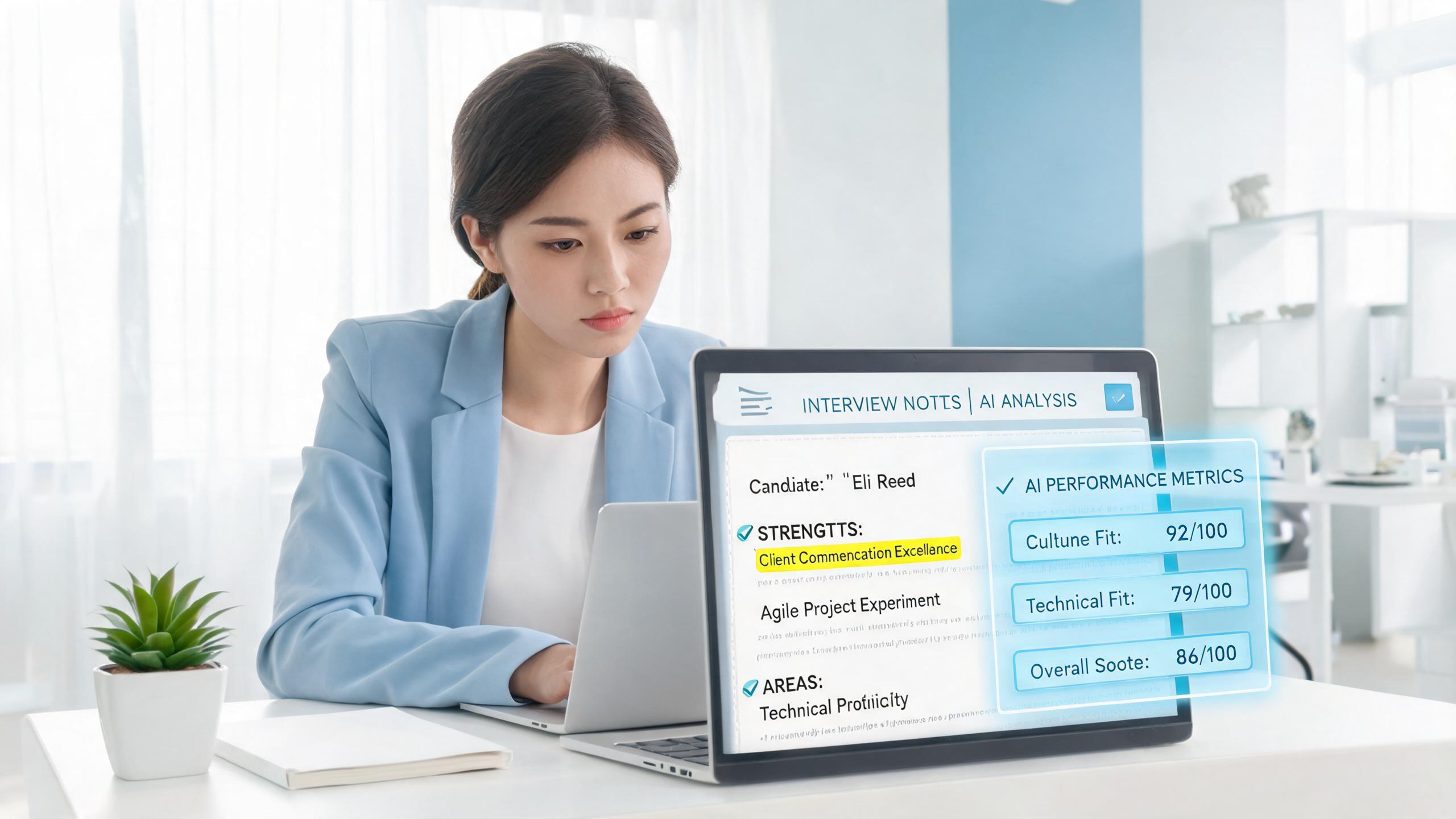
TL;DR: AI interview transcript review analyzes what you actually said in a real interview — not a mock — and surfaces patterns you'd never catch in the moment. It turns each completed round into a closed-loop coaching session before your next one.
Most people leave an interview, replay fragments of it in the shower, and convince themselves it went either better or worse than it did. Memory is unreliable. The cognitive bias problem is real: under stress, you compress the awkward pauses and inflate the strong answers. 3 hours later, you have a distorted picture.
AI interview transcript review fixes that. Instead of working from memory, you work from the actual record — what you said, how you structured your answers, where you lost the thread. This guide covers how it works, what it catches, and how to use it to systematically close the gap between interviews.
What AI Interview Transcript Review Actually Is
The phrase gets used two ways, and the difference matters.
Employer-side tools (insight7, Dovetail, Otter for HR) transcribe and analyze candidate pools in aggregate — they're for recruiters identifying themes across 50 applicant interviews. Not what we're talking about.
Candidate-side interview transcript review means analyzing your own interview record: what you said, how it compared to what you planned to say, where your answers drifted, what the interviewer signaled, and what you should change.
Until recently this was a manual process: you'd take notes immediately after, try to reconstruct the conversation, and send yourself a voice memo. The problem is you're always working from a flawed reconstruction. AI-powered transcript review replaces the reconstruction with the actual text, then does the analysis on top of it.
For post-interview reflection to actually improve your performance, you need both: the accurate record and the analytical framework to extract learning from it. AI provides both.
The "Game Tape" Advantage: Real Interviews vs. Mock Practice
Athletes watch game tape. They don't just train harder — they review specific plays where execution diverged from the game plan. That's the difference between mock interview practice and interview performance analysis on a real conversation.
Mock practice builds general fluency. It's useful. But it has a ceiling: you practice against simulated pressure, not the actual pressure of a live round with a real hiring decision attached. Your brain runs differently. Your answer structure shifts. You edit mid-sentence in ways you don't in practice.
Real interview transcript review catches things mock practice never will:
- The completion gap: Do you actually finish the Result in every STAR answer, or do you trail off into elaboration?
- Filler pattern under stress: When a question surprised you, did "um" spikes appear? How long did the pause last before you found the structure?
- Question reframing tells: Did you answer the question asked, or subtly pivot to the question you wanted?
- Concrete vs. vague drift: Over the course of a 45-minute interview, do your examples get progressively less specific? This is a stress-response pattern that's invisible until you read the transcript.
A 2024 paper in ACM (Daryanto et al., "Conversate: Supporting Reflective Learning in Interview Practice Through Interactive Simulation and Dialogic Feedback") found that dialogic AI feedback — the kind that responds to your specific answers — outperforms one-directional scoring. The implication for transcript review: you want an AI that engages with what you actually said, not one that runs a generic rubric.
What AI Finds in Your Transcript That You'd Miss
When you run a real interview transcript through AI feedback on interview answers, a few categories of insight emerge that are structurally hard to self-diagnose:
Missing Answer Components
STAR answers (Situation, Task, Action, Result) are easy to outline in prep but easy to truncate under pressure. AI can map every response against the framework and flag which component you dropped. In most candidates' transcripts, it's the Result — you describe what you did but not what it produced. Interviewers score based on Result. This is fixable once you see the pattern.
Consistency Across the Interview
Your first answer to "tell me about a time you influenced without authority" might be crisp. Your fourth behavioral answer, 35 minutes in, might repeat the same project — because under cognitive load, people cycle back to the examples they know best. AI cross-references all your examples and flags overlaps.
Language Confidence Signals
Hedging language ("I think," "sort of," "kind of") and passive voice ("the project was completed") vs. active ownership ("I shipped the feature") correlate with how confident candidates come across. A transcript makes these patterns visible in a way that self-perception doesn't.
Pacing and Structure Signals
Some platforms that record video interviews (like HireVue or certain async formats) produce transcripts with timestamps. The gap between a question and the start of your structured answer is visible data. Long unstructured gaps before you find your thread are different from a brief deliberate pause before a focused response. AI can flag the difference.
How to Do an AI Interview Transcript Review (Step-by-Step)
Whether you have a transcript from a live session or need to reconstruct one from recording, the process is:
Step 1: Get the transcript
- If you used AceRound during the interview, your transcript is already captured — the AI was present for the whole conversation.
- If you didn't, many video platforms (Zoom, Google Meet, Teams) offer automatic transcription if recording was enabled. Request the recording from the interviewer if you can, or check your own local recording.
- If you have nothing: immediately after the interview, dictate a reconstruction to a voice memo and transcribe it. Imperfect, but better than pure memory.
Step 2: Run a structured analysis prompt
Paste the transcript into an AI tool with a structured prompt. Don't just ask "how did I do?" — that produces generic output. Instead:
"Review this interview transcript. For each behavioral answer I gave: (1) identify which components of STAR are present or missing, (2) flag any examples I reused, (3) note where I hedged instead of stating directly, (4) highlight any questions I didn't fully answer. Format as a table."
Step 3: Compare against your prep
If you had a written answer framework before the interview, compare what you planned to say vs. what you actually said. The divergence points are the most valuable — those are the moments where pressure or surprise changed your execution.
Step 4: Write one revision per gap
Don't try to fix everything. Identify the single highest-impact gap from the transcript and write one improved answer. If you dropped Results in 3 of 4 STAR answers, practice ending every story with a quantified result for 10 minutes. That's more valuable than re-doing the entire prep deck.
Step 5: Carry forward, not just backward
A common mistake: treating transcript review as post-mortem only. The better use is forward-looking. Before your next round with the same company, read the transcript from the previous round. What examples have you already deployed? What topics surfaced that you should deepen? What did the interviewer signal interest in that you should expand?
Try it now: AceRound captures and reviews your interview session in real time. Start a free session →
The Closed-Loop Advantage of Tools That Were In the Room
Here's the thing about generic AI transcript review: you still have to bring the raw material yourself. The analysis is only as good as the transcript quality, and manually reconstructed transcripts have gaps.
Closed-loop interview coaching — where the same AI that assisted you during the interview also reviews the session afterward — is structurally different. It knows what suggestions it surfaced and which ones you used. It can show you: "At 14:32, when asked about scope management, we suggested leading with the constraint. You pivoted to the outcome instead. Here's what the gap looked like."
That's a different class of feedback than "your STAR answer was incomplete." It's the difference between a generic rubric and a specific debrief from your own live session.
A 2025 study of AI interview tools across 20 computer science students (Virtual Interviewers, Real Results) found 80% of participants rated AI interviewers as realistic, with measurable confidence gains. But the study also noted that the quality of post-session feedback was the variable most correlated with performance improvement — not the practice volume.
More practice without better feedback hits a ceiling fast. Transcript review is how you raise that ceiling.
Cross-Round Pattern Analysis: The Longer Game
Single-interview transcript review is valuable. But the real leverage is longitudinal interview performance analysis across multiple rounds or multiple companies.
If you're in active job search and going through several interview loops simultaneously, you'll accumulate data across very different contexts — a VC-backed startup, a Fortune 500, a Series B — with different interviewers and different question styles. The same weaknesses will appear in all of them, because your patterns are yours, not context-specific.
Cross-round analysis lets you answer questions you can't answer from a single session:
- Which types of questions reliably make your answers deteriorate?
- Are your answers shorter or longer than optimal? (Research on hiring suggests 60–90 second behavioral answers outperform both shorter and longer — but most people have no idea where their average falls.)
- Do you rely on a small set of 3–4 "hero examples" that are showing up in every interview, or do you have genuine range?
An AI interview answer generator can help you build that range — new examples, new angles. But you won't know what to regenerate until transcript analysis shows you where you're cycling.
FAQ
Does AI interview transcript review work for technical interviews too?
Yes, but the analysis looks different. For technical interviews, transcript review is less about STAR structure and more about: Did you articulate your reasoning out loud, or did you go quiet and think internally? Did you ask clarifying questions, and how quickly? Did you explain trade-offs or just produce a solution? These are coach-visible signals in a transcript even when the technical content itself is specialized.
What if I don't have a recording of my real interview?
Work with what you have. Immediately after any interview, dictate a voice reconstruction — don't type it, dictate it, because it's faster and more natural. Cover: what were the questions, approximately what did you say, where did you feel uncertain or unclear. Transcribe via any voice-to-text tool. This is imperfect but still worth analyzing because your immediate post-interview recall, while biased, is much richer than what you'll have 24 hours later.
Is it ethical to use AI to analyze my interview transcript?
Analyzing your own performance is standard practice — athletes do it, salespeople do it, public speakers do it. Using AI to do it more systematically isn't ethically different from reviewing your own notes. The ethical questions around AI in interviews relate to real-time assistance and deception, not post-interview self-review. See our deeper analysis of where the AI-in-interviews ethics line actually sits.
Can AI transcript review replace mock practice?
No, and it shouldn't try to. Mock practice builds fluency and confidence under simulated conditions. Transcript review builds self-knowledge about your actual patterns under real conditions. You need both — they're complementary, not substitutable. AI mock interview tools are the better fit for fluency; transcript review is where you diagnose and close specific gaps.
How long should I spend on post-interview AI analysis?
20–30 minutes, not more. The goal is extracting one to two actionable insights, not producing a comprehensive debrief. More time rarely produces proportionally more insight — it produces anxiety and overthinking. Identify the biggest gap, write one improved answer, move forward.
Does this work for phone screens, not just full interviews?
Absolutely. Phone screens are often where candidates underperform most because they can't read visual feedback from the interviewer. Having the transcript from a phone screen is particularly valuable — you can see where your answer structure drifted without the visual anchoring of eye contact.
Author · Alex Chen. Career consultant and former tech recruiter. Spent 5 years on the hiring side before switching to help candidates instead. Writes about real interview dynamics, not textbook advice.
Related Articles
Does TCS iON Detect AI or Cheating During the NQT Exam?
Does TCS iON detect AI during the NQT? What its remote proctoring monitors, and why the interview round after is a safer, prep-friendly stage.

Does BrightHire Record You? Yes — Here's What It Captures (2026)
Does BrightHire record your interview? Yes — video, audio, and an AI transcript, now part of Zoom since its 2025 acquisition. What's captured and how to opt out.
AceRound vs Beyz AI: Which Real-Time Interview Copilot to Trust?
AceRound vs Beyz AI compared: architecture, the pricing trap behind Beyz's $24.99 headline rate, a dedicated Beyz-detection tool, and unverified ratings.