What Reddit Actually Says About AI Interview Assistants in 2026
We read through the Reddit threads on AI interview copilots so you don't have to — the real praise, the real complaints, and the incidents everyone cites.
TL;DR: Reddit's take on AI interview assistants isn't one opinion, it's three. Prep tools (mock interviews, resume help) get near-universal approval. Live copilots that whisper answers during the actual call get split three ways — pragmatists use them as scaffolding, purists call it cheating, and a middle group only uses them for behavioral rounds, never live coding assessments. The tool itself is rarely what gets people caught; flat delivery and unnaturally perfect timing are.
Search "AI interview assistant" on Reddit and you'll land on the same thread pattern within minutes: one comment bragging about landing an offer with help from a copilot, three comments underneath warning that it's a fast way to get blacklisted, and a mod note reminding everyone this gets asked weekly. A post from a user going by u/keeneyegirl claiming to have used Cluely to get through six interview rounds at a fintech company picked up thousands of upvotes and an even longer argument in the comments about whether that's impressive or a red flag for the industry. That thread alone tells you more about where the community actually stands than any five-star review ever could.
This isn't a sales pitch dressed up as a Reddit roundup. It's an honest read of what people who've actually tried these tools are saying — the good, the risky, and the parts most "top AI interview tools" articles conveniently skip.
The three camps Reddit keeps splitting into
Every long thread on this topic settles into roughly the same three positions, whether it's on r/cscareerquestions, r/jobs, or a smaller interview-prep subreddit.
- Pragmatists — treat a copilot like digital cue cards. They'd use notes in a real interview if allowed, so a discreet on-screen prompt during a behavioral round doesn't feel categorically different to them.
- Purists — see any live assistance as lying about your own competence, full stop, regardless of format. To this camp, "cheating" isn't a spectrum.
- Conditional users — the largest and most nuanced group. They'll use a copilot for behavioral or culture-fit rounds where the interviewer is assessing communication, but draw a hard line at live coding assessments or take-homes with explicit no-tool policies, because the risk-reward flips entirely.
If you only read one camp's comments, you'll walk away with a distorted picture. The conditional-user camp is where most of the useful advice lives, because they're the ones actually weighing tradeoffs instead of arguing absolutes.
What Reddit has zero problem with: prep tools
Here's the part that rarely makes it into "is AI cheating" headlines: mock-interview and prep tools get almost no pushback anywhere on Reddit. Threads recommending Pramp-style peer practice, Exponent's structured FAANG drills, or even Google's free Interview Warmup tool read like consumer-electronics recommendations, not ethics debates. Nobody's arguing about whether rehearsing answers beforehand is "real" interview skill — it obviously is, and research on rehearsal from Harvard Business School backs that up directly.
That distinction matters because it's the cleanest dividing line in the entire debate: prep before the interview is universally fine; assistance during the interview is where the arguments start.
Where it gets genuinely divisive: live copilots
The controversial category is tools that listen in real time and surface suggested talking points on your screen while the interviewer is still speaking. Reddit's complaints about this category cluster around a few repeat themes:
- Pricing traps. Final Round AI in particular gets called out repeatedly for auto-renewal billing north of $148/month that's hard to cancel, with Trustpilot disputes referenced in multiple threads.
- Latency during the actual call. Users report 5–10 second lag on some tools right when they need the response fastest — which defeats the entire point of a "real-time" copilot.
- Quality gap between behavioral and technical use. Copilots built for conversational answers tend to fall apart the moment a live coding round starts, because reading a suggested explanation off-screen while also typing working code is a genuinely different cognitive task.
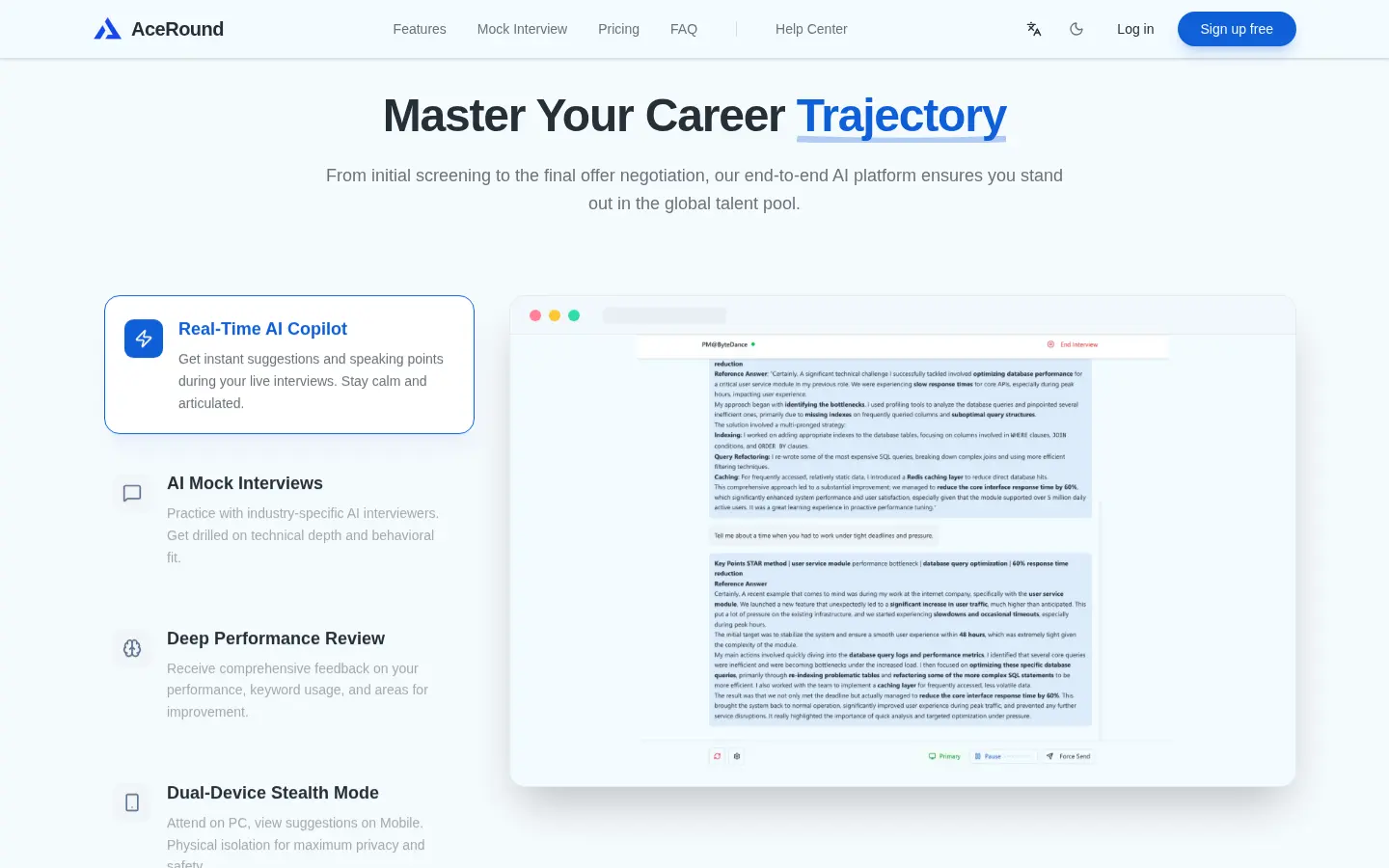
That last point is worth sitting with, because it's the actual product decision AceRound made: rather than promising to also handle live-coding assistance (where the risk of visible screen-share detection is highest and the reward is lowest), it's built around behavioral and general interview rounds — the format where a quick prompt is scaffolding, not a script for a problem you can't actually solve yourself.
The cautionary tales Reddit keeps citing
Two stories come up again and again whenever this topic gets debated, and both are worth knowing before you read any glowing review.
The first is Cluely's founding story. Its CEO built an earlier version of the same concept as a student and was reportedly expelled from Columbia over it, with a subsequent Harvard offer rescinded once the incident surfaced — a background Cluely has never fully distanced itself from, even as its public marketing shifted to a tamer "AI meeting assistant" framing. It's the reference point Reddit reaches for whenever someone asks "but is this actually legit."
The second is the aforementioned u/keeneyegirl thread — a candidate who says they used a copilot to get through six full interview rounds for a real fintech role. Depending on which subreddit you read it in, that story gets held up as proof the tools work, or as exhibit A for why hiring processes need to change. Either way, it's cited constantly, which tells you it's the story people's fears (or hopes) actually anchor to — not hypothetical scenarios.
What actually gets people caught, according to Reddit
The recurring, almost boring consensus across dozens of threads: the tool is hard to detect; the technique is what fails. The behavioral tells people describe getting flagged for are consistent:
- Reading a suggestion verbatim instead of paraphrasing it in your own voice
- Eye movement that drifts toward a second screen or off-camera area at a consistent rhythm
- Response timing that's unnaturally uniform — a beat of silence, then a fully-formed answer, every single time
- Language that's more polished than the rest of your speech pattern, especially on follow-up questions the tool didn't anticipate
That last point matters more than people expect. A copilot can hand you a strong opening answer, but interviewers dig into follow-ups precisely because that's where prepared material runs out. If you can't defend or extend the answer when pushed, that gap is what actually raises suspicion — not the existence of a tool in the first place. Karat, which runs technical interviews for engineering teams at scale, publishes its own detection guidance for hiring managers built around exactly this pattern rather than trying to block software.
The part most "top tools" roundups skip: the ethics research
A recent academic review on ethics and social responsibility in AI-assisted interviewing breaks the real risk down into categories worth knowing even if you never plan to argue philosophy on Reddit: language homogenization (everyone's answers start sounding the same), erosion of interviewer-candidate rapport, unequal access (not everyone can afford the same tools), unclear accountability when something goes wrong, and privacy/compliance concerns tied to recording a live conversation through third-party software. None of that means don't use one — but the "is this cheating" question genuinely has more layers than a single subreddit thread can resolve, and pretending otherwise is how you end up over-relying on something you haven't actually thought through.
There's also a practical legal layer that's easy to ignore: most assessment platforms and many employment agreements explicitly prohibit undisclosed AI assistance during evaluation, and violating that isn't an abstract ethics question, it's a contract one — worth reading before you assume "everyone does it" covers you.
How to actually use one, the way Reddit's pragmatists do
Strip away the arguing and the pattern that Reddit's most credible commenters converge on looks like this:
- Use structured prep (mock interviews, question prediction, STAR-format rehearsal) heavily before the interview — this part is uncontroversial and effective.
- If you use live assistance, reserve it for behavioral and general rounds, not live-coding assessments with explicit no-tool policies.
- Treat any suggestion as a starting point you rephrase in your own words, not a script — this is also your actual protection against detection.
- Know the platform's stated policy before you use anything live. "Reddit says it's fine" isn't a defense if the assessment terms say otherwise.
If you're evaluating tools in this category, our own honest comparisons on Cluely, Interview Coder, and the broader undetectable AI interview assistant landscape go through the same tradeoffs in more detail — including where we think we're a good fit and where we're honestly not.
FAQ
Is using an AI interview copilot cheating? It depends on the format and the platform's stated policy, not on Reddit consensus. Most communities agree prep tools are fine and live assistance during a no-tool live-coding assessment is not; the murkiest territory is a behavioral round with no explicit policy either way.
Can interviewers detect AI copilot use during a video interview? Detecting the software itself is genuinely hard. What gets flagged is behavior — verbatim reading, unnatural response timing, and an inability to extend on follow-up questions that weren't anticipated.
Is Interview Coder detectable in 2026? Its window-hiding engineering is real, but detection has shifted from "can they see the app" to "does the candidate's behavior look natural," which is a harder problem for any tool to solve for you. See our full Interview Coder alternative comparison for specifics.
What's the most discreet interview copilot that won't get detected? No tool can promise that, and any marketing claiming otherwise should raise a flag on its own. The safer framing Reddit converges on is minimizing detection risk through how you use it, not which app you pick.
Are AI interview assistants worth it, or mostly scams? Neither, universally. Prep-focused tools have strong, consistent praise. Live-copilot tools vary widely in reliability and billing practices — read cancellation terms and latency reports before paying, which is exactly what the pricing complaints on Reddit are trying to warn you about.
How do I use an AI interview copilot without getting caught? Rephrase suggestions in your own words instead of reading them, stick to formats where live assistance isn't explicitly prohibited, and don't rely on it for questions you haven't prepared for at all — the gap shows up fast on a real follow-up.
Author · Alex Chen. Career consultant and former tech recruiter. Spent 5 years on the hiring side before switching to help candidates instead. Writes about real interview dynamics, not textbook advice.
Related Articles
OpenAI's AI Interview Policy: Banned, Required, or Team-Dependent
OpenAI sells AI coding agents, then bans most candidates from using one. Here's the round-by-round policy, including the new agentic round that flips it.
Does Harver Detect Cheating? What Its Proctoring Actually Checks
Does Harver detect cheating on its pre-employment assessments? A candidate look at Harver's Proctoring add-on, what gets logged after a flag, and what happens next.
Micro1's Zara AI Interview: What It Actually Tests (And Why Timing Gets Flagged)
Micro1's AI interviewer Zara has run 300,000+ interviews for remote roles. Here's why it flags response latency as a cheating signal, and what that means for AI prep.