US Remote Interview Tips for Candidates in India and the Philippines
US company remote interview tips for candidates in India and the Philippines: timezone math, connectivity backup plans, and what US interviewers actually score.
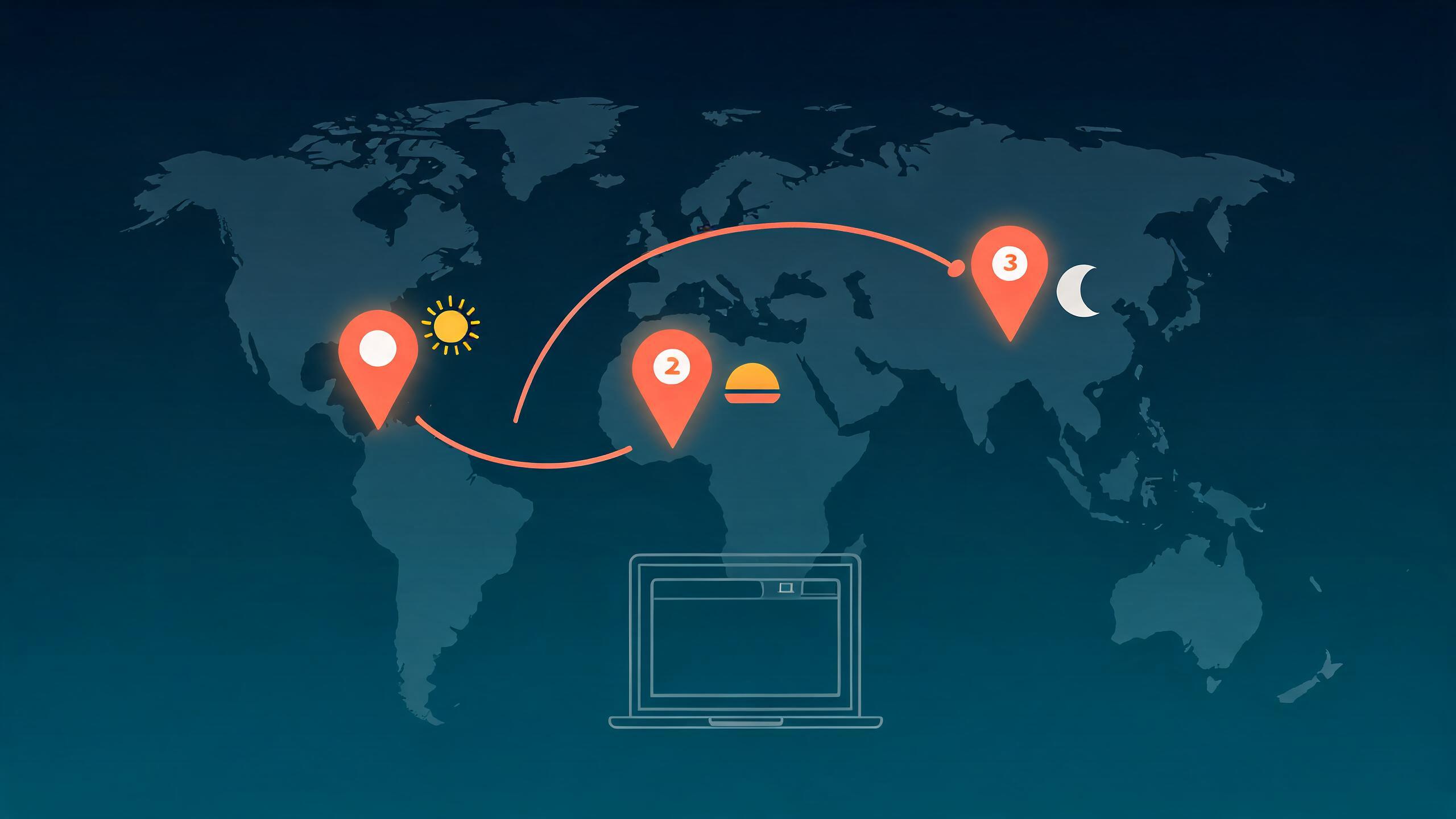
TL;DR: A US company remote interview from India or the Philippines fails less often on skills than on logistics — a miscalculated timezone, a dropped call with no backup plan, or a communication style that reads as "quiet" instead of "confident" to a US interviewer. Confirm the exact timezone in writing, build a wifi-loss contingency before you need one, and lead every answer with the outcome — regardless of role or industry.
Two candidates apply for the same remote role at a US company. Both are equally qualified. One gets the offer. The difference, more often than recruiters admit, isn't the interview answers — it's whether the candidate showed up on time in the right time zone, handled a connectivity hiccup like it was routine, and communicated in a register the interviewer recognized as direct and confident rather than deferential.
This isn't about IT-specific technical rounds or BPO voice assessments — it's the layer underneath all of that: the logistics and cross-cultural mechanics of a remote interview that most advice skips because it assumes you already know them.
The Timezone Math Nobody Explains Clearly
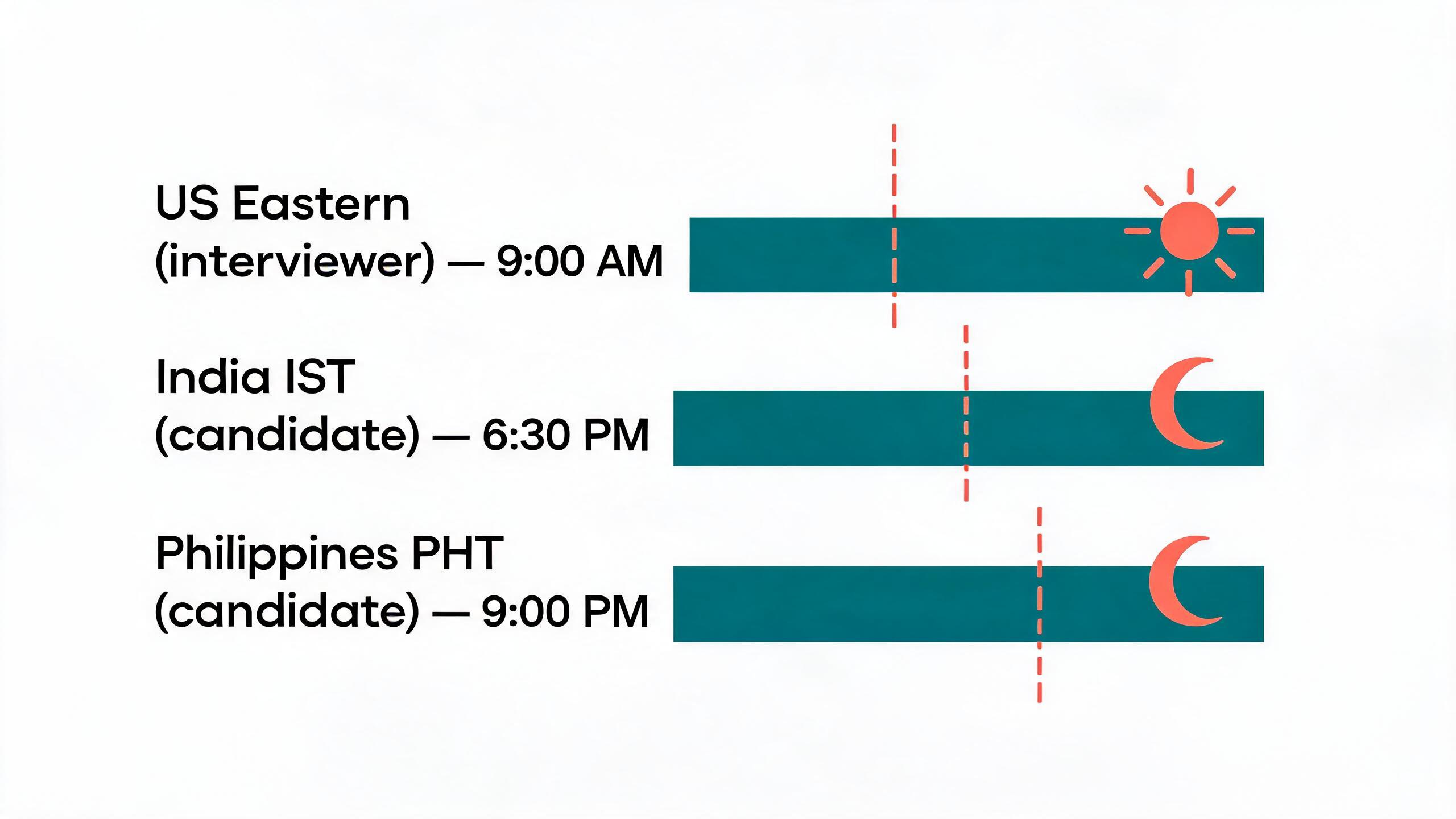
India Standard Time (IST) sits 9.5–10.5 hours ahead of US Eastern time and roughly 12.5–13.5 hours ahead of US Pacific, depending on Daylight Saving Time — there's no clean overlap with the US West Coast at all, which is why a "9am PT" interview invite often means 9:30pm or later in India. Philippine Time (PHT) runs 12–15 hours ahead of the continental US, and because night-shift work culture is already normalized there from decades of BPO industry hours, Filipino candidates are typically more schedule-flexible, but face a real fatigue cost interviewing at 1am after a full day.
The single most common avoidable failure: DST miscalculation. US clocks shift twice a year and most of Asia doesn't observe DST, so a calendar invite sent in January and an invite sent in July can silently shift by a full hour relative to your local time. When a recruiter sends "10am EST," reply to confirm the exact UTC offset or ask for a calendar invite with your local timezone auto-converted — don't do the math once and assume it holds all year.
What US Interviewers Are Actually Scoring (Beyond Your Answers)
US hiring managers evaluating remote candidates are informally scoring "remote-readiness" alongside your actual answers, even when they don't say so directly:
Ownership language. US interview culture rewards "I decided," "I built," "I pushed back on" — first-person, specific claims of what you did. Candidates from workplace cultures that emphasize collective credit and deference to hierarchy sometimes default to "we" and softer framing ("I helped with," "I was involved in"), which a US interviewer can misread as lack of initiative rather than cultural norm. It isn't — but you have to actively translate your contribution into direct language for it to land the way you intend.
Proactive communication about problems. If a US interviewer asks "how would you handle a blocker at 11pm your time when the team is asleep in California," they're testing whether you'll silently wait or flag it clearly and move on to the next task. Silence reads as risk in a distributed team; a stated plan reads as reliability.
Comfort with async ambiguity. Remote-first US companies frequently ask what tools you use for async work and how you'd prioritize when there's no one online to ask. Have a real answer ready — this is less about job-specific skill and more about whether you've actually worked distributed before. Buffer's State of Remote Work research found that timezone coordination is one of the top challenges cited by distributed teams themselves, so an interviewer asking about it isn't testing a trick question — they're checking if you've actually lived it.
Building a Connectivity Contingency Plan (and Saying So Out Loud)
Infrastructure fragility is a real, distinct risk in both markets — rolling brownouts and ISP instability are more common in the Philippines than candidates from more infrastructure-stable countries often realize, and monsoon-season connectivity drops are a recurring seasonal issue across parts of India. Owl Labs' State of Remote Work report tracks how widespread cross-timezone remote arrangements have become globally — the logistics friction you're planning for here is a known, well-documented part of distributed work, not a personal shortcoming. The fix isn't hoping it won't happen — it's having a stated backup and mentioning it upfront:
- Have a charged mobile hotspot ready as a fallback before the call starts, not scrambled together after it drops.
- Test your primary connection speed the morning of, not the week before.
- If a call does drop, message the interviewer immediately through whatever channel they gave you (email, LinkedIn, the scheduling tool) rather than waiting silently to reconnect — a two-line "connection dropped, reconnecting now" message reads as professionalism, not an excuse.
- If you know your connection is genuinely unreliable, it's reasonable to mention it briefly at the start of the call: "just a heads up, if we lose connection I'll rejoin within a minute." This reframes a potential interruption as something you've already planned for.
Video Call Etiquette Differences That Read as Red Flags (Or Don't)
A few small things get misread across the cultural gap in either direction:
- Camera framing and eye contact. Looking at your own video window instead of the camera lens reads as "distracted" to US interviewers even though it's a completely normal habit. A sticky note near your webcam as a visual anchor fixes this in one session of practice.
- Pauses before answering. A brief pause to think is read as thoughtful in most of the US; a long pause combined with a soft "um, so, actually" opener can read as uncertainty. Practice starting your answer with your conclusion first, then the supporting detail — it removes the need for a long wind-up.
- Group interview dynamics on panel calls. If multiple US interviewers are on the call and you're used to addressing the most senior person present, note that US panels generally expect you to make eye contact with whoever asked the question, not defer upward by default.
Scheduling Yourself Like a Pro, Not a Difficult Candidate
If a proposed slot genuinely doesn't work — 3am your time, for instance — it is completely normal and expected to propose an alternative. The way you phrase it matters more than the fact of asking: "That time is quite late for me in [city] — would [specific alternative, already converted to their timezone] work instead?" does the timezone math for them and reads as considerate, not high-maintenance. What reads poorly is a vague "can we do a different time?" that forces the recruiter to redo the conversion themselves.
Where AI Interview Help Fits Into This
None of the above solves the actual interview-answer problem — staying structured and specific while also managing a timezone-shifted, possibly connectivity-strained call is a real cognitive load on top of the interview itself. That's the gap AceRound AI is built for: real-time structure prompts while you're speaking, so a rough connection moment or a 1am brain fog doesn't cost you the point you were making. It's not a fix for infrastructure or a script to read from — it's there for the moment your focus splits between the interview and everything happening around it.
If you're specifically preparing for a technical round with a US tech company, our guide on how Indian IT professionals can use AI interview assistants covers that angle in more depth, and our BPO interview tips for Philippines candidates covers the call-center-specific pipeline if that's your track.
FAQ
How do I make sure I have the right time for a US interview if I'm in India or the Philippines? Ask the recruiter to send a calendar invite rather than a typed time — calendar tools auto-convert to your local timezone and account for Daylight Saving Time changes, which manual time-zone math often misses.
Is it okay to ask for a different interview time if the proposed slot is 2am or 3am my time? Yes. Propose a specific alternative already converted to their timezone rather than asking them to redo the math — it reads as considerate rather than difficult.
What if my internet drops in the middle of a US interview? Have a mobile hotspot ready beforehand, message the interviewer immediately through email or the scheduling platform if you disconnect, and consider mentioning your backup plan briefly at the start of the call if connectivity has been an issue recently.
Do US interviewers actually care about accent, or is it about something else? Research and interviewer feedback point more toward communication style — directness, ownership language, and pace — than accent itself. A clear, specific answer in an accented voice generally scores higher than a vague answer without one.
Should I mention that I'm applying from a different timezone or country during the interview? You don't need to over-explain it, but if a scheduling or connectivity issue comes up, briefly acknowledging it and moving on shows professionalism. Employers hiring internationally already expect timezone differences — treat it as a logistics fact, not something to apologize for.
Is remote work for US companies from India or the Philippines actually common, or a rare exception? It's common and growing — distributed teams spanning multiple timezones are now standard for many US remote-first companies, and both India and the Philippines are established, well-understood talent markets for US employers hiring remotely.
Author · Alex Chen. Career consultant and former tech recruiter. Spent 5 years on the hiring side before switching to help candidates instead. Writes about real interview dynamics, not textbook advice.
Related Articles

Actuary Interview Questions: Where an AI Copilot Helps and Where Exams Still Decide
Real actuary interview questions — behavioral, technical, and brain teasers — plus an honest look at where live AI interview help applies and where SOA/CAS exams remain the real gatekeeper.
Correctional Officer Interview Questions: The Full Hiring Pipeline
Correctional officer interview questions and the real 9-stage hiring pipeline, with real oral board questions and an honest map of where interview prep actually helps.
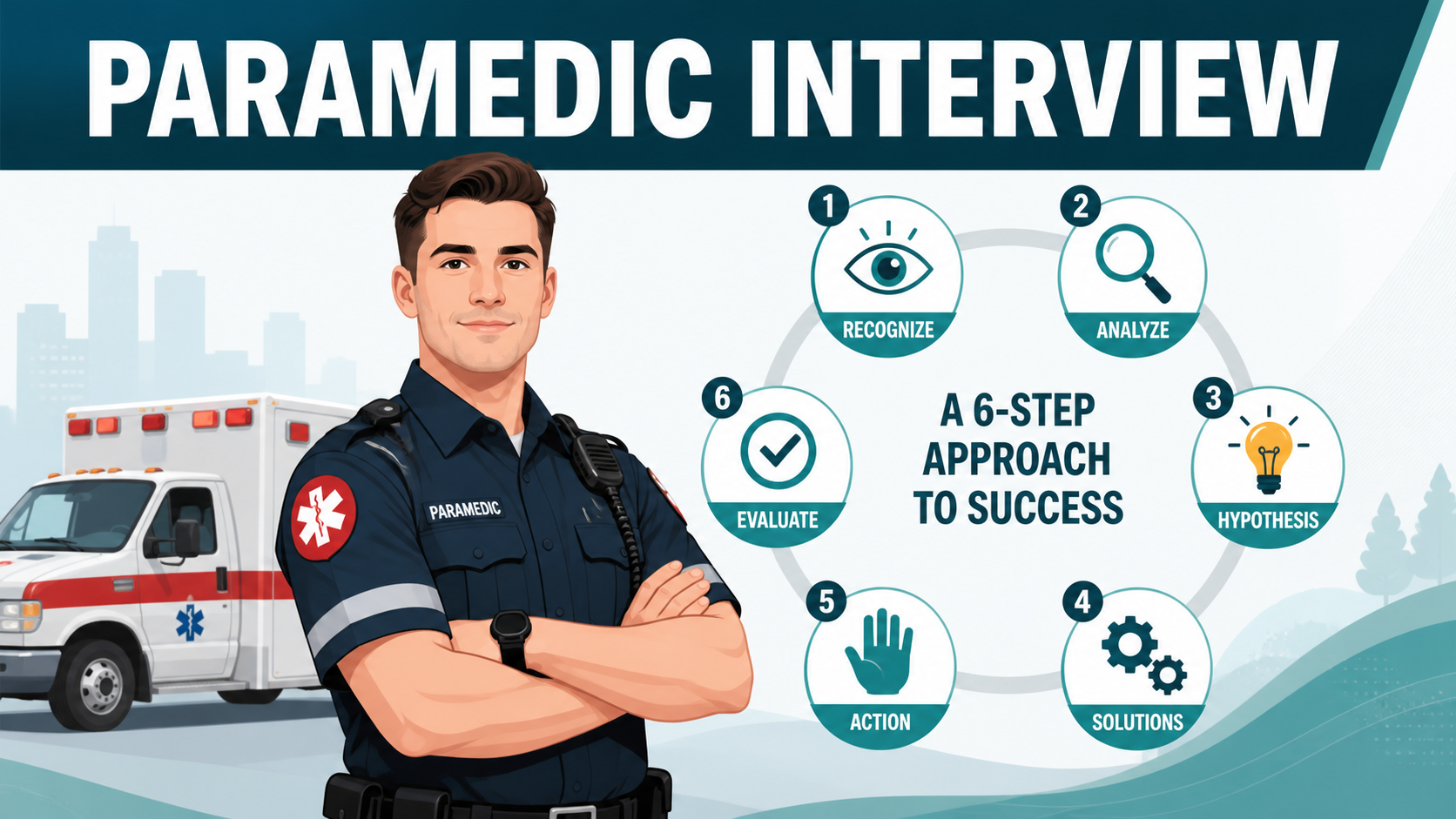
EMT & Paramedic Interview Questions Decoded
EMT and paramedic interview questions decoded: the clinical-judgment framework hiring panels are really scoring, with sample scenario answers.