Situational Interview Questions: How to Answer Hypotheticals With Confidence
A practical guide to situational interview questions — what they test, how they differ from behavioral questions, and a repeatable framework for answering hypotheticals you've never faced.

TL;DR: Situational interview questions ask "what would you do if..." instead of "tell me about a time." There's no real memory to pull from — you have to reason through a hypothetical live, in front of someone scoring your judgment. Use a STAR-shaped answer anyway, lead with the value you'd prioritize when two good options conflict, and never say "I've never dealt with that" — reframe toward the closest thing you have handled.
Ask ten people what they think is the hardest interview question, and a good chunk will say some version of "what would you do if you disagreed with your manager in front of the whole team?" It's not hard because it's obscure — it's hard because you can't just retrieve a memory and narrate it. You have to build an answer from scratch, out loud, while someone across the table (or a scoring rubric behind a screen) is watching how you reason under pressure.
That's the whole category: situational interview questions. This guide covers what makes them different from behavioral questions, a framework for the part every other guide skips — deciding what to prioritize when the hypothetical pits two good instincts against each other — and worked examples you can adapt on the spot.
What Are Situational Interview Questions?
Situational interview questions present a hypothetical work scenario and ask how you'd handle it — "What would you do if a teammate missed a deadline that put your delivery at risk?" or "How would you respond if a customer escalated a complaint you couldn't immediately fix?" You're not recalling a real event; you're reasoning through one that hasn't happened, in real time.
Employers use them for two practical reasons. First, some candidates — new grads, career switchers, people early in a field — genuinely don't have five years of relevant war stories to draw on, so a hypothetical levels the playing field. Second, situational-judgment formats have decades of research behind them: a well-known meta-analysis by Christian, Edwards, and Bell (2010) found situational judgment tests are meaningful predictors of job performance, which is a big part of why interviewers keep asking them even though candidates dread them.
The catch: because there's no real memory to lean on, weak answers drift into vague platitudes ("I'd communicate clearly and work as a team") that say nothing about how you'd actually decide.
Situational vs. Behavioral Interview Questions: What's the Actual Difference?
The two get used almost interchangeably in casual conversation, but the mechanics of answering them are different enough to prep separately:
- Behavioral questions ask about the real past — "Tell me about a time you missed a deadline" — and you answer with a true story you already lived through.
- Situational questions ask about a hypothetical future — "What would you do if you were about to miss a deadline?" — and you have to construct a plausible, specific response with no real event to anchor it.
- Scenario-based interview questions are close enough to situational that most sources use the terms interchangeably, but where a distinction gets drawn, "scenario-based" usually means the hypothetical is tightly grounded in the actual role — a support scenario for a support job, a coding-tradeoff scenario for an engineering job — while "situational" can be a more generic hypothetical about teamwork or conflict that applies across roles. In practice, prep the same way for both: reason through the hypothetical out loud, structured, and specific.
Get this mixed up and you'll do real damage: sliding into "I would probably..." during what's actually a behavioral, evidence-only interview reads as dodging the question — some formats will redirect you on the spot with "can you tell me about a time this actually happened?" Know which one you're in before you open your mouth.
How to Answer Situational Interview Questions (Even With No Real Precedent)
You can still use STAR here — it just runs on a constructed scenario instead of a remembered one:
- Situation — restate the hypothetical in your own words, briefly, so the interviewer knows you understood it correctly.
- Task — name what you'd be responsible for solving in that moment.
- Action — the part that actually gets scored. Walk through the specific steps you'd take, in order, and why — not just what you'd do, but what you'd weigh before doing it.
- Result — what outcome you'd be aiming for, and how you'd know you got there.
The Action section is where most answers fall apart, because candidates default to a vague verb salad — "I'd communicate, collaborate, and escalate if needed" — instead of committing to an actual sequence. A stronger version names the first concrete move: "I'd go directly to the teammate first, privately, before looping in anyone else, because escalating immediately would damage trust I might not need to spend." That single sentence does more work than three sentences of buzzwords, because it shows a reason behind the action, not just a list of nice-sounding verbs.
The Answer-Priority Framework: What to Lead With When Two Good Options Conflict
Here's the part most prep guides skip entirely, and it's usually the actual point of the question. Situational questions are rarely testing whether you know the "correct" process — they're testing what you reach for first when two legitimate priorities pull in different directions. Before you start narrating actions, decide out loud (even in one sentence) which value you're leading with:
- Safety / compliance — anything involving physical risk, legal exposure, or policy violation overrides everything else, and you should say so explicitly if the scenario touches it.
- Trust and relationships — for interpersonal scenarios (a struggling teammate, a disagreement with your manager), go direct and private before you escalate. Escalating first, before giving someone a chance to fix it themselves, reads as reaching for authority instead of solving the problem.
- Process integrity — when a shortcut would work today but breaks something for the next person, naming that tradeoff shows judgment, not just speed.
- Speed / customer impact — when the scenario is time-boxed (an angry customer, a live outage), say you'd act first and formalize the fix afterward — hesitating to "do it properly" when someone's actively affected reads as poor prioritization, not thoroughness.
Naming your priority explicitly — "I'd treat this as a trust issue first, so I'd go to them directly before anyone else" — gives the interviewer something concrete to evaluate, instead of forcing them to infer your reasoning from a pile of actions. This is also the fastest way to sound decisive instead of hedgy, which matters more in situational rounds than almost anywhere else in the interview.
What If You've Genuinely Never Faced That Exact Situation?
This is the single most common worry candidates raise about situational rounds — and it's a non-issue once you know the move. You are never expected to have lived the exact hypothetical. Two honest paths work:
- Bridge to the closest real thing. "I haven't managed a missed vendor deadline specifically, but I have had a teammate fall behind on a shared deliverable, and the approach I'd take is similar: check in privately first, understand the blocker, then decide together whether we need to adjust scope or timeline." You're not making anything up — you're reasoning by analogy from something real.
- Reason from first principles, and say that's what you're doing. "I haven't been in this exact spot, so I'll walk through how I'd think about it" is a legitimate, honest opening — it signals self-awareness instead of weakness, as long as you follow it with an actual structured answer, not a shrug.
What doesn't work: "I've never dealt with that, so I'm not sure" and stopping there. The question was never really about whether you've personally lived the scenario — it's about whether you can reason clearly when you haven't.
Prepping in the days before an interview is one thing — staying structured once you're actually mid-answer, under time pressure, with a scenario you didn't rehearse, is a different problem. AceRound listens in real time during the interview itself and can nudge you back toward Situation → Task → Action → Result if your answer starts drifting into vague buzzwords, or flag when you've spent too long on setup and not enough on the actual decision. It won't invent judgment you don't have — the reasoning still has to be yours — but it helps you deliver a structured answer even when the hypothetical genuinely catches you off guard.
12 Common Situational Interview Questions and How to Approach Them
Conflict with a peer "What would you do if a teammate wasn't contributing to a shared project as expected?" Priority to lead with: trust — check in privately before escalating.
Disagreeing with your manager "What steps would you take if you disagreed with your supervisor's approach to a problem?" Priority to lead with: raise it directly and respectfully, with a specific alternative — not just an objection.
Competing deadlines "How would you handle a situation where you had multiple conflicting deadlines?" Priority to lead with: transparency — flag the conflict early to whoever owns the priority call, rather than silently picking one.
Unfamiliar task "How would you react if you were asked to take on a task you've never done before?" Priority to lead with: say yes, then name the specific first step you'd take to get up to speed (who you'd ask, what you'd read).
Giving hard feedback "What would you do if you had to give a colleague critical feedback they might not want to hear?" Priority to lead with: specificity and privacy — vague feedback in public helps no one.
Discovering a mistake — yours "What would you do if you realized, after the fact, that you'd made a costly error?" Priority to lead with: disclose immediately, before it's discovered by someone else.
Discovering a mistake — a colleague's "What would you do if you noticed a coworker making a mistake that could affect the whole team?" Priority to lead with: talk to them directly first, not around them.
Underperforming team member "How would you handle a team member who consistently underperforms?" Priority to lead with: understand the cause privately before assuming it's a motivation problem.
Angry customer "How would you respond if a customer escalated a complaint you couldn't fix immediately?" Priority to lead with: acknowledge and act on what's in your control now; formalize the fix after.
Scope creep "What would you do if a project's scope kept expanding without more time or resources?" Priority to lead with: make the tradeoff visible to whoever owns the decision, instead of silently absorbing it.
Ethical gray area "What would you do if you were asked to do something you weren't comfortable with?" Priority to lead with: compliance/safety overrides — name the specific concern, don't just comply quietly.
No clear direction "What would you do if you were given a task with unclear instructions and no one available to ask?" Priority to lead with: make a reasonable assumption, state it explicitly, and proceed — don't stall waiting for perfect clarity.
Common Mistakes That Weaken Situational Answers
- Buzzword soup instead of a sequence. "I'd communicate, collaborate, and escalate if needed" names no actual first move.
- Skipping the priority call. Jumping straight to actions without ever signaling why you chose that order makes the answer feel arbitrary, not judged.
- Overcorrecting into a wall of caveats. "It depends on a lot of factors, but..." for thirty seconds before saying anything concrete reads as avoidance, not nuance. One clarifying assumption is fine; five is stalling.
- Claiming zero conflict ever. "I'd never disagree with my manager" or "that would never happen on my team" reads as low self-awareness, not harmony.
- Ending on the action, not the outcome. Always close with what you were aiming for and how you'd know you got there — leaving it on "and that's what I'd do" undersells the answer.
FAQ
What are situational interview questions? Questions that present a hypothetical work scenario — "What would you do if..." — and ask you to reason through how you'd handle it, as opposed to describing something that actually happened.
What's the difference between situational and behavioral interview questions? Behavioral questions ask about real past events you can narrate from memory; situational questions ask about a hypothetical future scenario you have to reason through live, with no real event to draw on.
How do I answer scenario-based interview questions? Restate the scenario briefly, name which priority you're leading with when two good options conflict, walk through a specific sequence of actions with reasons attached, and close with the outcome you'd be aiming for.
What's the difference between situational and scenario-based interview questions? The terms are largely interchangeable. Where people draw a line, "scenario-based" usually means the hypothetical is tightly tied to the actual job (a support ticket for a support role), while "situational" tends to be a broader hypothetical about teamwork, conflict, or judgment that could apply across roles.
How do you answer situational or behavioral interview questions if you don't have any experience to walk through — should you make something up, or just admit you haven't faced it? Don't make something up, and don't stop at "I haven't dealt with that" either. Say so briefly, then bridge to the closest real experience you have, or reason from first principles and say that's what you're doing — the question is testing your reasoning, not your memory.
Is it okay to ask clarifying questions before answering a situational question? Yes, one or two focused clarifying questions show judgment. More than that starts to look like stalling — commit to a reasonable assumption if the interviewer doesn't give you more detail.
Prepping for other interview formats too? Our guides on competency-based interview questions and behavioral interview questions cover the evidence-based, past-experience side of interviewing — worth reading alongside this one so you know which mode you're in before you open your mouth.
Author · Alex Chen. Career consultant and former tech recruiter. Spent 5 years on the hiring side before switching to help candidates instead. Writes about real interview dynamics, not textbook advice.
Related Articles
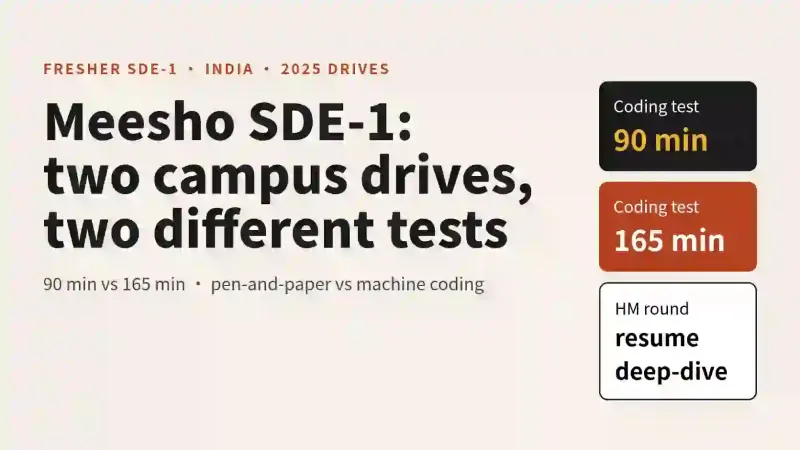
Meesho SDE-1 Interview Process for Freshers: Three 2025 Accounts Compared
Meesho SDE-1 campus accounts from 2025 disagree on test length, round order and design format. Here is what each reported and how to prep for any of them.
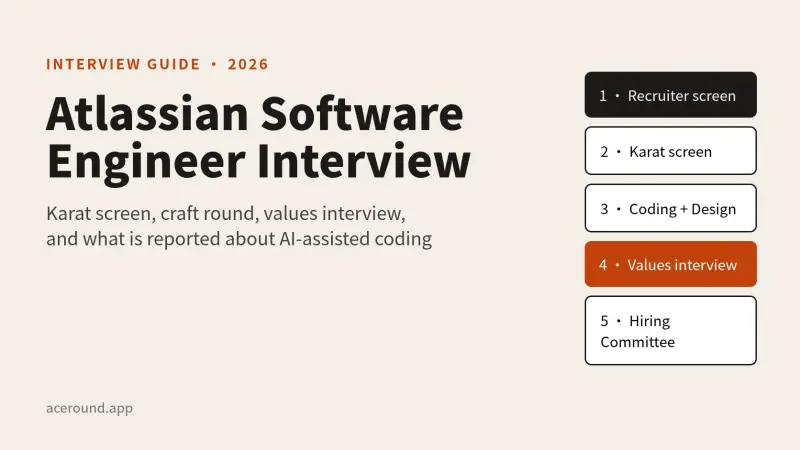
Atlassian Software Engineer Interview: Karat Screen, Craft Round and the Values Interview
How Atlassian's engineering loop works, from the Karat screen to the values round, what is official and what candidates report, including the AI-assisted rounds.
LinkedIn's AI-Enabled Coding Interview: What Candidates Report and How to Prepare
LinkedIn reportedly swaps one coding round for a CoderPad session with an AI panel. Here is the reported format, what gets scored, and what is unconfirmed.