Does HireVue Detect Cheating? Tab Switches & AI Answers (2026)
HireVue flags tab-switching and identity mismatches but can't reliably catch ChatGPT answers. See exactly what triggers a flag — and what happens next.
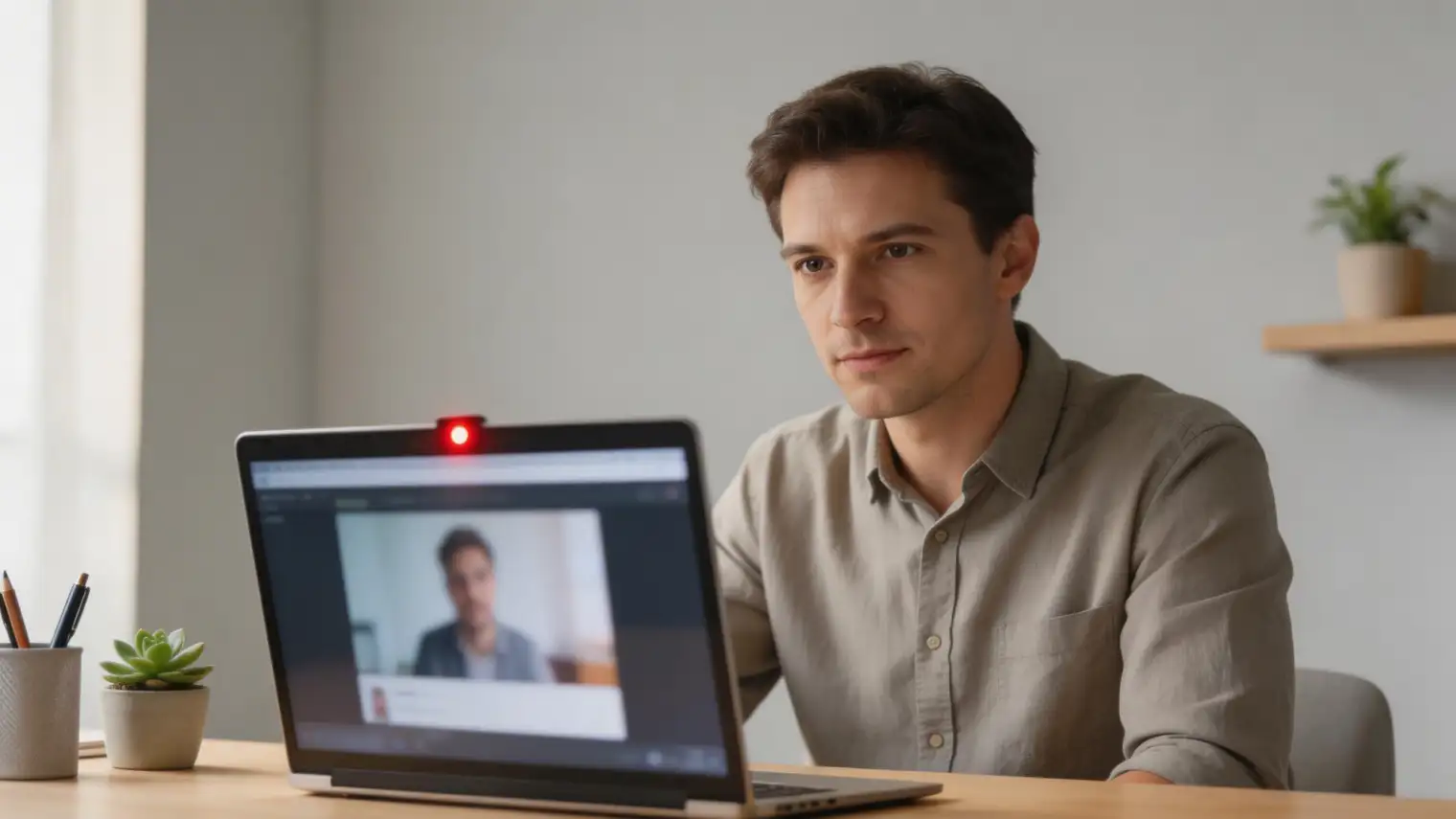
TL;DR: Yes, HireVue does flag suspicious behavior — tab switching, identity mismatches, and statistically similar answers between candidates all trigger a human review, never an automatic reject. What it can't reliably do is detect ChatGPT-generated content. The real risk isn't getting caught mid-interview; it's that AI-written answers score poorly on their own merits because they're generic and personally empty.
The question you typed but wouldn't say in a job-seeker Facebook group: Can HireVue actually catch me if I cheat?
You're not alone. HireVue reported in 2023 that over 85% of HR leaders said they were worried about candidates cheating during virtual interviews. The concern is real, it's widespread, and the internet is full of contradictory claims about what the system can and can't detect.
Here's an honest breakdown — what HireVue monitors, what it misses, and why the expected shortcut usually doesn't deliver what you're hoping for.
What HireVue Actually Monitors
HireVue's detection capabilities depend on how a specific employer has configured their instance. There's no single universal HireVue setup — banks, consulting firms, and tech companies use different settings. That said, these monitoring features are either standard or widely enabled:
Periodic identity snapshots. HireVue captures still images of you throughout the interview to confirm you're the same person who checked in at the start. This is designed to catch proxy interview situations — someone else completing the interview on your behalf — more than cheat-sheet usage.
Browser focus and tab switching. This is the most commonly triggered flag. If you switch away from the HireVue browser window during an assessment, the system notes it. Multiple tab switches register as suspicious activity. This catches people Googling answers mid-question or pulling up a chat window.
Shared script detection. HireVue runs a similarity score across response pairs. If two candidates submit answers that score ≥0.4 on their internal similarity measure, the system flags it as potential script sharing. HireVue defines this threshold as the point where coincidence becomes implausible. This is the feature most likely to catch coordinated cheating rings on finance and consulting assessment questions.
Voice and speech pattern analysis. Many HireVue configurations still analyze vocal patterns — speaking pace, filler words, hesitation patterns. These don't flag "cheating" directly but affect your competency score.
What dropped: facial analysis. After a complaint from the Electronic Privacy Information Center in 2021, HireVue discontinued automated facial expression analysis. A 2024 BIPA lawsuit (Deyerler v. HireVue) is ongoing, but as of 2026, the company states it does not use automated facial scoring. Whether every employer has fully disabled it across all custom configurations is a separate question — but the standard platform no longer scores faces.
Can HireVue Detect ChatGPT or AI-Generated Answers?
This is the question people are really asking. The honest answer: not reliably, not automatically.
HireVue doesn't have a certified ChatGPT detector. The company's own research data, released in a 2025 whitepaper titled "Do Cheaters Prosper?", found no score drift in their assessments since large language models became widely available between 2022 and 2026. Their interpretation: either candidates aren't using AI at scale, or AI-generated answers aren't scoring significantly better than authentic ones.
The second explanation is the more interesting one.
Here's why AI-generated answers tend to fail in HireVue even when not "detected":
STAR format requires personal specifics. HireVue behavioral questions are scored against competency models trained on high-performing responses from actual candidates in similar roles. Those responses have texture: specific projects, measurable outcomes, named stakeholders. An AI-generated answer reads generically — it describes a "team" with no details, a "positive outcome" with no number. The NLP scorer flags low specificity as a low competency signal.
The dead air problem. If you're copying an AI-generated response during recording time, you're sitting silent for 20–40 seconds while it generates. HireVue records your full response window. A long pause followed by suddenly reading a scripted answer is visible and scorable.
The delivery problem. Even if the content is solid, reading from a screen while facing a camera makes your eyes track differently. You sound less natural. Interviewers who review flagged responses notice immediately.
Goldman Sachs explicitly warned students in 2024 against using ChatGPT in their HireVue submissions. Their concern wasn't AI detection technology — it was that AI answers lack the specificity their assessors look for.
Can You Use Notes During a HireVue Interview?
This question comes up constantly, and the answer is more nuanced than "yes" or "no."
Your own notes: generally tolerated. If you've prepared bullet points with your own STAR examples and glance at them, HireVue's detection systems aren't designed to catch that. Looking at a second monitor occasionally is different from sustained off-camera focus.
Shared scripts: flagged. The similarity detection system is specifically built to catch when candidates use the same pre-written script. If you download a "HireVue answer template" from a forum and submit it verbatim, you're at risk — not because of AI detection, but because someone else likely used the same template.
Excessive looking away: noted. If your eyes are consistently off-camera for significant portions of each answer, it registers as unusual behavior. There's no hard threshold published, but sustained off-screen focus is the kind of flag that gets reviewed by a human.
The practical guidance: prepare your examples thoroughly enough that a quick glance at a bullet point is sufficient. Don't read from a script.
What Happens If HireVue Flags Your Interview?
HireVue's official position is that automated flags trigger human review, not automated rejection. The system surfaces suspicious behavior; a human at HireVue or at the employer decides what to do with it.
What that review can lead to:
- No action: The flag was a false positive — you glanced away at a noise, you had a slow internet connection that caused tab issues. Human reviewers see this regularly.
- Employer notification: The recruiting team is told specific responses were flagged, with the candidate's information. How they proceed depends on the employer.
- Application disqualification: Standard outcome for clear violations. Most employers disqualify without explanation.
- Longer-term consequences: Some employers maintain internal lists of flagged candidates. If you apply to the same company through a different role or years later, you may be quietly filtered. Recruiter networks in concentrated industries (finance, consulting, certain tech sectors) share information informally.
The irreversible risk isn't the immediate disqualification — it's the reputation consequence in a smaller industry than most candidates realize.
The Real Math: Why Cheating Usually Backfires
Most candidates who consider cheating HireVue are doing so because they feel unprepared. That's the actual problem to solve.
The cheat attempt introduces three compounding risks:
- Getting caught by a detection mechanism (moderate risk)
- Producing a generic answer that scores low even when not flagged (high probability)
- Making it through HireVue but being exposed in the subsequent human interview (near certainty if you faked specifics)
HireVue is typically a screening step. If your AI-generated answer describes a project you didn't work on or a skill you don't have, you'll face follow-up questions in the next round that expose the gap. That's a worse outcome than a mediocre HireVue score.
What actually works: building real answers before the interview. Not memorized scripts, but structured stories from your own experience. If you've done the job, you have the material. The problem is usually that candidates haven't organized it into STAR format in advance.
That's the gap AceRound AI is designed to fill — real-time practice and structure before the interview, not a crutch during it. The goal is that when HireVue asks "tell me about a time you had to change direction mid-project," you already know exactly which story to tell, and you own it well enough to deliver it naturally.
See also: HireVue AI Interview Tips That Actually Work and Is Using AI in Interviews Cheating?
Frequently Asked Questions
Does HireVue record your screen?
Not typically in the video interview format. HireVue records your camera and audio. In coding assessments (CodeVue), screen recording is often enabled. Browser activity monitoring (tab switching) is logged separately from screen capture.
Can HireVue detect if you look away?
Looking away occasionally isn't flagged. Sustained off-camera focus — consistently looking at something to the side or below for most of each answer — is the pattern that gets noted. There's no published threshold.
What happens if you cheat on HireVue?
Depends on what's flagged and how the employer responds. Outcomes range from no action (false positive) to immediate disqualification to longer-term ATS flagging. HireVue doesn't automatically reject anyone — flags go to human review.
Can HireVue detect ChatGPT?
No automated detection as of 2026. HireVue's own data shows no meaningful score drift since LLMs became available. However, AI-generated answers typically score poorly because they lack the personal specificity that HireVue's competency models reward.
Is it okay to use notes during a HireVue interview?
Your own bullet points are generally fine. Reading verbatim from a shared script is the flagged behavior. Glancing at notes you prepared yourself rarely triggers detection, but it does affect your delivery quality.
Does HireVue use facial recognition?
HireVue discontinued automated facial expression analysis in 2021 following FTC scrutiny. The platform states it no longer scores facial features. Voice patterns are still analyzed in many configurations.
Author · Alex Chen. Career consultant and former tech recruiter. Spent 5 years on the hiring side before switching to help candidates instead. Writes about real interview dynamics, not textbook advice.
Related Articles
OpenAI's AI Interview Policy: Banned, Required, or Team-Dependent
OpenAI sells AI coding agents, then bans most candidates from using one. Here's the round-by-round policy, including the new agentic round that flips it.
Does Harver Detect Cheating? What Its Proctoring Actually Checks
Does Harver detect cheating on its pre-employment assessments? A candidate look at Harver's Proctoring add-on, what gets logged after a flag, and what happens next.
Micro1's Zara AI Interview: What It Actually Tests (And Why Timing Gets Flagged)
Micro1's AI interviewer Zara has run 300,000+ interviews for remote roles. Here's why it flags response latency as a cheating signal, and what that means for AI prep.