Google Interview Warmup Shut Down: Free Alternatives (2026)
Google Interview Warmup shut down in April 2026. See the free alternatives that still work, plus a free practice tool and a sample questions list by track.

Is Google Interview Warmup still available? No — Google discontinued it in April 2026. Free replacements that still work today: AceRound AI's free tier (STAR feedback + follow-ups), Gemini Live, ChatGPT voice mode, and Yoodli. Skip ahead to the side-by-side alternatives comparison or grab the free Google Interview Warmup questions list by track below.
TL;DR: Warmup was a useful free speaking drill, but it is no longer available in 2026. The best mix today is Gemini or ChatGPT for free mock questions, Yoodli for delivery feedback, and AceRound AI when you need STAR feedback or live interview support.
In April 2026, Google quietly retired Interview Warmup, the free practice tool it launched in 2022 as part of its Grow with Google initiative. There was no dramatic announcement. One day the tool worked; a few weeks later, job seekers were being pointed toward broader Google products like Gemini Live and Career Dreamer.
For the candidates still searching "Google Interview Warmup" before an interview this week, the useful answer is not nostalgia. It is: what did the tool actually help with, what did it never solve, and which replacement should you use based on your specific gap?
What Google Interview Warmup Actually Was
Interview Warmup was a browser-based voice practice tool. You picked an industry track — UX design, data analytics, IT support, digital marketing, project management, general — and it presented questions one at a time. You spoke your answer aloud, and the tool transcribed it. The original Google announcement described three feedback areas: job-related terms, most-used words, and talking points.
In practice, the feedback felt like two main signals:
- Talking points: words and phrases from your answer highlighted against a list of common terms for that role
- Most-used words: a frequency map of the vocabulary you used most
That's the full feature set. No follow-up questions. No STAR evaluation. No scoring. No memory between sessions. You got five questions per session and whatever the word cloud told you.
The tool served a real need: it gave people a low-stakes place to hear themselves answer interview questions out loud, often for the first time. For a free browser tool, that was enough to matter.
What It Did Well
Accessibility. Interview Warmup required nothing — no account, no download, no payment. You opened a browser and started speaking. For first-generation job seekers, recent graduates with no industry contacts, and anyone who'd never had a practice interview with a real person, that zero-friction entry was genuinely valuable.
Reducing the "speaking out loud" barrier. Most interview prep happens silently — in notes, in your head, in bullet points. The single biggest difference between a prepared answer and a polished one is having said it aloud at least twice. Interview Warmup forced that step.
Industry-specific questions. The question sets for Google's Career Certificate tracks were thoughtfully written. If you were transitioning into UX or data analytics from an unrelated background, the questions reflected real entry-level interview content, not generic behavioral prompts.
The Google Interview Warmup questions list covered solid ground for each track. The IT support questions, for example, were more realistic than most third-party prep sites.
Where It Fell Short
Word clouds don't evaluate answers
The core feedback mechanism — vocabulary frequency — identifies whether you used the words, not whether you used them well. "I leveraged data analysis to improve user retention" and "data data data analysis analysis" score similarly if they contain the same words.
This matters most for STAR-method answers. A complete STAR response requires specific structure: Situation, Task, Action, Result. Interview Warmup had no way to check whether your answer had all four components, whether your "result" was quantified, or whether your story was coherent. It could tell you that you said "teamwork" twice. That's a different skill entirely.
No conversational follow-up
The hardest part of most interviews isn't the initial answer. It's when the interviewer says "Can you tell me more about the decision you made there?" or "How would you have handled it differently?"
Interview Warmup presented questions in isolation. Every session was five independent prompts with no connection between them. Real interviews are conversations. The tool practiced a skill adjacent to interviews — verbal fluency under a prompt — but not the skill of navigating a live two-way exchange.
Non-native English speakers got the least value
This is the gap no competitor article talks about.
If you're a native English speaker who just hasn't practiced, word-frequency feedback is a useful mirror. You stop saying "um" so often, you remember to mention the specific terms the role requires, you build confidence.
If you're a non-native speaker applying in English, your problem is usually different: you know the vocabulary, you know the concepts, but you lose fluency under pressure. You stop mid-sentence, you use workarounds for words you can't retrieve quickly, you speak too formally or too casually without knowing which.
Word clouds don't help with any of that. The feedback you need is about phrasing, rhythm, sentence completion, and register — not whether you said "stakeholder" during a product management question.
Five questions per session, no persistence
Power users hit the ceiling quickly. There's no way to create custom question sets, revisit your previous answers, track improvement over time, or drill a specific question type. For anyone doing serious prep — three to five companies, multiple rounds — Interview Warmup ran out of utility within a week.
If your search started with "google interview warmup" because you need a free place to practice today, start with a low-friction option first. AceRound AI gives you practice sessions with STAR feedback and a real-time mode for live interviews; if you only need prompts, Gemini or ChatGPT is enough. For a broader breakdown of practice-only vs. live support tools, read the real-time AI interview helper guide.
Google Interview Warmup Questions List (by Track)
Google never published the Warmup question bank as a single static list, and after the April 2026 shutdown the original pool is no longer reachable from the tool. Each track drew from behavioral, situational, and foundational-concept questions in roughly equal mix. These are the categories Warmup covered and the kinds of prompts you would have seen, by track:
UX Design
- Tell me about a time you advocated for a user need against business pressure.
- How do you decide what to test in a usability session?
- Walk me through a design you shipped that you would change in hindsight.
- How do you prioritize feedback from research vs. feedback from stakeholders?
Data Analytics
- Describe a project where the data you started with did not answer the question.
- How do you explain a confidence interval to a non-technical stakeholder?
- Tell me about a time you spotted an issue in someone else's analysis.
- What is the difference between a useful metric and a misleading one?
IT Support
- Walk me through how you would troubleshoot a user who cannot connect to the internal network.
- Tell me about a time a customer was frustrated. How did you de-escalate?
- How do you prioritize when several tickets come in at the same time?
- Explain the difference between phishing and spoofing to a non-technical user.
Digital Marketing
- Tell me about a campaign that missed its goal. What did you learn?
- How do you decide which channel to prioritize for a new product launch?
- What is the difference between brand and performance marketing in your experience?
- How do you measure the success of a content piece beyond pageviews?
Project Management
- Tell me about a project that went over budget or behind schedule. What did you do?
- How do you handle a stakeholder who keeps changing requirements?
- Walk me through how you set milestones for a six-month initiative.
- How do you balance scope, time, and quality when one of them has to give?
General (cross-role)
- Tell me about yourself.
- Why do you want this role?
- Describe a time you failed and what you learned.
- Tell me about a conflict on a team and how you resolved it.
- Where do you see yourself in five years?
To drill these in 2026, the closest free workflow is to pick a track, paste a question into ChatGPT or Gemini voice mode, and ask for a STAR evaluation after each answer. AceRound AI covers all six original Warmup tracks plus engineering, sales, finance, and healthcare roles Warmup never supported, with STAR feedback built in.
Why Google Shut It Down (And What That Tells You)
Google hasn't published a detailed explanation, so treat any neat explanation as inference. The pattern is familiar: Interview Warmup was a free consumer tool with speech transcription and no direct monetization path. Google's current recommendations — Gemini Live for conversation and Career Dreamer for career exploration — fit its broader AI product strategy better than a narrow interview warmup page.
The lesson for job seekers is practical: free tools from platform companies are bets on that company's priorities, not yours. When the platform's priorities shift, the tool disappears. The users who relied most heavily on Interview Warmup — people in career transition, new graduates, first-generation job seekers — were the least positioned to absorb the disruption.
This doesn't mean you should avoid free tools. It means you should understand what you're building on.
Google Interview Warmup Alternatives in 2026
Google's own replacements
Google redirects to two products:
Gemini Live — Google's conversational AI. It can conduct mock interviews if you prompt it correctly, and it will respond to follow-up questions. The quality of feedback depends heavily on how well you frame the conversation. It's more flexible than Interview Warmup but requires more effort to set up as an interview practice tool, and the feedback is conversational rather than structured.
Career Dreamer — A career exploration tool focused on matching your experience to role suggestions. Useful earlier in the job search process; less relevant for interview prep.
AI interview practice free options
AceRound AI (aceround.app) is the most direct replacement for what Interview Warmup was trying to do, with the gaps filled. It provides real-time AI interview assistance during live video calls (Zoom, Google Meet, Teams) and structured practice sessions with STAR-evaluated feedback. Unlike Interview Warmup, it gives follow-up questions, tracks your answer across the four STAR components, and adapts to your industry. There's a free tier. For a deeper look at how real-time AI interview help works in practice, see our real-time AI interview helper guide.
Yoodli — Voice-based feedback tool with more detailed delivery analysis than Interview Warmup (pace, filler words, clarity score). Better than word clouds for native speakers working on presentation quality; still limited on content evaluation.
Gemini / ChatGPT — Both can conduct mock interviews in free tiers. You lose the voice element unless you use voice mode, but the conversational quality and follow-up capability are significantly better than Interview Warmup. Prompt: "You're an interviewer for a [role] at [company type]. Ask me one behavioral question, evaluate my STAR answer, then ask a natural follow-up."
Interview practice tool comparison
| Feature | Interview Warmup (shutdown) | AceRound AI | Yoodli | ChatGPT / Gemini |
|---|---|---|---|---|
| Free tier | No longer available | Yes | Limited | Yes |
| Voice input | Yes | Yes | Yes | Voice mode |
| STAR evaluation | No | Yes | No | Conversational |
| Follow-up questions | No | Yes | No | Yes |
| Industry tracks | 6 tracks | All roles | General | All roles |
| Real-time interview assist | No | Yes | No | No |
| Non-native speaker support | Weak | Better | Better | Good |
For anyone who used Interview Warmup specifically because it was free and low-friction, the honest recommendation is to try AceRound's free tier or use ChatGPT/Gemini with a structured interview prompt. All three give you the conversational follow-up that Interview Warmup never had.
If you're comparing tools more broadly, our best AI interview tools guide covers the landscape in more detail.
Who Should Use What
You're a new graduate prepping for your first interviews: Start with AceRound's free tier or a structured ChatGPT prompt. The follow-up question capability matters more than you think at this stage.
You're a career changer and miss the industry-specific questions: The six Google Career Certificate tracks are gone, but ChatGPT can replicate them with a good prompt. For UX: "You're a hiring manager at a mid-size tech company. Ask me entry-level UX designer behavioral questions and evaluate my answers." AceRound has role-specific question banks as well.
You're a non-native English speaker: Yoodli gives better delivery feedback than Interview Warmup ever did. AceRound provides real-time in-interview support. Consider also whether you want async practice (rehearsing before) or real-time help (during the actual interview) — they're different use cases.
You need serious prep across multiple companies: Any of the free tools will plateau quickly for serious prep. Real-time AI interview assistance during actual interviews (AceRound's main use case) covers ground that no practice-only tool reaches.
Quick Decision Guide
Use this if you have less than an hour before your next practice block:
| Your situation | Best replacement | Why |
|---|---|---|
| You just want free questions out loud | Gemini or ChatGPT voice mode | Fastest setup, natural follow-ups |
| You want delivery feedback | Yoodli | Stronger pacing and filler-word feedback |
| You need STAR structure feedback | AceRound AI | Checks whether your story has situation, action, and result |
| You are nervous in live calls | AceRound AI real-time mode | Helps recover when you blank during a real interview |
| You are still choosing a career direction | Career Dreamer | Better for role exploration than interview rehearsal |
The old Google tool was best for the first line of this table. Most candidates who miss it actually need the second or third line.
FAQ
Was Google Interview Warmup discontinued?
Yes. Google discontinued Interview Warmup in April 2026, roughly four years after launch. There was no official farewell post; the page quietly began redirecting to other Grow with Google products. As of 2026, the tool is fully shut down — any third-party mirror that claims to be "Google Interview Warmup" is not affiliated with Google and won't get the original feedback engine, which lived on Google's servers.
Is Google Interview Warmup still available?
No. The Interview Warmup app is offline in 2026. Google now points the same intent to Gemini Live for conversational practice and Career Dreamer for role exploration. Neither is a drop-in replacement for the original five-question voice drill, which is why third-party tools like AceRound, Yoodli, and ChatGPT voice mode are the current go-tos.
What is the best Google Interview Warmup alternative in 2026?
The best Google Interview Warmup alternative depends on which part of Warmup you used most:
- For free practice with follow-up questions and STAR feedback: AceRound AI free tier — it's the closest functional replacement and adds the structure Warmup never had.
- For voice delivery coaching (pace, filler words, clarity): Yoodli.
- For conversational mock interviews with zero setup: ChatGPT or Gemini voice mode, primed with a behavioral interview prompt.
- For live-call support during a real interview: AceRound's real-time mode — Warmup didn't cover this use case at all.
Most people who Google "Google Interview Warmup alternative" actually need structured feedback or follow-up questions, which means AceRound or ChatGPT/Gemini, not Yoodli.
Where can I find the Google Interview Warmup questions list?
Google Interview Warmup covered six career tracks — UX design, data analytics, IT support, digital marketing, project management, and a general track — with five questions per session drawn from a larger pool. That pool was never published as a single static list, and Google has not released it after shutting down the tool. We collected representative prompts per track in the Google Interview Warmup questions list (by track) section above. To drill them today, the freshest free workflow is to paste a question into Gemini or ChatGPT voice mode and ask for STAR evaluation, or use AceRound's question bank, which covers the same six tracks plus roles Warmup never supported.
Is Google Interview Warmup free?
Google Interview Warmup was free when it operated. It shut down in April 2026 and is no longer available. Google's current free-adjacent options are Gemini Live for conversational practice and Career Dreamer for career exploration, but neither is the same one-click warmup tool.
Is Google Interview Warmup worth using in 2026?
The tool no longer exists. Google's URL now redirects to alternative products. If you find cached versions or browser-based mirrors, they may not represent the current state of the product or provide reliable feedback.
What happened to Google Interview Warmup?
Google retired Interview Warmup in April 2026 as part of changes to its Grow with Google initiative. The official replacements are Gemini Live for conversational practice and Career Dreamer for career exploration.
Did Google Interview Warmup work for technical interviews?
No. The tool only covered behavioral and situational questions across six career tracks. It had no capability for coding questions, system design, or technical role-specific content. For technical interview prep, see our guide to AI for technical interviews.
Can Google Warmup detect if your answers are good?
Interview Warmup could only detect vocabulary frequency. It couldn't evaluate answer quality, structure, specificity, or whether your STAR story made sense. The talking-points feature was useful for reminders about industry terminology, not for assessing answer strength.
Author · Alex Chen. Career consultant and former tech recruiter. Spent 5 years on the hiring side before switching to help candidates instead. Writes about real interview dynamics, not textbook advice.
Related Articles
OpenAI's AI Interview Policy: Banned, Required, or Team-Dependent
OpenAI sells AI coding agents, then bans most candidates from using one. Here's the round-by-round policy, including the new agentic round that flips it.
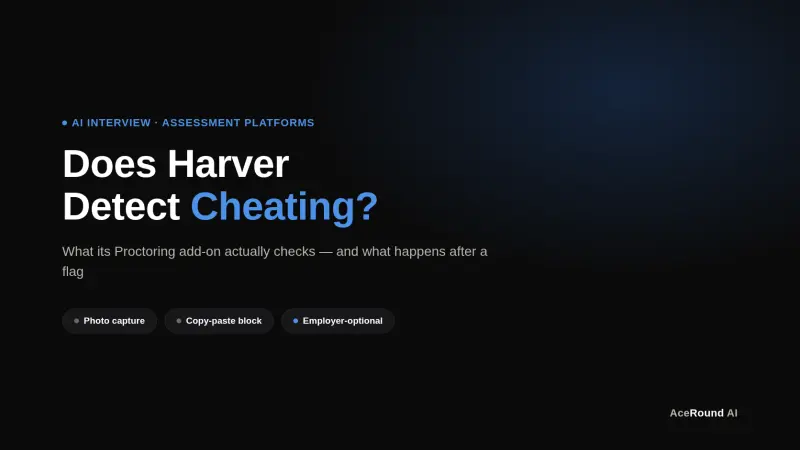
Does Harver Detect Cheating? What Its Proctoring Actually Checks
Does Harver detect cheating on its pre-employment assessments? A candidate look at Harver's Proctoring add-on, what gets logged after a flag, and what happens next.

Micro1's Zara AI Interview: What It Actually Tests (And Why Timing Gets Flagged)
Micro1's AI interviewer Zara has run 300,000+ interviews for remote roles. Here's why it flags response latency as a cheating signal, and what that means for AI prep.