Supply Chain Manager Interview AI: Your Complete Preparation Guide
Master supply chain manager interviews with AI. Learn the 4 core themes, KPI story frameworks, and how AI tools help you practice disruption scenarios.
TL;DR: Supply chain manager interviews are uniquely demanding because you need to demonstrate both hard KPI fluency (OTIF, fill rate, inventory turns) and behavioral depth (crisis management, cross-functional leadership) in the same conversation. AI interview tools let you practice the specific story formats — not just the question list — before you walk into the room.
The interview starts in 40 minutes. Your phone shows the job description one more time: "Supply Chain Manager, Global Operations." You've run the numbers at your current job — improved OTIF from 82% to 94% over 18 months, reduced expedited freight spend by $1.2M, survived a supplier failure that would have shut down a production line. You have the stories. But do you know how to tell them?
Supply chain interviews have a specific problem that generic interview prep doesn't solve: you're expected to move fluidly between hard operational data and behavioral storytelling, sometimes within the same answer. An interviewer asks "how do you handle supplier disruptions?" and they want to see both your incident response playbook AND your composure under pressure. Get the metrics right but narrate flatly, and you're forgettable. Tell a gripping story with vague numbers, and you raise doubt about whether you actually drove the results.
This guide is specifically about that gap.
Why Supply Chain Manager Interviews Are Different
Most behavioral interview prep teaches you a universal STAR formula: Situation, Task, Action, Result. That's not wrong, but it undersells what supply chain interviewers are actually listening for.
Supply chain roles sit at the intersection of three worlds: operations (the machinery), finance (the cost and working capital), and commercial (the customer-facing service levels). An interviewer in this field expects candidates to inhabit all three in their answers. When they ask you about improving fill rates, they want to hear the operational change you made AND the financial impact AND why customer service improved as a result.
This creates a preparation challenge that AI interview tools are unusually well-suited to solve. You can't just rehearse answers in your head — you need an interlocutor who pushes back on vague numbers, asks "what exactly did you do?" when you say you "drove improvement," and follows up with "what would you have done differently?"
The 4 Core Themes in Every Supply Chain Manager Interview
Based on common interview patterns across the industry, supply chain manager interviews consistently probe the same four areas. Structure your preparation around them.
1. Disruption and Crisis Management (Your Hardest Scenario)
This is the question candidates dread most — and the one that differentiates experienced managers from people who got lucky in stable environments.
Expect variants like:
- "Tell me about a time your supply chain faced a major disruption. How did you respond?"
- "Walk me through a supplier failure situation and how you managed it."
- "Describe the most complex logistics crisis you've handled."
The trap: most candidates describe the situation in detail (COVID disruption, port backup, supplier bankruptcy) and then gloss over the action with vague verbs like "we pivoted" or "I coordinated across teams." Interviewers have heard this hundreds of times.
What strong answers include:
- The specific trigger and timeline ("On March 15, our primary supplier notified us of a force majeure — 6-week stoppage")
- Your immediate assessment window ("Within 4 hours I had mapped three alternative sourcing options with lead times and premium costs")
- The tradeoff you made explicitly ("We chose the higher-cost secondary supplier over the longer-lead alternative because customer commitments in Q2 were non-negotiable")
- Quantified outcome ("Maintained 92% OTIF through the disruption period; incremental cost was $340K against a $2M service-level penalty we avoided")
Practice this with AI interview tools by running the full scenario — not just the opening answer, but the follow-up questions. Interviewers routinely ask "What would you have done if the secondary supplier had also been unavailable?" That's where preparation separates from improvisation.
2. Metrics Fluency and KPI Ownership
Supply chain managers are expected to speak fluently in the language of operations metrics. The most common ones:
| Metric | What interviewers want to hear |
|---|---|
| OTIF (On Time In Full) | Baseline, your interventions, % improvement |
| Inventory Turnover | Formula understanding, seasonal context, cash impact |
| Fill Rate / Service Level | How you measured it, gap-to-target analysis |
| Forecast Accuracy | How you drove forecast error down, cross-functional alignment |
| Expedited Freight Spend | As % of total freight, specific reduction efforts |
| Lead Time | End-to-end vs. supplier-specific, how you compressed |
The format that works best for STAR method supply chain examples: baseline → diagnosis → intervention → quantified result. Not "I improved OTIF" but "OTIF was at 78% when I joined; root cause analysis showed 60% of misses were attributable to a single supplier with inconsistent raw material delivery; we implemented vendor-managed inventory at their facility and OTIF reached 93% within 9 months."
The second number always needs the why. An interviewer who hears "we improved OTIF from 78% to 93%" will ask how. Prepare that answer in advance.
3. AI Literacy in Operations (The New #1 Question for 2025–2026)
Here's something most supply chain behavioral interview questions prep guides miss entirely: AI literacy has become a core competency question in supply chain interviews.
AI-related supply chain job postings grew 86% between 2022 and 2024 (Scope Recruiting data). Interviewers at forward-looking companies — 3PLs, manufacturers, retailers — now routinely ask:
- "How are you currently using AI or predictive analytics in your supply chain work?"
- "Have you worked with demand forecasting tools? Which ones?"
- "How do you see AI changing the supply chain role in the next 3 years?"
Candidates who answer "I've used Excel and ERP systems" and stop there are increasingly at a disadvantage. You don't need to be an AI engineer, but you should be able to describe:
- A specific tool or module you've used (Power BI forecasting, SAP AI analytics, Azure ML for demand sensing, or even basic statistical models)
- A concrete operational change that resulted from using it
- An honest view of what AI can and can't do in your context ("Our AI-generated forecasts were 18% more accurate than manual consensus, but they still required judgment adjustment during promotional periods")
The third point — honest limitations — actually builds credibility. Interviewers who work in supply chain understand that AI tools aren't magic.
If you don't have direct AI tool experience yet, the AI interview preparation angle works in your favor: you can legitimately describe how you're preparing for this shift, including using AI interview tools to practice articulating your technical background and exploring AI-augmented operations. Showing self-awareness about an industry trend is better than silence.
4. Cross-Functional Leadership and Supplier Negotiation
Supply chain managers sit between procurement, logistics, finance, manufacturing, and commercial. The interview will test whether you can lead without formal authority — the hardest skill to fake.
For operations manager interview tips on this theme: interviewers aren't just asking who you influenced, they're asking how you built the coalition. "I aligned stakeholders" is not an answer. "I identified that the finance team's concern about working capital was blocking the inventory optimization project, so I built a simulation showing the cash impact under three scenarios before our next cross-functional meeting" — that's an answer.
Supplier negotiation questions test similar dynamics. Your answer should move past "I negotiated better pricing" into the specific levers: payment terms, volume commitments, dual-sourcing pressure, performance scorecards, and how you maintained the relationship while holding the line on accountability.
How AI Interview Tools Change Your Preparation
The standard preparation flow — read a list of 50 common supply chain interview questions, think through your answers, feel vaguely ready — has a fundamental flaw: you never practice the full conversational arc.
Real supply chain interviews don't follow a script. The interviewer will ask about your OTIF improvement story, then follow up with "what specifically changed in the supplier's process?", then probe "how did finance react to the working capital implications?", then ask "if you could do it again, what would you do differently?" Each follow-up requires you to stay in the story with precision.
AI interview tools like AceRound are designed for exactly this preparation mode. You can:
- Run supply-chain-specific scenarios (not generic behavioral practice, but "walk me through improving a key operational metric under budget constraints")
- Get real-time feedback on answer structure, specificity, and time management — supply chain answers tend to run long
- Practice the follow-up gauntlet that interviewers use to distinguish candidates who lived the experience from those who memorized a story
- Refine your metrics fluency — if you can't answer "what was your inventory turnover ratio?" without pausing, practice saying the number out loud until it's natural
The STAR method for behavioral interviews is the foundation, but supply chain interviews need a layer on top: the KPI story format described above. Practice both until they're automatic.
On Certifications: What to Mention and When
APICS/ASCM certifications (CSCP, CPIM, CLTD) are meaningful signals. If you hold one, mention it naturally when the topic connects — not in your opening self-introduction as a recitation, but in context. "When I was preparing for my CSCP exam, I went deep into demand planning theory, which gave me the framework I used when redesigning our S&OP process."
Research shows ASCM-certified supply chain professionals earn up to 25% more than non-certified counterparts. Interviewers from supply chain backgrounds recognize what these certifications require.
If you don't hold one, don't volunteer the absence. If asked directly, be honest and frame it forward: "I haven't pursued CPIM yet, but I've built my operational knowledge through direct experience and I'm planning to certify within the next 18 months."
Preparing for Your First Supply Chain Manager Role
Transitioning from a specialist or analyst role into a manager interview has its own challenge: you may have supported the work but not owned the decisions. Here's how to handle it:
- Distinguish your contribution clearly: "I built the analysis that showed the inventory opportunity; the decision was made by my director, but I presented it and drove the implementation on my side of the team"
- Show decision awareness: Describe the tradeoffs you understood, even if you weren't the final decision-maker
- Demonstrate readiness for scope expansion: Bring a specific example of taking initiative beyond your job description
This is an area where AI interview practice is particularly useful. You can walk through the full story, get feedback on whether your framing sounds like a manager-ready candidate or a support-role candidate, and adjust before the real conversation.
Frequently Asked Questions
How do I prepare for a supply chain manager interview with no formal supply chain experience?
Focus on transferable operational experience: any role where you managed complexity, tracked performance metrics, worked across functions, or solved logistics-type problems. The core competencies transfer; you need to translate the language. AI interview tools can help you reframe your experience into supply chain terminology with coaching on the specific questions you'll face.
What are the most common behavioral questions for supply chain managers?
Disruption management ("tell me about a supplier failure you handled"), cross-functional alignment ("describe a project where you had to bring multiple departments together"), process improvement ("walk me through a metric you improved and how"), and strategic planning ("how do you build your annual sourcing strategy") are the most common themes. The AI literacy question is now appearing frequently too.
Should I be worried about AI replacing supply chain jobs?
In interviews, no — and you shouldn't frame it that way in your answers either. The supply chain function is expanding its use of AI, which is creating demand for managers who understand both operations and data. The candidates who thrive are those who position themselves as users and overseers of AI tools, not competitors with them. That's an honest and accurate framing.
Is anyone actually using AI to help with supply chain interview prep?
Yes, and increasingly so. Candidates preparing for competitive supply chain manager roles at large manufacturers, 3PLs, and retailers are using AI interview tools to practice the full conversational arc — not just to review question lists, but to simulate the follow-up pressure that distinguishes interviews at this level.
What if I can't land another supply chain job despite strong experience?
This is a real frustration in the current market — experienced supply chain professionals who are having trouble getting to the offer stage. Often the issue isn't experience quality but interview performance: either the stories aren't structured tightly enough, the metrics aren't specific enough, or the cross-functional leadership angle is underdeveloped. Getting specific feedback on your actual answers (not just whether they're "good") usually reveals the gap quickly.
How do I talk about the AI skills I don't have yet?
Honestly and specifically. Describe the adjacent tools you've used, acknowledge the gap with self-awareness, and show that you're actively addressing it — whether through specific training, following industry developments, or using AI tools in your interview preparation process itself. Interviewers value honesty and directness over overstatement.
Author · Alex Chen. Career consultant and former tech recruiter. Spent 5 years on the hiring side before switching to help candidates instead. Writes about real interview dynamics, not textbook advice.
Related Articles
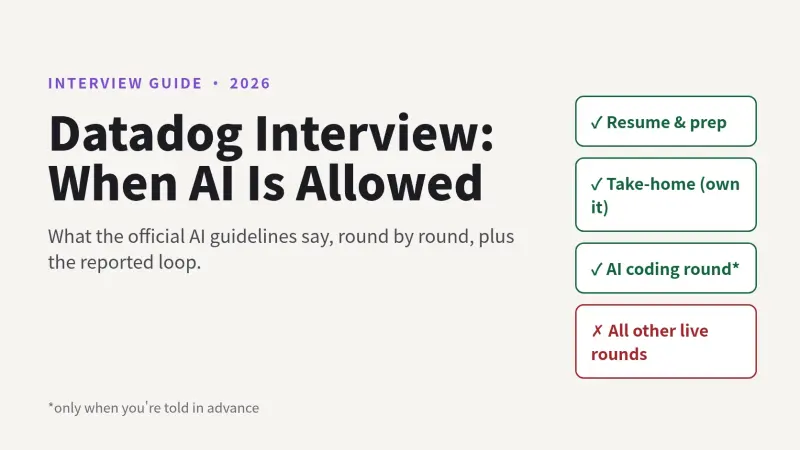
Datadog Interview Process (2026): What's Allowed With AI, Round by Round
Datadog publishes its AI rules for candidates. Here's what they allow, what they ban, the reported loop, and how to prep for the project deep dive.
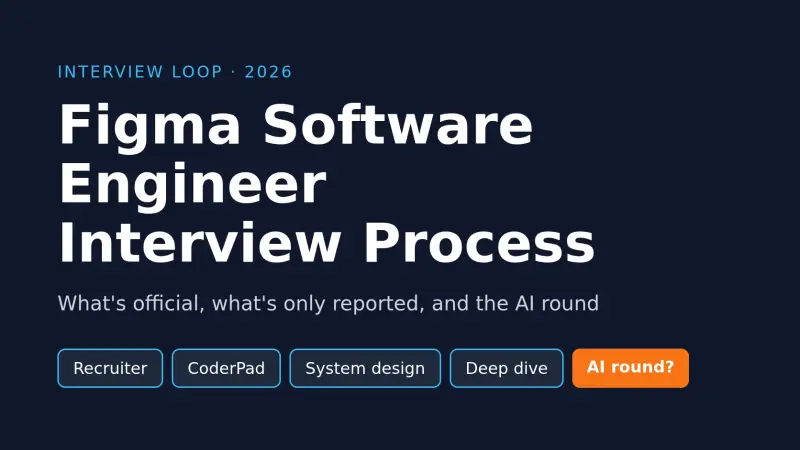
Figma Software Engineer Interview Process (2026): What's Reported
Figma publishes no interview rubric. Here's the loop candidates report, the product-flavored coding and design rounds, and what's known about an AI round.
Oracle and PayPal Fresher Interview Process in India: What Candidates Reported, Year by Year
Oracle India's test moved from aptitude plus core CS to HackerRank with a REST API task. PayPal's cut-offs and platform also differ. Posts compared.