How to Use AI to Prepare for a Product Manager Interview (2026 Guide)
TL;DR: Product manager interview AI tools work best when you use them to stress-test your frameworks and practice your stories — not to generate answers on the fly. This guide covers how to fit AI into every phase of PM interview prep, where it genuinely helps, and where it'll quietly make you worse.
A friend of mine spent 8 weeks preparing for a PM role at a mid-size tech company. He used ChatGPT to generate 200 practice questions, answered them all, and still bombed the product sense round. The interviewer asked him to design a grocery delivery feature for elderly users, and he froze — because he'd been practicing answering questions, not thinking through problems.
AI in PM interview prep is genuinely useful, but only if you know what you're asking it to do.
What Everyone Gets Wrong About PM Interview Prep
Most of the content about "product manager interview AI" out there is actually about interviewing for AI PM roles — how to demonstrate ML literacy, how to talk about probabilistic systems. That's a different topic.
This guide is for anyone preparing for a product manager role who wants to use AI tools more effectively in their prep. Whether you're going for a generic PM job at a startup or a senior PM role at a FAANG company, the framework is the same.
The core mistake: using AI as an answer machine instead of a thinking partner. When you ask an AI to "give me an answer to the CIRCLES question about Spotify," you get a polished, generic response that sounds like every other candidate. When you ask it to pressure-test your answer, point out weak assumptions, and simulate a skeptical interviewer, you actually get better.
PM Behavioral Interview Frameworks: Where AI Helps Most
Behavioral questions are the place where AI-assisted PM interview prep has the clearest ROI. Here's why: behavioral prep is essentially about story selection and structure — two things AI is genuinely good at helping you refine.
PM behavioral interviews test for leadership, cross-functional influence, product judgment under pressure, and resilience. Companies want to see specific examples, not abstract claims.
The STAR method (Situation, Task, Action, Result) is the baseline. For PM roles, you'll often want to extend it to STARR — adding a second R for Reflection — because interviewers want to know what you'd do differently.
How to use AI here:
- Dump a rough draft of your story into an AI tool
- Ask it to check: "Is the Action section specific enough? Does it show ownership?"
- Ask it to simulate a follow-up question: "What if your stakeholder pushed back on your prioritization decision?"
- Iterate until the story holds up under pressure
What AI doesn't do well: it can't tell you if your story is actually impressive given your seniority level. A story that sounds strong to a language model might be underwhelming to a Staff PM at Google. You still need human calibration — a peer who's done these interviews, or a career coach.
The CIRCLES Method Interview: Using AI as a Framework Drill Partner
The CIRCLES method (Comprehend the situation, Identify the customer, Report the customer's needs, Cut through prioritization, List solutions, Evaluate tradeoffs, Summarize) is one of the most commonly taught product sense frameworks. It's also one of the most misused.
Most candidates treat CIRCLES as a checklist they sprint through. Interviewers notice. The point isn't to hit every step — it's to demonstrate structured thinking that actually serves the user.
AI-assisted CIRCLES practice:
- Give the AI a product sense question: "Design a feature for LinkedIn that helps laid-off workers find jobs faster"
- Ask it to critique your CIRCLES walkthrough: "What did I skip or rush? Where did my user segmentation feel too broad?"
- Ask for a harder variant: "Now assume LinkedIn's core feed algorithm is off-limits. How does your answer change?"
The PM product sense interview is the round that trips up the most candidates who are technically qualified. AI can give you 10x more practice reps than any mock interview coach — and it's available at 2 AM when you're panicking before your onsite.
One honest limitation: AI-generated CIRCLES walkthroughs tend to converge on the same safe user segments (millennials, power users, busy professionals). Push it to challenge your assumptions, not validate them.
AI-Assisted PM Interview Prep: The Phase-by-Phase Approach
Here's the approach that actually works, broken down by prep phase:
Phase 1: Audit (Weeks 1–2)
Dump 5–7 of your best career stories into an AI tool and ask for a gap analysis:
- Which behavioral competencies do these stories cover?
- What's missing? (PM interviews typically expect coverage of: leadership, conflict resolution, data-driven decisions, prioritization, failure recovery)
- Which stories feel generic or weak?
This audit saves you from practicing the wrong things.
Phase 2: Framework Drilling (Weeks 2–5)
Use AI to generate 20–30 product sense and execution questions, then time yourself and evaluate with AI feedback. Specifically useful:
- Product sense: Ask AI to vary the difficulty, constraint set, and user base
- Execution: Give metrics scenarios and ask AI to poke at your diagnosis ("You said DAU dropped 15% — what's the next question you'd ask, and why?")
- Prioritization: Use RICE (Reach, Impact, Confidence, Effort) or ICE scoring, then ask AI to challenge your weights
Phase 3: Mock Simulation (Weeks 5–7)
Some AI interview tools now run full simulated PM interview loops — you respond in real time, it gives structured feedback. This is where tools like AceRound AI become directly useful: you get the feel of a live conversation with an evaluator, not just a static Q&A.
The key difference in Phase 3 is simulating the format, not just the content. PM interviews are conversations. You need to practice thinking out loud, not reciting prepared answers.
Phase 4: Real-Time Support (Interview Day)
This is the most controversial part. Using an AI copilot during a live interview is a gray area — but for video interviews specifically, having a subtle reference tool available changes the game.
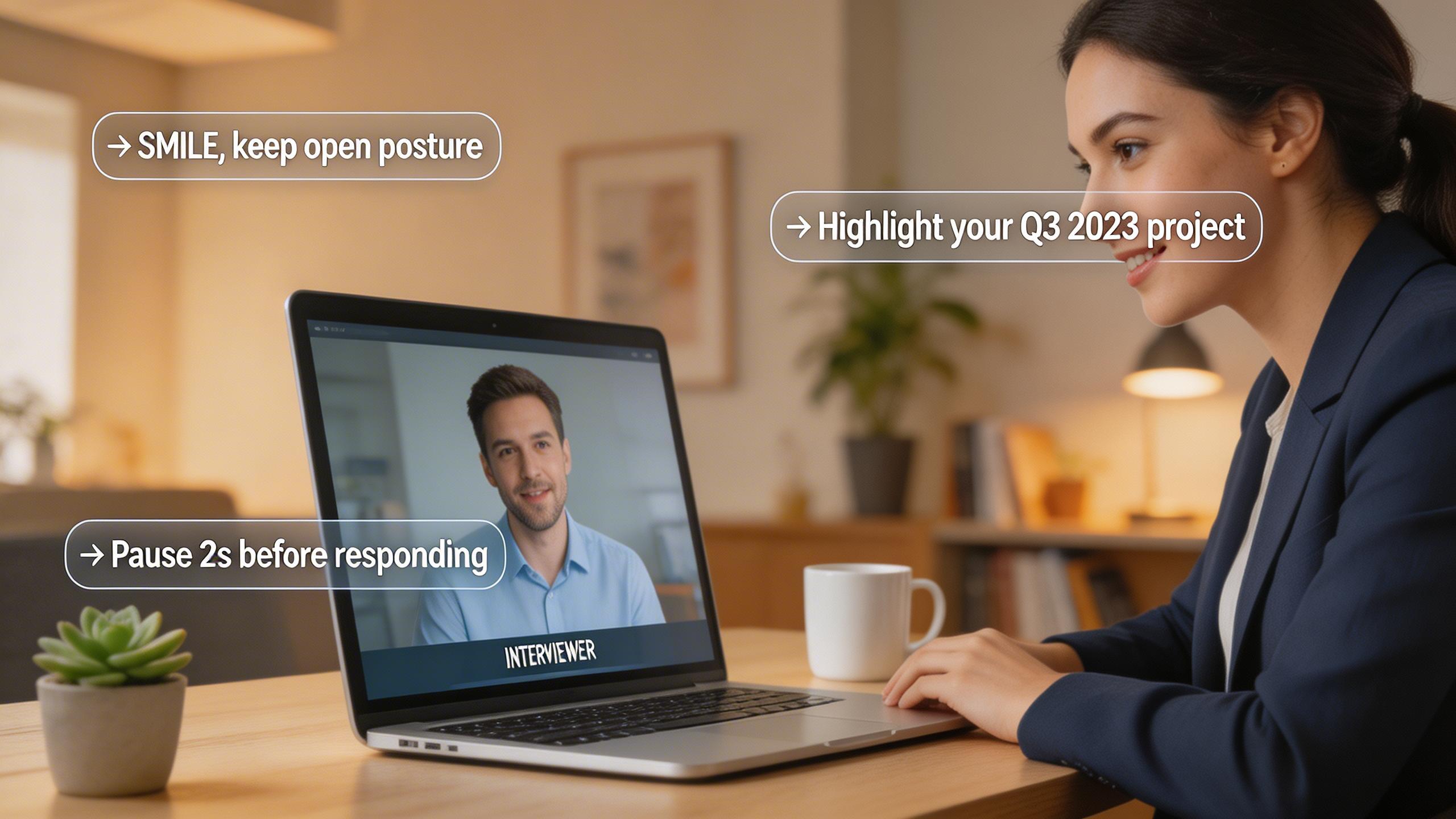
AceRound AI is built for this: it listens to the conversation in real time and surfaces relevant suggestions without being visible to the interviewer. For a PM candidate, this can help with:
- Remembering which framework to apply mid-question
- Catching a behavioral question before you drift into storytelling mode
- Flagging when you've been talking for 4 minutes and need to land the answer
Whether you use it on interview day or not, going through the preparation with real-time feedback loops makes your answers sharper.
What AI Can't Do for Your PM Interview
Let's be direct about limitations, because most AI interview prep articles won't:
AI can't give you product intuition. PM product sense questions test for user empathy developed over years of observing real products, talking to real users, and making bad calls and learning from them. An AI can teach you the vocabulary, not the judgment.
AI-generated stories are obvious. If you let an AI write your behavioral answers, experienced interviewers will notice. The language is too clean, the reflection is too neat, the numbers are suspiciously round. Use AI to structure your stories, not to invent them.
AI can't calibrate your level. The bar for a PM at a Series A startup and the bar for a Staff PM at Stripe are wildly different. AI doesn't know which one you're aiming for — or whether your answers clear that bar. Get human feedback.
AI can't replace reps. Twenty AI-simulated interviews won't replace five real ones. If you have access to actual mock interviewers — through a referral, a career coach, or peer prep groups — prioritize those in the final 2 weeks.
Frequently Asked Questions
Can I use AI during a product manager interview? Depends on the format. For take-home assignments or async assessments (like Karat OA-style screens), there's no explicit rule against AI — but you'll need to explain your reasoning in a follow-up. For live panel interviews, using an AI tool that's invisible to the interviewer is technically possible and increasingly common. Whether it's ethical depends on the intent: using it as a framework reminder is very different from reading answers off a screen.
How long should I prepare for a PM interview? 6–8 weeks is realistic for someone currently employed who can dedicate 1–2 hours daily. Compressed into 3–4 weeks is possible if you do intensive mock interview loops. Less than 2 weeks is rarely enough for FAANG-level PM interviews.
What's the hardest round in a PM interview? Product sense is where most technically qualified candidates stumble. It requires structured thinking and genuine product judgment. Behavioral rounds are often underestimated — candidates prepare stories but don't practice being pushed on them.
Does using AI to prep for interviews count as cheating? Using AI to prepare (generate questions, critique your answers, simulate conversations) is no different from using any other study resource. No employer in the world would object to that. Using AI to generate answers in real time during a live assessment is a different question — companies have different policies, and a small number explicitly prohibit it.
Which PM interview frameworks matter most? STAR for behavioral questions. CIRCLES or a simplified product design framework (Define → Prioritize → Design → Measure) for product sense. RICE or ICE for prioritization. You don't need to know all of them equally well — know the ones that fit your role and company context.
How do you practice PM interview product sense if you don't have a PM background? Start with consumer apps you use every day. Pick a feature, walk through a CIRCLES analysis, then critique it. Do this 2–3x per week. The reps build intuition faster than studying theory. AI tools are genuinely useful here for generating diverse, unexpected product scenarios.
Author · Alex Chen. Career consultant and former tech recruiter. Spent 5 years on the hiring side before switching to help candidates instead. Writes about real interview dynamics, not textbook advice.
Related Articles
Real-Time AI Interview Helper: What It Does and How to Use It
A practical guide to real-time AI interview helpers — how they work during live interviews, legitimate use cases, and what to avoid.

Can HireVue Detect Cheating? What Actually Gets Flagged in 2026
HireVue cheating detection explained: tab switching, shared scripts, AI-generated answers, and looking away — what the system actually flags and what it misses.
The Honest Switcher's Guide to Finding a Final Round AI Alternative
Comparing the best Final Round AI alternatives for 2026: honest breakdown of pricing, real-time performance, detection risks, and when each tool actually makes sense.