Panel Interview Tips: How to Handle 4 Interviewers Firing Questions at Once
Panel interview tips AI strategies to manage cognitive overload, eye contact, and rapid-fire questions when facing multiple interviewers simultaneously.
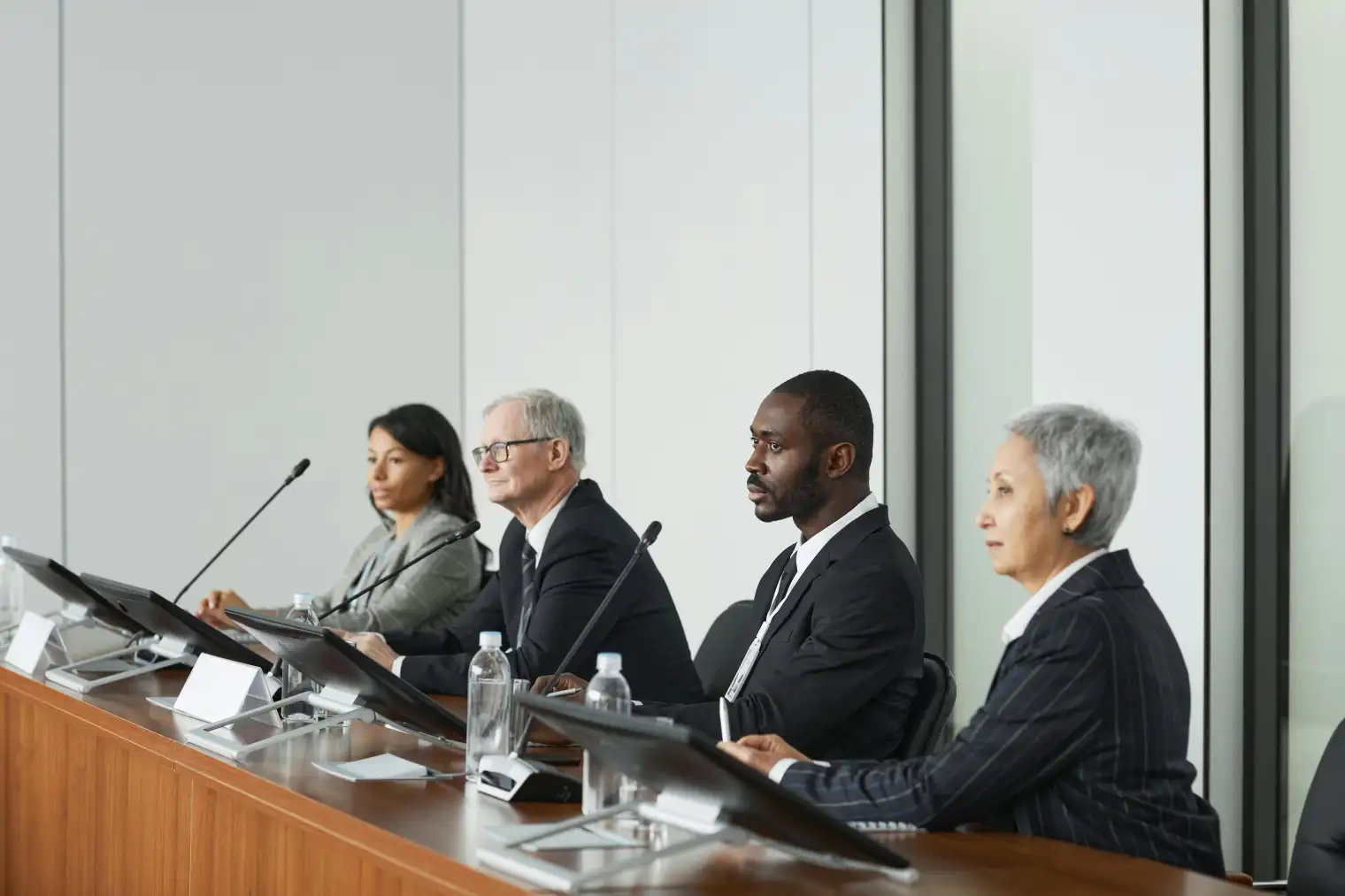
TL;DR: Panel interview tips with AI come down to one problem: split attention. You're not struggling because the questions are harder — you're struggling because 3–5 people are evaluating you simultaneously, each through a different lens. AI prep tools help you simulate that dynamic before the call. Real-time AI assistance helps you maintain structure when it gets fragmented in the moment.
Three minutes into the interview, the VP of Engineering asks what you'd do in your first 90 days. You're halfway through your answer when the Product Manager cuts in with a follow-up. To your left, the HR Director is writing something down — either good notes or visible skepticism. You haven't made eye contact with the CTO in 90 seconds, and you've completely lost track of who hasn't spoken yet.
This is panel interview territory. Not hard because the questions are harder — hard because your attention is being pulled in four directions while you're trying to sound coherent, structured, and calm.
Standard interview prep doesn't address this. Articles about STAR answers or "research the company beforehand" aren't wrong — they're just insufficient. They prepare you for one conversation, not four simultaneous ones.
The Real Problem: Split Attention, Not Harder Questions
A one-on-one interview is cognitively manageable. You track one person's body language, direct your answers at one face, and recover from a stumble in one person's eyes.
A panel interview fragments all of that. Research from Harvard Business School on multi-evaluator interview settings shows that candidates perform inconsistently across panel formats — not because of knowledge gaps, but because the simultaneous evaluation context creates performance variance that prep alone doesn't resolve. The problem is cognitive load, not preparation depth.
What specifically goes wrong:
Attention routing. You're deciding in real time who to look at, who asked what, and whether a follow-up changes your current answer — all while speaking.
Competing agendas. Each panelist evaluates a different dimension. The tech lead wants depth and precision. HR wants culture fit signals. The hiring manager wants to know if you can actually do the job. They're listening for different things in the same answer.
Recovery complexity. In a one-on-one, a stumble is between you and one person. In a panel, five people watched you stutter, and you have to regroup with five people watching.
Understanding this changes how you prepare.
Before the Panel: AI Prep That Actually Simulates Multi-Voice Dynamics
Most candidates prepare the same way for a panel as for a one-on-one: practice their answers, research the company, review their resume. That's necessary but not sufficient.
The specific preparation gap is multi-voice simulation. You need practice sessions where different "interviewers" interrupt, probe from different angles, and ask follow-ups that redirect your answer midstream.
Research each panelist individually. If you received the panel lineup in advance (most invite emails name the interviewers), look each one up. LinkedIn profiles, recent publications, or talks they've given will tell you their professional emphasis. A technical panelist who wrote about distributed systems will probe differently than one focused on engineering management. Feed this to an AI interview coach and ask it to generate questions each person is likely to ask based on their role.
Run multi-persona mock sessions. Tell your AI tool to play three interviewers with distinct roles: one technical, one focused on leadership and culture, one senior stakeholder asking about strategy. Ask it to interrupt you with follow-up questions mid-answer. This simulates the actual cognitive load better than answering questions one by one. AI mock interview tools that let you configure multiple interview voices are worth the extra setup time here.
Prepare STAR stories that work from multiple angles. Any story you plan to tell needs to satisfy a technical panelist (what specifically did you do?), an HR panelist (how did you handle the team dynamics?), and a senior stakeholder (what was the business impact?). Practice routing the same story through different emphasis angles. An AI interview answer generator can help you test whether your STAR stories hold up under multi-dimensional questioning.
AceRound AI supports multi-role mock interview sessions — set up custom interviewer personas and get interrupted mid-answer with follow-ups that reflect each role's priorities. Set up a panel mock session before your next interview.
Five Tactics That Change How You Perform in the Room
These work regardless of whether you use any AI tools. They address the specific mechanics of panel settings:
1. Address routing: who gets the direct answer. The default should be: make eye contact with the person who asked the question, but end your answer by sweeping the room. You're answering the asker, but you want every panelist to feel included. Don't stare at one person for a two-minute answer.
2. The 70/30 eye contact rule. Roughly 70% of your attention goes to the person who asked. The remaining 30% sweeps naturally to the others. It sounds mechanical written out, but in practice, it prevents the two failure modes: (a) ignoring panelists who didn't just speak, and (b) looking around the room so much you seem unfocused.
3. When two panelists speak at once. This happens more than you'd expect. Don't try to answer both questions simultaneously. A clean response: "Those are related points — let me address [Person A's question] and then make sure I get to what you're raising." It acknowledges the second question and buys you structure without seeming evasive.
4. Write down names at the start. When introductions happen at the opening, write each person's name in the order they're sitting. Refer to it if needed. Using a panelist's name once during a substantive answer (not obsequiously — once, naturally) signals attention and social intelligence.
5. The intentional pause. Before answering any substantive question in a panel setting, pause for 2–3 seconds. Candidates in one-on-ones do this instinctively when they think. In a panel, the same pause feels like a considered response rather than a freeze, because five people are watching you think. It also gives you time to route the answer — who asked this, what do they care about, which of my prepared stories fits?
Where AI Assistance Actually Matters During a Live Panel
Live AI assistance during an interview is valuable when it reduces cognitive load — and in panel settings, cognitive load is the entire problem. What AI can do well here and what it can't:
What works: Structural prompts. When a question hits and your memory goes blank, seeing "STAR → Situation, then what you actually did" on screen helps more than you'd expect. It's not that you forgot the STAR framework — it's that you're managing five people's reactions while trying to construct an answer, and the structure acts as a reset.
What also works: Key facts on demand. If a panelist asks something company-specific and you need to reference a detail, an AI that surfaces relevant context from your pre-loaded company research buys you precision without a visible lookup.
What doesn't work well: Reading full AI-generated sentences in a panel setting. One-on-one, an interviewer tracks only your pacing and word choices. Five panelists tracking simultaneously are more likely to notice the cadence shift that comes with reading someone else's text. Real-time AI interview helpers work best in panel settings when they prompt structure and surface facts, not when they draft complete responses for you to recite.
The honest limitation: Panel interviews involve more unscripted social dynamics than one-on-ones — the side conversations, the spontaneous follow-up, the read of the room. AI assistance handles structured answering well. It doesn't help you navigate the interpersonal undercurrents of a five-person room in real time. That part requires the prep you did beforehand.
What Each Panelist Type Is Actually Listening For
Panel composition varies, but most include a version of these four:
Technical panelists want precision and depth. They're checking whether your description of a past project matches what someone who actually did it would say. Vague answers that sound correct are more suspicious to them than a direct "I'm not sure about X, but here's how I'd approach finding out."
HR and people-team panelists are evaluating culture fit, communication style, and how you handle adversity. They're often less interested in the specifics of what you did than in how you describe your relationship to the people involved, the constraints you navigated, and what you learned.
Senior stakeholders (VP, Director, C-suite observers) are listening for whether you think at the right altitude. They don't want implementation details — they want to hear you contextualize your work in terms of business impact, organizational priorities, and what you'd do differently at scale.
Peer or team panelists are asking: would I want to work alongside this person? They're evaluating collaboration instincts, communication clarity, and whether you'll make their job harder or easier. Self-aggrandizing answers or stories where you single-handedly saved the project will register negatively with this group even if the facts are true.
Knowing this, you can tune the emphasis of the same story for the person asking. The core narrative stays constant — only the angle of emphasis shifts.
Post-Panel: Thank-You Emails That Actually Stand Out
The standard advice (send within 24 hours, be specific) is correct. The detail most candidates miss in panel settings: one email per panelist is almost always better than one combined email addressed to the group.
A generic "Thank you all for your time" email signals that you're treating the panel as a monolith. A specific email to each panelist that references one thing from their line of questioning signals that you were genuinely engaged — and that you noticed what they individually cared about. Use the names you wrote down at the start.
Reference something concrete: "Your question about handling competing priorities across teams got me thinking about [specific aspect]..." This isn't flattery — it demonstrates that you were present and listening throughout, which is exactly what a panel is designed to test.
FAQ
Is it normal to feel more nervous in a panel interview than a one-on-one?
Yes, and research backs this up — multi-evaluator settings create performance anxiety that doesn't correspond to actual preparation level. Even highly qualified candidates freeze in panels because the cognitive demands are genuinely higher. The preparation that helps most is simulating the multi-voice context, not just drilling answers in isolation.
How do I manage talking to multiple interviewers at once without losing track of who asked what?
Write down panelists' names in their seating order at the start. When a question is asked, note which role (not name — role) is asking before you answer. "Technical question from engineering lead" tells you how to pitch the answer more than the name does.
What do I do when two panelists ask questions at the same time or in rapid succession?
Don't try to answer both simultaneously. Explicitly name what you're doing: "I want to make sure I address both of those — let me start with [first question] and then come back to what you're raising." It signals social awareness and gives you a structure to execute.
Should I address my answers to the most senior person or spread my attention equally?
Direct about 70% of your answer to the person who asked, and sweep the room for the remaining 30%. The most senior person in the room typically isn't the one asking the most questions — they're observing how you interact with everyone else. Equal attention to the room signals confidence.
How do I make eye contact with multiple people without looking weird or robotic?
The failure mode isn't making too much eye contact — it's making eye contact that doesn't follow the conversation. Natural eye contact flows: look at the person asking, look at others when you're making a broader point, return to the asker as you finish. Mechanical rotation (every 15 seconds, person to person regardless of context) reads as rehearsed.
How do I prepare for questions I can't predict when there are multiple interviewers with different agendas?
You can't predict every question, but you can predict the categories each panelist will probe. Research their role and recent work before the interview. Then prepare two or three stories that are flexible enough to emphasize different dimensions: technical depth for engineers, people dynamics for HR, business impact for senior stakeholders. The same story told from different angles covers most of what a multi-agenda panel will throw at you.
Author · Alex Chen. Career consultant and former tech recruiter. Spent 5 years on the hiring side before switching to help candidates instead. Writes about real interview dynamics, not textbook advice.
Related Articles

Deloitte USI, EY GDS, KPMG GDC, and PwC AC: India Hiring Process Explained
Deloitte USI, EY GDS, KPMG GDC, and PwC AC run four separate hiring processes — HireVue, group exercises, and Eduthrill included — and none of them match a TCS-style aptitude test.
Virtual Onsite Interview Loop: How to Survive 4-6 Back-to-Back Rounds
What a virtual onsite interview loop is, why round 4 is where candidates fall apart, and how to prepare for 4-6 back-to-back video rounds in one day.
Interviewing While Employed: How to Actually Prepare With Zero Time
Job searching while employed means near-zero prep time, not just staying discreet. Here's a 20-minute prep script, plus what the counteroffer statistics actually show.