How to Answer 'Tell Me About a Difficult Coworker' in Any Interview
Master the difficult coworker interview answer with archetype-specific frameworks, STAR examples, and tactics for edge cases — no clean story required.

TL;DR: The difficult coworker interview answer trips up candidates who try to sound perfect. What actually works: name a specific conflict type, show what you did (not just how you felt), and deliver a concrete outcome. You don't need a happy ending — you need a story where you behaved professionally and learned something real.
A CPP Global Human Capital Report found that U.S. employees spend an average of 2.8 hours per week dealing with conflict — and 85% report experiencing workplace conflict regularly. Interviewers who ask about difficult coworkers already assume you've had one. The question isn't whether you experienced conflict. It's whether you handled it like someone worth hiring.
Most candidates blow this question the same way: they either claim they've never had a difficult coworker (instant red flag), they describe a situation where they were clearly the hero and the coworker was clearly the villain (even bigger red flag), or they give such a vague, sanitized answer that the interviewer learns nothing useful.
This guide fixes that.
Why Interviewers Ask About Difficult Coworkers
This question is an EQ calibration test disguised as a casual prompt. Specifically, interviewers are scoring three things:
Self-awareness: Can you recognize interpersonal friction and talk about your own role in it honestly? Candidates who only see the other person's faults signal blind spots that scale badly.
Conflict resolution skill: Do you have a process — reaching out directly, documenting issues, looping in a manager at the right time — or do you just white-knuckle through or escalate everything?
Retention risk: A CIPD Good Work Index finding shows that employees experiencing conflict are twice as likely to leave within 12 months. Employers aren't hiring someone who'll take one difficult colleague as a reason to quit.
What interviewers are not looking for: proof that you've never annoyed anyone, or that every professional relationship in your career ended in mutual respect and birthday cards.
The STAR Method for Difficult Coworker Answers
The STAR method (Situation, Task, Action, Result) works here, but it needs a conflict-specific layer between Situation and Task: a Stakes Sentence that names what was actually at risk.
Without the stakes sentence, your story sounds like a project recap. With it, the interviewer understands why the conflict mattered — and why your response was worth noticing.
Structure:
- Situation (1 sentence): What was the work context?
- Stakes (1 sentence): What would have broken down if the conflict continued?
- Task (1 sentence): What were you responsible for in this dynamic?
- Action (2–3 sentences): Specifically what did you do? Name tools, conversations, timing.
- Result (1–2 sentences): What happened? Include numbers or observable changes where possible.
Target length: 90–150 seconds spoken. Practice out loud, not just in your head.
For a deeper look at behavioral interview questions beyond coworker conflicts, the underlying principles are the same.
5 Difficult Coworker Archetypes — and How to Answer for Each
Generic advice says "use STAR and stay professional." That's not wrong, but it doesn't help when you're staring at a blank page trying to remember which conflict to use and how to frame it.
Here are the five most common conflict types and what an effective answer looks like for each.
1. The Passive-Aggressive Colleague
What makes it hard to answer: Passive aggression is hard to document and easy to come across as petty when describing. "They said 'fine'" doesn't land well in an interview room.
What to emphasize: You observed a pattern (not a single incident), you addressed it privately and directly, and you named the impact on work outputs — not on your feelings.
Sample angle: "A teammate would agree to deliverables in meetings, then miss deadlines without flagging blockers. After the second missed deadline affected a client handoff, I blocked 15 minutes with them privately to ask if there were constraints I wasn't aware of. Turned out they were overloaded and didn't feel safe saying no to the team lead. We agreed on a system: they'd flag any deadline risk 48 hours in advance. The next three handoffs landed on time."
2. The Credit-Stealer
What makes it hard to answer: It sounds self-serving. Candidates who describe this conflict often sound bitter rather than professional.
What to emphasize: You addressed visibility systematically rather than personally. Project documentation, CC'ing stakeholders, proposing shared authorship on deliverables — these show structural problem-solving, not ego protection.
Sample angle: "I noticed that a senior colleague's update emails to leadership often referenced 'our analysis' without naming contributors. I raised it directly with them — not accusatorially, but framing it as wanting to make the team's process more visible. We set up a project summary format that listed contributors alongside deliverables. It became standard practice across the team."
3. The Chronically Late Teammate
What makes it hard to answer: It risks sounding like you're reporting someone rather than resolving something.
What to emphasize: You separated the person from the pattern, addressed it without making it personal, and found a structural fix rather than just tolerating or escalating.
Sample angle: "A junior developer regularly missed our daily standups, which meant blockers went unaddressed until afternoon. I moved our one-on-one check-in to right before standup — informally — which created a natural pull. Within two weeks, attendance improved and we caught a dependency issue 24 hours earlier than we would have otherwise."
4. The Scope-Creeper
What makes it hard to answer: In many companies, scope creep is rewarded, not penalized. Answering this requires you to explain why containing it was the right move.
What to emphasize: You respected their enthusiasm while protecting delivery commitments — and you had the data to back up the tradeoff.
Sample angle: "A colleague with strong product instincts kept proposing feature additions during a sprint we'd already scoped. I appreciated the ideas but flagged that each addition added 8–12 hours to a fixed-deadline build. I suggested a 'parking lot' doc for new ideas that we'd review after launch. We shipped on time, and three of the deferred ideas made it into the next cycle — including one that became a top-used feature."
5. The Remote Ghost (Async and Hybrid Friction)
What makes it hard to answer: Remote conflict is newer territory, and many interviewers are still calibrating what good looks like here.
What to emphasize: You acknowledged the ambiguity of remote communication, proposed structure rather than blame, and measured the result.
Sample angle: "A remote teammate in a different time zone was consistently unreachable during overlap hours, which was blocking code reviews. Rather than escalating, I asked them to document a daily 'available window' in our team channel. We designed a lightweight async review protocol with two-hour SLAs. Review cycle time dropped from three days to about 14 hours."
Practice your coworker conflict answer before your next interview. AceRound AI gives you real-time answer coaching in a live interview simulation — so you can run your STAR story, get feedback on pacing and specificity, and walk in confident. No sign-up required for the first session.
What If You Don't Have a Clean Story?
Every template article assumes you have a resolved, professional conflict with a happy outcome. Most candidates don't. Here's how to handle the three hardest edge cases.
"I'm entry-level — I've never had a real coworker conflict."
Use university, internship, or volunteer examples. The competency being tested is interpersonal navigation under friction, not corporate experience specifically. A group project where one person was disengaged and you addressed it directly is a legitimate answer.
Frame it explicitly: "I'm coming from an academic context, but I had a parallel experience in a group project..." — and then make the STAR story tight.
"The conflict wasn't really resolved."
This is more common than interview prep materials admit. You don't need a tidy resolution. What you need is a story where your behavior was professional, proportionate, and evidence-based — even if the other person didn't change.
Acceptable endings: "We continued to have friction, but it stopped affecting deliverables." / "They eventually transferred to a different team." / "I escalated to my manager when it became a team-wide issue." What's not acceptable: "I just avoided them."
"HR got involved."
If HR was involved, you can still answer this — with care. Focus on what you documented, why you escalated, and what the process looked like from your side. Don't name names or characterize the outcome in detail. A short, factual treatment is usually enough: "The situation escalated to the point where I involved HR. I won't go into the specifics, but I'll say I learned a lot about what good documentation looks like and how to raise concerns formally without it feeling personal."
3 Sample Answers by Career Stage
Entry-Level (Group Project Framing)
"In a four-person capstone project, one teammate submitted drafts consistently late and the rest of us were absorbing the rework. I didn't want to escalate to the professor right away, so I asked to meet with them one-on-one. They mentioned they were working two jobs that semester. We reorganized their tasks toward earlier-stage research work with lighter late-stage deliverables. The project submitted on time and they contributed meaningfully. I'd do the same thing now — address it directly first, understand the context, then adjust."
Mid-Level (Professional Workplace, Process Fix)
"At my previous company, I worked closely with a data analyst who had a habit of sharing half-finished outputs in cross-functional meetings, which led to leadership making decisions based on preliminary numbers. I raised it privately after the second instance — framing it as a visibility issue, not a trust issue. We agreed on a simple 'draft vs. final' status label for anything shared outside the team. The confusion largely stopped. That system is still in place three years later."
Senior-Level (Upward Management)
"I once managed a peer — technically a cross-functional partner with more company tenure than me — who consistently bypassed agreed communication protocols and went directly to our shared VP. I requested a one-on-one to understand their concern. The underlying issue was that they felt left out of decisions I was making that affected their team. I restructured our touchpoints to include them earlier in the decision cycle. It took about a month, but the bypass behavior stopped and we ended up collaborating well on three more initiatives. The lesson: what looks like defiance is often a communication gap."
What to Avoid
Claiming zero conflict: "I've never really had a difficult coworker — I get along with everyone" reads as dishonest or lacking self-awareness. Every interviewer has worked with difficult colleagues. They know.
Describing only the other person's faults: If your story has a clear villain, you probably need to reframe. Focus on what you did, not what they did wrong.
Badmouthing by description: Even without naming someone, describing an ex-colleague as "toxic," "incompetent," or "impossible to work with" raises questions about your judgment.
Vague resolution: "We worked it out eventually" without specifics signals the story isn't real or that you don't remember it well. Either way, it doesn't build trust.
Moralizing: Don't editorialize about what the coworker should have done. It makes you sound like you're still irritated.
Frequently Asked Questions
"What's a simple answer when they ask how I'd handle conflict with a coworker?"
Lead with the context, describe one concrete step you took to address it directly, and state what happened. Two sentences is fine if you're in a fast-paced screen. You can always add detail if they probe.
"What if I've never had a difficult coworker — what do I say?"
Use a non-workplace example: group project, volunteer team, student organization. Name the friction, describe what you did, and connect it to how you'd handle something similar professionally. Don't claim you've never experienced interpersonal friction — it's not credible.
"How do I answer this if a coworker filed an HR complaint against me?"
You are not required to disclose an HR complaint in an interview. If it comes up (e.g., you were let go over it), acknowledge it briefly, focus on what you learned, and don't editorialize about the other person. Keep it short and factual.
"What's the most challenging coworker interview question to answer?"
Most candidates find the "what if it wasn't resolved" variant hardest — because every template assumes a clean ending. The answer: your story doesn't need a happy ending. It needs to show professional behavior and self-awareness throughout.
"Do interviewers want me to name the difficult coworker's specific behavior?"
Yes — specificity builds credibility. "They missed deadlines" is weaker than "they missed three consecutive Monday handoffs." But don't go so detailed that it sounds like you're filing a formal complaint.
"Is it okay to say the conflict was my fault too?"
Absolutely — in fact, this is often the answer that lands best. Saying "I later realized I could have flagged the dependency earlier, which would have avoided the crunch" shows self-awareness and makes the whole story more credible.
Author · Alex Chen. Career consultant and former tech recruiter. Spent 5 years on the hiring side before switching to help candidates instead. Writes about real interview dynamics, not textbook advice.
Related Articles
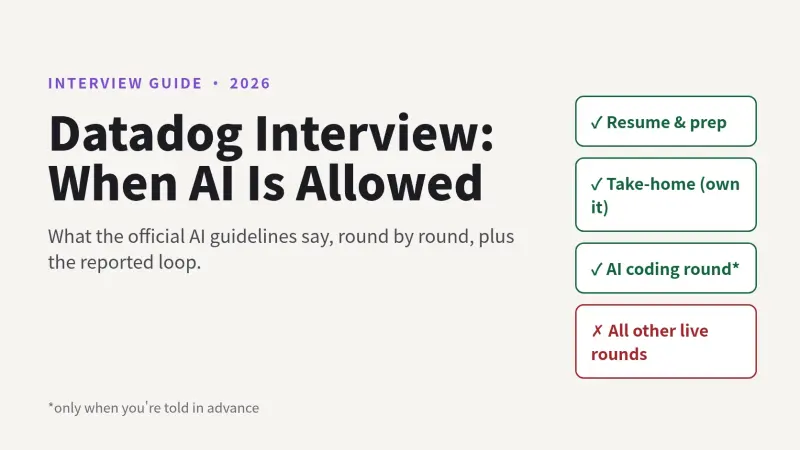
Datadog Interview Process (2026): What's Allowed With AI, Round by Round
Datadog publishes its AI rules for candidates. Here's what they allow, what they ban, the reported loop, and how to prep for the project deep dive.
Figma Software Engineer Interview Process (2026): What's Reported
Figma publishes no interview rubric. Here's the loop candidates report, the product-flavored coding and design rounds, and what's known about an AI round.
Oracle and PayPal Fresher Interview Process in India: What Candidates Reported, Year by Year
Oracle India's test moved from aptitude plus core CS to HackerRank with a REST API task. PayPal's cut-offs and platform also differ. Posts compared.