Customer Service Interview Questions: How to Prepare With AI Help
Customer service interview AI prep for the questions that actually decide the offer — the angry-customer scenario, STAR answers, and async video screens.

TL;DR: Customer service interview AI prep works best on the one question that actually eliminates candidates — the angry-customer scenario. The U.S. Bureau of Labor Statistics still counts roughly 341,700 annual openings in the role despite a projected decline in total headcount, so the hiring bar per seat is higher, not lower. Prep material is everywhere; what's missing is help in the moment the scenario question actually lands.
Someone typed this into Quora, verbatim: "I really blew a job interview because I was so nervous, I couldn't really think. Would a company be likely to give me another chance if I explained my anxiety?"
That's the real failure mode in customer service interviews, and it's not a knowledge gap. Every candidate has read the same three listicles by interview day. They know the STAR method. They've rehearsed "tell me about a time you dealt with a difficult customer" in the mirror. Then the actual interviewer adds a twist their rehearsed story doesn't cover, and the answer falls apart in real time.
The Questions You Will Almost Certainly Get
Across Indeed, Zendesk, Tidio, and every major hiring guide, the same core question set repeats with near-total consistency:
- "Tell me about a time you dealt with a difficult or angry customer." The single most-discussed customer service interview question online, by a wide margin.
- "What does good customer service mean to you?" Screens for a real definition versus a generic buzzword answer.
- "How would you handle an angry customer who's yelling at you?" A close variant of #1, sometimes asked as a live roleplay instead of a story.
- "Why do you want to work in customer service?" Recruiters say they can tell within thirty seconds whether the answer is genuine or rehearsed.
- "What would you do if you didn't know the answer to a customer's question?" Tests whether you escalate honestly or bluff.
If you can only prepare for one, prepare for #1 — it's the gateway question every other answer gets measured against.
Why the Angry-Customer Question Trips People Up
Every competing guide tells you to use STAR: Situation, Task, Action, Result. That's correct as far as it goes, but it treats the question like a memory test. The actual difficulty is delivery under pressure, not content recall.
Here's the structure that consistently reads as competent rather than rehearsed, in three beats:
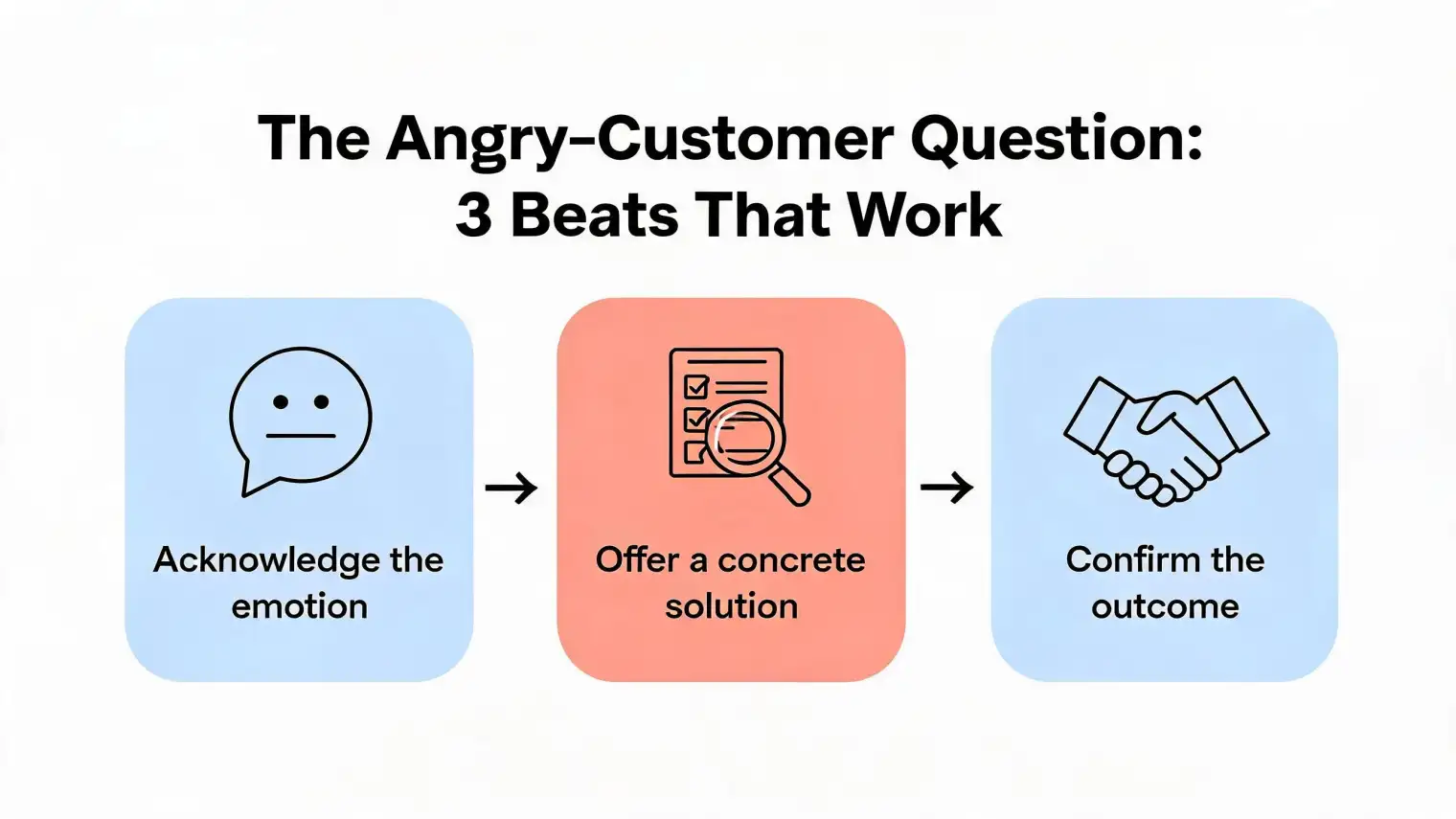
- Acknowledge the emotion before you problem-solve. "I could see they were frustrated, and I let them finish before responding" beats jumping straight to a fix — interviewers are listening for whether you can sit with someone's anger without getting defensive or rushing them.
- Name the specific action you took, not a philosophy. "I checked the order history, found the shipping delay, and offered a partial refund plus expedited replacement" beats "I always try to find a solution."
- Close the loop. State the outcome and, if it's honest, what you'd do differently. A story that ends in "and they were satisfied" without any friction along the way usually reads as invented.
The reason this trips people up live: most candidates over-prepare the content of one story and never rehearse delivering it out loud under time pressure while someone reacts to it. Reading the STAR framework and executing it while an interviewer's face is doing something unexpected are different skills.
When It's an Actual AI Interview, Not a Human One
Entry-level customer service and BPO roles increasingly route candidates through an asynchronous AI video screen before any human ever sees the application — record yourself answering three or four prompts, submit, wait. If you're prepping for one of these, the format itself changes what matters: see our breakdown of how to answer AI interview questions for how structured AI scoring differs from a live human read, and our guide on AI phone screen interview tips if the first round is voice-only rather than video.
The honest caveat: async AI screens can't ask a genuine follow-up the way a human interviewer improvising a twist can. They score consistency and keyword coverage more than they score how you handle being thrown off. That means the delivery-under-pressure problem above still shows up later, usually in the live panel round that follows if you pass the screen.
The Global BPO Angle
None of AceRound's markets is itself a BPO hiring hub, but it's worth knowing the scale behind why English-language customer service interviews look the way they do everywhere: the Philippines alone employs roughly 1.82 million people in BPO work generating an estimated $38 billion in revenue. Interviews for these roles explicitly screen for resilience, clarity under pressure, empathy, and shift flexibility — the same core competencies as any other customer service interview, just applied at enormous hiring volume. If you're a non-native English speaker applying to a remote or offshore customer service role, the phone-manner and scenario questions above are the ones doing the actual filtering — accent is rarely the disqualifier candidates assume it is.
Practicing the Delivery, Not Just the Story
This is where a live AI interview assistant like AceRound is actually useful, and where we'll be straightforward about the limits. AceRound gives real-time answer suggestions while you're speaking — so if an interviewer's angry-customer scenario includes a twist your rehearsed story doesn't cover ("what if the customer also demands a manager"), you get a live prompt for how to extend the three-beat structure instead of freezing.
What it won't do: simulate the actual emotional read of a human interviewer watching your face, or replace practicing out loud with another person before the real thing. Use it to stress-test how your story holds up when the question gets an unexpected follow-up, not as your only rehearsal.
Run through your "difficult customer" story once, then have someone (or a mock AI interview) add a complication you didn't plan for. If your answer collapses, that's the gap to close before interview day — not more STAR theory, more reps under a slightly-off-script condition. Our guide on teamwork example interview answers covers a related pattern: the collaborative language that also reads well in customer-service panel rounds where a second interviewer plays a difficult "customer."
FAQ
Tell me about a time you had to deal with a difficult customer. Use the three-beat structure: acknowledge the emotion first, name the specific action you took, then close with the outcome. Avoid a story with no real friction in it — a conflict that resolves too smoothly usually reads as invented.
What does good customer service mean to you? Give a real definition, not a slogan. Something like "solving the actual problem, not just being polite while the problem stays unsolved" shows you've thought about the difference between friendliness and effectiveness. Recruiters report they can tell within seconds whether this answer is rehearsed or genuine.
How would you handle an angry customer who's yelling at you? If asked as a live roleplay rather than a story, the sequence still holds: let them finish, acknowledge without agreeing that yelling is acceptable, then move to a concrete next step. Staying warm without over-apologizing is the balance interviewers are actually scoring.
Why do you want to work in customer service? Avoid generic "I like helping people." Reference something specific — a past experience where solving someone's problem mattered to you, or what you find genuinely engaging about troubleshooting under pressure.
What would you do if you didn't know the answer to a customer's question? The correct instinct is to say you'd escalate honestly rather than guess or stall. "I'd tell them I want to get this right and check with [a specific resource], then follow up within [a specific timeframe]" beats pretending you'd figure it out on the spot.
I bombed my last interview because I froze up — will another company give me a fair shot? Yes, and it's worth reframing: freezing under pressure is a delivery problem, not a competence problem, and it's fixable with repetition under mildly unpredictable conditions rather than more memorization. Most candidates over-prepare content and under-prepare for being thrown a question they didn't expect.
Author · Alex Chen. Career consultant and former tech recruiter. Spent 5 years on the hiring side before switching to help candidates instead. Writes about real interview dynamics, not textbook advice.
Related Articles
Airbnb Software Engineer Interview: The Core Values Round, Explained
Airbnb's four core values are public, but the interview round built on them isn't documented. Here's what's official, what candidates report, and how to prepare.
Cisco and Intuit Fresher Interview Process in India: Official vs Reported
Cisco's own Code with Cisco page, a third-party guide and one Intuit SDE-1 account differ on rounds and timing. What each says, and how to prep.
Meesho SDE-1 Interview Process for Freshers: Three 2025 Accounts Compared
Meesho SDE-1 campus accounts from 2025 disagree on test length, round order and design format. Here is what each reported and how to prep for any of them.