What Is Your Biggest Accomplishment? How AI Helps You Answer Right
Learn how to use biggest accomplishment interview AI tools to mine, structure, and rehearse achievement stories that land — with real STAR examples and cross-cultural framing tips.

TL;DR: The biggest accomplishment interview question trips up strong candidates because the problem isn't a lack of achievements — it's having no practiced story ready. Using AI interview tools to mine, structure, and rehearse accomplishment stories before the interview closes the gap between what you've done and what you can actually articulate under pressure.
Eight minutes before your video interview, you realize you've completely blanked on the metrics behind your best project. You remember it was successful. You remember people praised it. But the exact numbers? Gone.
This is the most common failure mode for "What's your biggest accomplishment?" — not that candidates haven't achieved anything, but that their best stories are locked behind the fog of recency bias and interview nerves. The interview doesn't test your career; it tests your preparation.
Behavioral questions like this one predict job performance better than almost any other interview format. A meta-analysis published in the Journal of Business Research found that past-behavior questions — asking candidates to describe real prior situations — outperform hypothetical situational questions in predictive validity. When a hiring manager asks for your greatest accomplishment, they're getting a data point that actually tells them something.
That's worth taking seriously. And that's where AI-assisted interview preparation changes the equation.
Why the Greatest Achievement Interview Question Trips Up Good Candidates
Most interview advice frames this as a confidence problem. "Just believe in yourself." It's not.
The real problems are structural:
Memory compression. Brains are bad at storing career history as retrievable stories. We remember emotions (proud, stressed, relieved) but not the operational details that make stories credible: the timeline, the initial state, the specific actions we took, the measurable delta.
The modesty trap. In many workplace cultures — especially in Asia and Northern Europe — self-promotion is muted during actual work. You do good things and don't make a big deal about it. Then an interviewer asks you to spend two minutes talking about how great you are, and the instinct to hedge takes over.
Metric amnesia. Numbers decay fastest. "I improved the process" you remember. That the improvement reduced onboarding time by 11 days and saved the team approximately 240 hours per quarter — that's gone within six months unless you recorded it.
Scale mismatch. Early-career candidates often feel their accomplishments "don't count" compared to someone with 15 years of experience. Mid-career professionals sometimes pick something they're proud of personally but that doesn't signal business impact clearly.
None of these are character flaws. They're preparation gaps that AI tools are specifically good at closing.
AI Interview Answer Preparation: The Story-Mining Workflow
The biggest shift AI brings to this question isn't generating an answer for you — it's helping you excavate one you already have.
Here's the workflow that works:
Step 1: Freeform memory dump
Open a conversation with an AI interview tool and just start talking about a project you're proud of. Don't try to structure it. Say whatever comes to mind — the chaos, the team dynamics, the problem that triggered it, the thing that almost went wrong.
Step 2: AI-guided extraction
Once you've dumped the raw material, prompt the AI to ask clarifying questions: What was the baseline before you started? What specific things did you personally do versus what the team did? What changed as a measurable result? What's the earliest you could tell it was working?
This structured interrogation drags out details that freeform writing doesn't. Most people know more than they think — it's locked in implicit memory until the right question unlocks it.
Step 3: Number reconstruction
If you don't have the exact metric, use approximation scaffolding. An AI can help you reason backward: "If your team handled 200 support tickets/week before and 140 after the process change, that's a 30% reduction — is that roughly accurate?" You're not fabricating; you're recovering an estimate you genuinely believe is close to true.
Step 4: STAR structure + rehearsal
Once the raw story exists, use an AI like AceRound AI to format it as a STAR response and then run through it interactively. The AI plays the interviewer, interrupts with follow-up questions, and flags vague language ("we improved things significantly" is not a story; "we reduced churn by 18 points over 6 months" is).
Try it now: AceRound AI offers real-time coaching for behavioral questions including accomplishment stories. Start a free practice session and run through your story before your next interview.
STAR Method Accomplishment Example: What "Done Right" Looks Like
The MIT Career Advising guide on STAR puts it simply: the method forces you to tell a story, not give a speech.
Here's the difference in practice:
Weak answer (common pattern):
"My biggest accomplishment was leading a digital transformation project at my last company. I coordinated multiple stakeholders, managed a tight timeline, and delivered results that the leadership team was really happy with."
This answer has no teeth. The interviewer hears: vague verbs, unspecified outcome, appeal to authority rather than evidence.
Strong STAR accomplishment answer:
"At [Company], our sales team was spending 4 hours/week manually compiling a report that fed into every weekly deal review meeting. I noticed that the data was coming from three systems that all had APIs. I spent two weeks prototyping a script that pulled and formatted the data automatically — on my own time, to prove the concept. Once I had a working version, I brought it to the sales ops manager and got it formally prioritized. It took another three weeks to productionize with their team. The result: that 4-hour manual job became a 5-minute button click, and the sales team used the freed time to run an extra call cycle per rep per week. Over 12 months, that correlated with about 8% more pipeline sourced per rep."
Notice what makes this work: a concrete initial state (4 hours, manual), a specific personal action sequence (prototyping solo first, then escalating), a measurable outcome (5 minutes, 8% pipeline correlation), and a time frame that makes the numbers plausible.
The goal isn't to sound impressive. The goal is to sound true. Detailed, specific stories sound true because they are.
For more on how STAR applies across different behavioral questions, see the complete STAR method guide.
Accomplishment Stories for Interviews with Confidential Data or Unclear Numbers
Two real obstacles that generic advice ignores:
Confidentiality/NDA situations:
You can tell the story shape without the specifics. "I can't share the exact revenue numbers due to confidentiality, but I can tell you the project was one of the company's three top-priority initiatives that year, and by the end of Q3 we'd shipped the full feature set to production, which was the milestone the commercial team had been waiting for."
This is honest, it maintains trust, and it still gives the interviewer something concrete. What you're protecting is the number; you're not hiding the outcome category (shipped on time, met commercial milestone, reduced risk).
No clear metric:
Not all valuable work produces clean metrics. If you led the culture initiative or wrote the technical documentation that onboarded 40 engineers over 18 months, the metric is indirect. Don't pretend a metric exists that doesn't. Instead, use proxy evidence:
- "The documentation I wrote is still in active use today, three years after I wrote it, without major revisions — I know this because new joiners still message me with questions and I can see the page views in Confluence."
- "Employee engagement scores for the team improved from 72 to 81 on the annual survey in the year following the initiative."
Proxy evidence is still evidence. AI tools can help you articulate it in a way that doesn't sound like you're apologizing for the absence of a harder number.
If you've struggled to frame your own story of failure or setbacks, the same structure applies — see how to answer "describe a time you failed" for the parallel framework.
The Cross-Cultural Calibration Problem
This section exists because most interview advice is written for a specific cultural context and never acknowledges it.
Japanese and East Asian candidates applying to Western companies:
The accomplishment question creates real cultural friction. Japanese interview norms (成功体験, or "success experience") embed personal credit inside a collective framing. You're expected to acknowledge team contributions first, situate your own role as a supportive function, and hedge outcomes with "we still have room to improve."
In a Japanese-language interview for a Japanese company, that's sophisticated. In an English-language interview for a US or European company, it reads as low confidence.
The fix isn't to abandon your cultural instincts entirely — that produces a different kind of inauthenticity. It's to add a layer: after describing the team context, explicitly claim your specific contribution. "Within that team effort, my personal role was X, and the metric I was directly responsible for was Y."
You can be accurate about collective work and still be clear about your individual contribution. Those aren't contradictions.
Korean candidates targeting chaebols or global companies:
Korean corporate interview culture expects scale and ambition. The framing "highest-level goal you achieved" (최고 수준의 목표를 세우고 성취한 경험) biases toward big-ticket wins. If your best story is a small efficiency improvement, you need to connect it upward — to department strategy, to the company's annual goals, to what a manager explicitly praised as high-leverage.
Chinese candidates applying overseas:
The specific pain point: accomplishments described in company-internal metrics (internal ranking systems, OKR scores, KPI percentages against internal targets) don't translate to interviewers at foreign companies who have no reference frame for those benchmarks.
The translation layer is essential. "I was in the top 10% of performance rankings at a 50,000-person company" means more when you add: "which corresponds to roughly 5,000 employees; the cutoff score required a combination of individual delivery metrics and cross-team collaboration ratings."
An AI tool like AceRound AI can specifically help with this translation layer — you describe the internal context, it helps you reformulate it into language that lands for a global hiring audience.
FAQ
What is your greatest accomplishment — sample answers by career stage?
For entry-level: focus on impact within a constrained scope (a project for a single class, a role on a student team, an internship deliverable). "I redesigned the onboarding checklist during my internship, which the team adopted permanently — the new-hire manager told me it halved the number of 'day 1 confusion' support requests."
For mid-career: pick something with business impact you can own. You should have at least 2-3 strong stories ready; choose based on what the role requires. Technical role → technical accomplishment. People manager role → team outcome you enabled.
For senior/executive: the metric should be organizational-scale. Revenue, retention, cost reduction, culture change, market position. And the story should show that you designed the strategy, not just executed it.
How do I pick between multiple accomplishments?
Match to the role. Read the job description and identify what the hiring manager is most anxious about for this hire. Then choose the accomplishment that best demonstrates you've solved that specific type of problem before.
Can I use the same accomplishment for multiple companies?
Yes, but recalibrate the framing each time. The underlying story can be the same; what you emphasize in the telling should shift based on what each company's role cares about. Using AI interview preparation tools to practice multiple framings of the same story is one of the best uses of the technology.
What if my biggest accomplishment is personal, not professional?
Unless the interviewer explicitly invites personal examples ("in your life, not just at work"), keep it professional. Personal accomplishments, even impressive ones, don't give hiring managers data about your professional judgment. Save them for culture-fit conversations.
How long should my answer be?
90 seconds to 2.5 minutes. Long enough to be specific, short enough that the interviewer doesn't lose the thread. If you're going longer, you're either over-explaining context or stacking multiple stories. Stick to one story per response.
Is using AI to prepare accomplishment answers considered cheating?
No — you're using it to recall and articulate something you actually did. AI isn't inventing the accomplishment. The concern about AI and interviews relates to using it to generate answers about things that never happened, which is a different thing entirely. Preparation tools have always existed; this one is just faster and more interactive. See our full take on AI in interviews for more context.
Author · Alex Chen. Career consultant and former tech recruiter. Spent 5 years on the hiring side before switching to help candidates instead. Writes about real interview dynamics, not textbook advice.
Related Articles
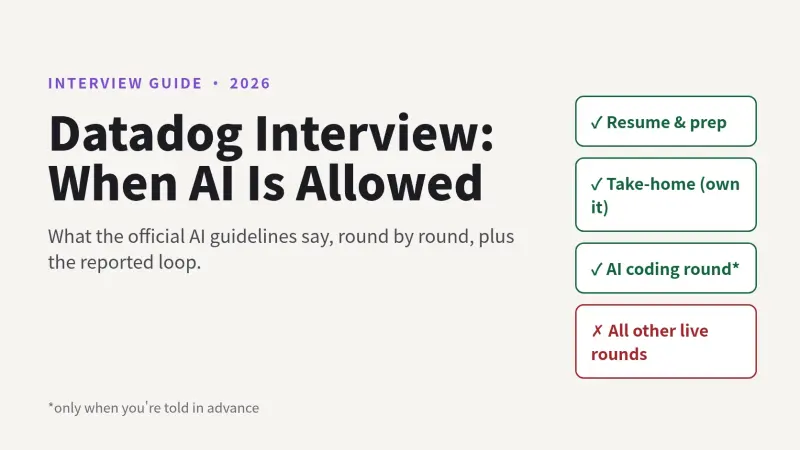
Datadog Interview Process (2026): What's Allowed With AI, Round by Round
Datadog publishes its AI rules for candidates. Here's what they allow, what they ban, the reported loop, and how to prep for the project deep dive.
Figma Software Engineer Interview Process (2026): What's Reported
Figma publishes no interview rubric. Here's the loop candidates report, the product-flavored coding and design rounds, and what's known about an AI round.
Oracle and PayPal Fresher Interview Process in India: What Candidates Reported, Year by Year
Oracle India's test moved from aptitude plus core CS to HackerRank with a REST API task. PayPal's cut-offs and platform also differ. Posts compared.